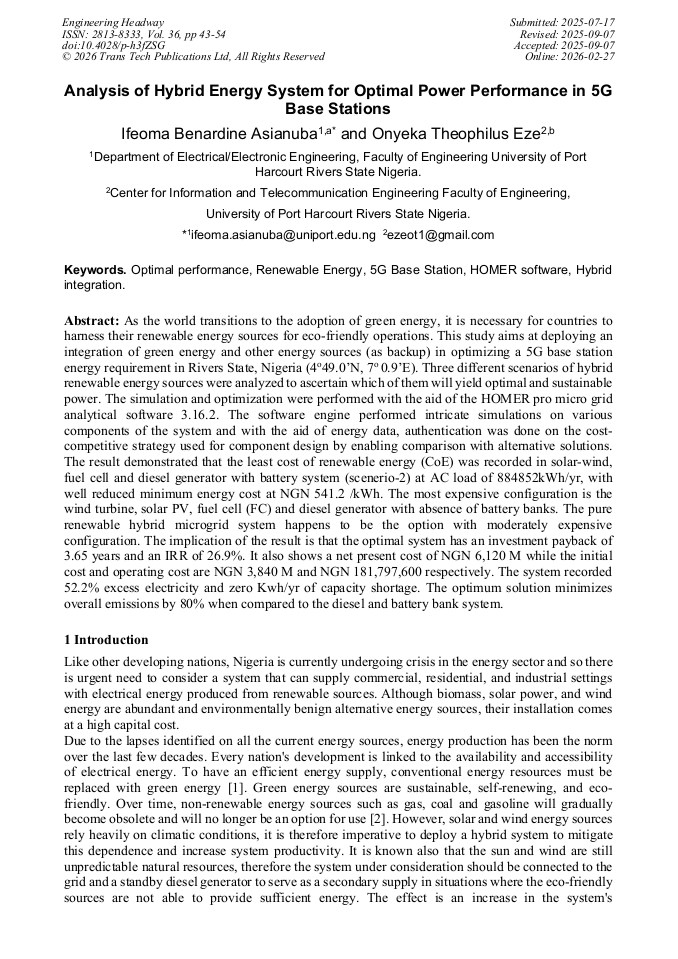
Analysis of Hybrid Energy System for Optimal Power Performance in 5G Base Stations

Article Preview

Abstract:

As the world transitions to the adoption of green energy, it is necessary for countries to harness their renewable energy sources for eco-friendly operations. This study aims at deploying an integration of green energy and other energy sources (as backup) in optimizing a 5G base station energy requirement in Rivers State, Nigeria (4o49.0’N, 7o 0.9’E). Three different scenarios of hybrid renewable energy sources were analyzed to ascertain which of them will yield optimal and sustainable power. The simulation and optimization were performed with the aid of the HOMER pro micro grid analytical software 3.16.2. The software engine performed intricate simulations on various components of the system and with the aid of energy data, authentication was done on the cost-competitive strategy used for component design by enabling comparison with alternative solutions. The result demonstrated that the least cost of renewable energy (CoE) was recorded in solar-wind, fuel cell and diesel generator with battery system (scenerio-2) at AC load of 884852kWh/yr, with well reduced minimum energy cost at NGN 541.2 /kWh. The most expensive configuration is the wind turbine, solar PV, fuel cell (FC) and diesel generator with absence of battery banks. The pure renewable hybrid microgrid system happens to be the option with moderately expensive configuration. The implication of the result is that the optimal system has an investment payback of 3.65 years and an IRR of 26.9%. It also shows a net present cost of NGN 6,120 M while the initial cost and operating cost are NGN 3,840 M and NGN 181,797,600 respectively. The system recorded 52.2% excess electricity and zero Kwh/yr of capacity shortage. The optimum solution minimizes overall emissions by 80% when compared to the diesel and battery bank system.
You might also be interested in these eBooks

Info:

Periodical:

Engineering Headway (Volume 36)

Pages:

43-54

Citation:

Online since:

February 2026

Export:

Price:

Permissions CCC:

Permissions PLS:

Сopyright:

© 2026 Trans Tech Publications Ltd. All Rights Reserved

Share:

Citation:

* - Corresponding Author

[1] A.Bhardwaj., & R. Verma. Renewable Energy Powered Base Stations for Rural Telecommunication: A Case Study in India. International Journal of Renewable Energy Research (2018), 8(4), 1822-1830.

Google Scholar

[2] O. E. Balogun, P.A. Owolawi and V.M Strivastrava Hybrid power systems for GHSM and 4G base stations in South Africa., Proceedings of IEEE AFRICON, (2017), 978-1- 5386-2774-7/17/$31.00©2017IEEE, pp.1046-1051.

DOI: 10.1109/afrcon.2017.8095619

Google Scholar

[3] K. Abraiz,., and N. A.Muhammad, Model and Design for the Control of Hybrid Domestic Power System, City University Research Journal, (2012) 3(1). Article 17, 1-8 (17.)

Google Scholar

[4] Y. Chai, Y. Li, and Y. Huang. Energy-Efficient Base Station Placement Algorithm for 5G network. Journal of Ambient Intelligence and Humanized Computing, (2020),11(6), 2271-2279.

Google Scholar

[5] B.K. Das, S. Ghosh, and M. Chakraborty. Solar Energy for Powering 5G A Networks: Review of Renewable Energy, (2020), 160, 1221-1233.

Google Scholar

[6] M. Mohammadi, S. Soleymani, and M. Shafie-Khah. Renewable energy integration in 5G networks: Renewable and Sustainable Energy Reviews, (2020) 133, 110278.

Google Scholar

[7] J. Zhang, et al. Environmental impacts of 5G: A Review of Science of The Total Environment, (2015) 707, 135974.l

Google Scholar

[8] M. Ndiaye., and I. Khoufi. Green 5G networks: Energy efficient and renewable energy powered. In Proceedings of 2019 IEEE Wireless Communications and Networking Conference (WCNC) (pp.1-6). IEEE.

Google Scholar

[9] Y. Zhang, and Y. Zhang Energy-Efficient Resource Allocation for Green Wireless Communication Systems Powered by Renewable Energy Sources. IEEE Transactions on Vehicular Technology, (2019) 68(12), 11728-11741.

Google Scholar

[10] A. Brydon A report on 5G mobile network feature (2014), https://www.unwiredinsight.com/ 2014/5g-mobile network-feature

Google Scholar

[11] J. Lorincz and I. Bule Renewable energy source for power supply of base station sites, Int. J of Bus data Commun, network, (2013), 9, 55-74. 13.

DOI: 10.4018/jbdcn.2013070104

Google Scholar

[12] C. R. Murthy.; D. C. Kavitha: A survey of green base stations in cellular networks. IRACST Int. J. Computer. Network. Wireless. Commun. (IJCNWC). 2012, 2, 232–236.

Google Scholar

[13] M. Vincenzo., and A. Sara, INRIA Sophia Antipolis Mediterranean, Reducing Costs and Pollution in Cellular Networks. IEEE Communication Magazine August (2011)

Google Scholar

[14] S. Jahdi. Renewable Hybrids Grid Connection Using Converter Interferences Loi, Lei, Lai-3. Grid Connection Power Electronic. International Journal of Sustainable Energy, 1 (2012), 51-57.

DOI: 10.20533/ijsed.2046.3707.2013.0009

Google Scholar

[15] Ericsson. (2018). Energy Consumption for 5G Small Cell Sites Retrieved from https://www.ericsson.com/en/reports-and-papers/white-papers/energy-

Google Scholar

[16] P. Ferreira, M. Trindade. and J.Martins, Interfaces for renewable energy sources with electric power systems. Renewable Energy, (2003), 1-6. Retrieved from http://repositorium.sdum.uminho.pt/handle/1822/1 528.

Google Scholar

[17] S. Amadi, T. Dike, and S..Nwokolo, Global Solar Radiation Characteristics at Calabar and Port Harcourt Cities in Nigeria. Trends in Renewable Energy, (2020) 6(2), 111-130

DOI: 10.17737/tre.2020.6.2.00114

Google Scholar