On-Line Prediction of Dry Zones during Composite Process through Digital Shadow Approach

Article Preview

Abstract:

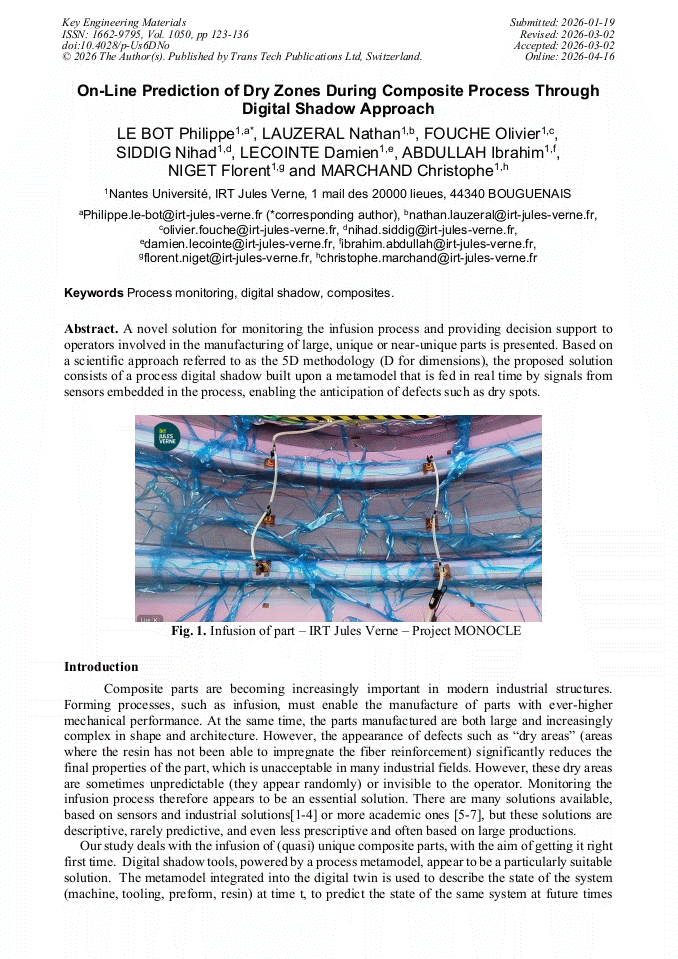
A novel solution for monitoring the infusion process and providing decision support to operators involved in the manufacturing of large, unique or near-unique parts is presented. Based on a scientific approach referred to as the 5D methodology (D for dimensions), the proposed solution consists of a process digital twin built upon a metamodel that is fed in real time by signals from sensors embedded in the process, enabling the anticipation of defects such as dry spots.

You have full access to the following eBook
Info:

* - Corresponding Author

[1] C. Le Gleuher, C.Buchmann, K. Schlegel, A. Friedberger : (2018). « Advanced Flow Front And Cure Monitoring Using High Frequency Technology", SAMPE Europe Conference 2018 Southampton.

Google Scholar

[2] N. Gupta, "Fiber optic sensors for monitoring flow in vacuum enhanced resin infusion technology (VERITy) process," National Aerospace Laboratories, Elsevier, Bangalore, 2008 .

Google Scholar

[3] Luna Inc., "Engineering Note EN-FY1318 Measuring Liquid Level Using Fiber Optic Sensing," 13 08 (2013).

Google Scholar

[4] N. Pantelelis, "Quality Monitoring and Process Control in CFRP Production", 9th CFK-VALLEY STADE CONVENTION 2015 16-17 June 2015, Stade, Germany.

Google Scholar

[5] P. le Bot, G. Lebreton, N. Siddig, P. Couarraze, O. Fouché, C. Sébastien, A. De Fongalland, F. Cara, P. Gerard, "Anomaly detection during thermoplastic composite infusion: Monitoring strategy through thermal sensors," in Key Engineering Materials, Achievements and Trends in Material Forming, vol. 926, 2022, p.1423–1436.

DOI: 10.4028/p-n27w97

Google Scholar

[6] P. Wang, J. Molimard, S. Drapier, A. Vautrin, J.C. Minni, « Monitoring the resin infusion manufacturing process under industrial environment using distributed sensors », Journal of Composite Materials 0(0) 1–16, (2011).

DOI: 10.1177/0021998311410479

Google Scholar

[7] P. Venegas, I. Ortiz de Mendibil, A. Montero and J. Aurrekoetxea, "Quality control by Infrared Thermography of the infusion manufacturing process of composite automotive specimens", 13th international conference on quantitative infrared thermography 2016, july 4-8, gdańsk, Poland.

DOI: 10.21611/qirt.2016.145

Google Scholar

[8] Q. Qi, F. Tao, T. Hu, N. Anwer, A. Liu, Y.Wei, L. Wang, A. Nee, "Enabling technologies and tools for digital twin", Journal of Manufacturing Systems, Volume 58, Part B, (2021).

DOI: 10.1016/j.jmsy.2019.10.001

Google Scholar

[9] P. Le Bot, D. Lecointe, N. Sidigg, O. Fouché, Le Guennec Yves,I. Abdullah, F. Niget Florent, C. Marchand Christophe, "Digital shadow dedicated to resin infusion filling process of composites parts", ECCM21, Nantes, July (2024).

Google Scholar

[10] ISO 23247-1:2021 Automation systems and integration — Digital twin framework for manufacturing.

Google Scholar

[11] https://docs.pytorch.org/vision/main/models/deeplabv3.html.

Google Scholar

[12] Y. Xie, T. Takikawa, S. Saito, O. Litany, S. Yan, N. Khan, S. Sridhar, "Neural fields in visual computing and beyond". In Computer graphics forum (Vol. 41, No. 2, pp.641-676).

DOI: 10.1111/cgf.14505

Google Scholar

[13] M. Tancik, P. Srinivasan, B. Mildenhall, S. Fridovich-Keil, N. Raghavan, U. Singhal; "Fourier features let networks learn high frequency functions in low dimensional domains"; Advances in neural information processing systems, 33, 7537-7547.

Google Scholar

[14] P. Mulye, E. Syerko, C. Binetruy, and A. Leygue, "A novel finite element based method for predicting permeability of heterogeneous and anisotropic porous microstructures", Materials, MDPI.

DOI: 10.20944/preprints202405.0867.v1

Google Scholar