p.43
p.59
p.69
p.81
p.93
p.103
p.113
p.123
p.137
AI-Based Predictions of Forming Effects for Enhanced Crash Simulation

Abstract:
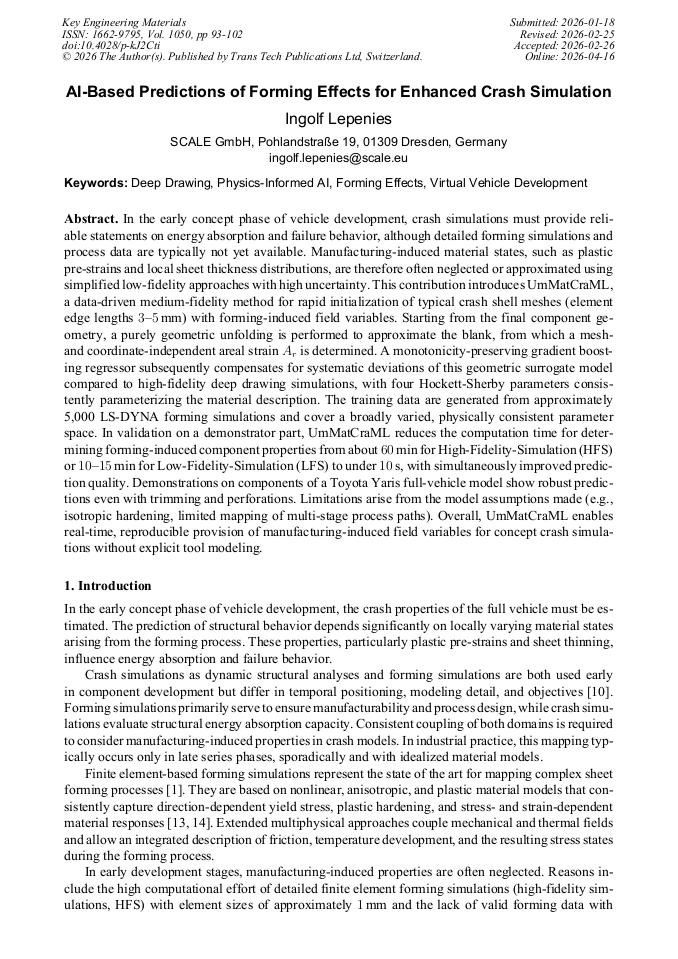
In the early concept phase of vehicle development, crash simulations must provide reliable statements on energy absorption and failure behavior, although detailed forming simulations and process data are typically not yet available. Manufacturing-induced material states, such as plastic pre-strains and local sheet thickness distributions, are therefore often neglected or approximated using simplified low-fidelity approaches with high uncertainty. This contribution introduces UmMatCraML, a data-driven medium-fidelity method for rapid initialization of typical crash shell meshes (element edge lengths 3–5 mm) with forming-induced field variables. Starting from the final component geometry, a purely geometric unfolding is performed to approximate the blank, from which a mesh-and coordinate-independent areal strain (Ar) is determined. A monotonicity-preserving gradient boosting regressor subsequently compensates for systematic deviations of this geometric surrogate model compared to high-fidelity deep drawing simulations, with four Hockett-Sherby parameters consistently parameterizing the material description. The training data are generated from approximately 5,000 LS-DYNA forming simulations and cover a broadly varied, physically consistent parameter space. In validation on a demonstrator part, UmMatCraML reduces the computation time for determining forming-induced component properties from about 60 min for High-Fidelity-Simualtion (HFS) or 10–15 min for Low-Fidelity-Simulation (LFS) to under 10 s, with simultaneously improved prediction quality. Demonstrations on components of a Toyota Yaris full-vehicle model show robust predictions even with trimming and perforations. Limitations arise from the model assumptions made (e.g., isotropic hardening, limited mapping of multi-stage process paths). Overall, UmMatCraML enables real-time, reproducible provision of manufacturing-induced field variables for concept crash simulations without explicit tool modeling.
Info:
Periodical:
Pages:
93-102
DOI:
Citation:
Online since:
April 2026
Authors:
Permissions:
Share:
Citation: