Relevance of an Equivalent Circuit Model for the Discharge Phenomenon of Fibers Containing Fine Particles

Article Preview

Abstract:

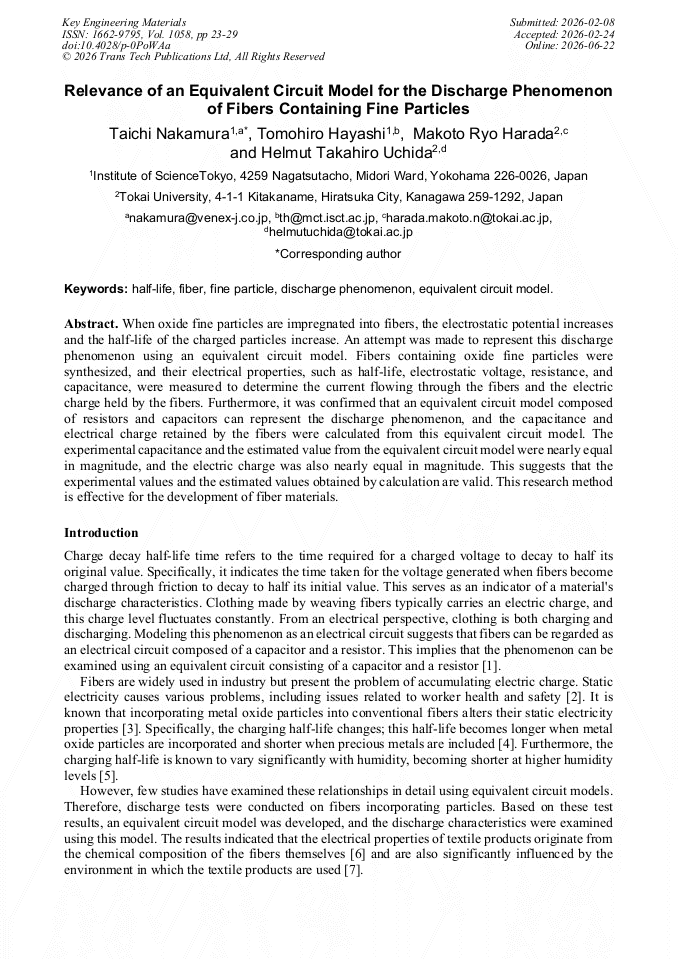
When oxide fine particles are impregnated into fibers, the electrostatic potential increases and the half-life of the charged particles increase. An attempt was made to represent this discharge phenomenon using an equivalent circuit model. Fibers containing oxide fine particles were synthesized, and their electrical properties, such as half-life, electrostatic voltage, resistance, and capacitance, were measured to determine the current flowing through the fibers and the electric charge held by the fibers. Furthermore, it was confirmed that an equivalent circuit model composed of resistors and capacitors can represent the discharge phenomenon, and the capacitance and electrical charge retained by the fibers were calculated from this equivalent circuit model. The experimental capacitance and the estimated value from the equivalent circuit model were nearly equal in magnitude, and the electric charge was also nearly equal in magnitude. This suggests that the experimental values and the estimated values obtained by calculation are valid. This research method is effective for the development of fiber materials.
You might also be interested in these eBooks

Info:

Periodical:

Pages:

23-29

Citation:

Online since:

June 2026

Export:

Price:

Permissions CCC:

Permissions PLS:

Сopyright:

© 2026 Trans Tech Publications Ltd. All Rights Reserved

Share:

Citation:

* - Corresponding Author

[1] Jian Feng Gu, Stephan Gorgutsa and Maksim Skorobogatiy: Smart Mater. Struct. Vol. 19 (2010), p.115006.

Google Scholar

[2] Qu, Z., Zhu, Z., Liu, Y. et al. Parasitic capacitance modeling and measurements of conductive yarns for e-textile devices. Nat Commun Vol. 14 (2023), p.2785.

DOI: 10.1038/s41467-023-38319-6

Google Scholar

[3] Norbert Gibson: Journal of Electrostatics Vol. 40–41, June (1997), p.21.

Google Scholar

[4] Mohamed Rehan, Hamada M. Mashaly, A.S. Montaser, Reda M. Abdelhameed: Journal of Molecular Liquids Vol. 387 (2023), p.122603.

DOI: 10.1016/j.molliq.2023.122603

Google Scholar

[5] Tao Huang, Hao Yu, Hongzhi Wang, Qinghong Zhang, Meifang Zhu: Phys. Chem. C Vol. 120, 47 (2016), p.26600.

Google Scholar

[6] Ali Kilic, Eunkyoung Shim, Bong Yeol Yeom, Behnam Pourdeyhimi: Journal of Electrostatics Vol. 71 (2013), p.41.

Google Scholar

[7] Ng, CY; Chen, TP; Tse, MS; Lim, VSW; Fung, S; Tseng, AA: Applied Physics Letters, Vol. 86 (2005), p.1.

Google Scholar

[8] Japan Industrial Standard L 1094 Testing methods for electrostatic propensity of woven and knitted fabrics, (2019), p.3.

Google Scholar

[9] Yang HY, Zhu SK, Pan N.: J. Applied Polymer Sci. Vol. 92 (2003), p.3201.

Google Scholar

[10] Huang Y, Tao J, Meng W, Zhu M, Huang Y, Fu Y, Gao Y, Zhi C: Nano Energy. Vol 11 (2015), p.518.

Google Scholar

[11] Lozovski,T., Montrimas, E., Maldžius, R., Yanthetic: Metals, Vol. 109 (1-3) March (2000), p.195.

Google Scholar

[12] Mangala Joshi, Raman Sandhoo, Bapan Adak: Progress in Organic Coatings Vol. 165, April (2022), p.106744.

Google Scholar

[13] Mohammad Jafarpour Morteza Ghorbani: Materials Today Communications Vol. 29 (2021), p.102865.

Google Scholar

[14] Taichi Nakamura, Evan Angelo Quimada Mondarte, Hiroyuki Tahara, Ryongsok Chang, Tomohiro Hayashi: Molecular Crystals and Liquid Crystals, Vol. 728, 1 (2021), p.52.

DOI: 10.1080/15421406.2021.1946977

Google Scholar