Finite Element Analysis of Ply Orientation Effects in Carbon Fiber/Epoxy Composite External Fixators

Article Preview

Abstract:

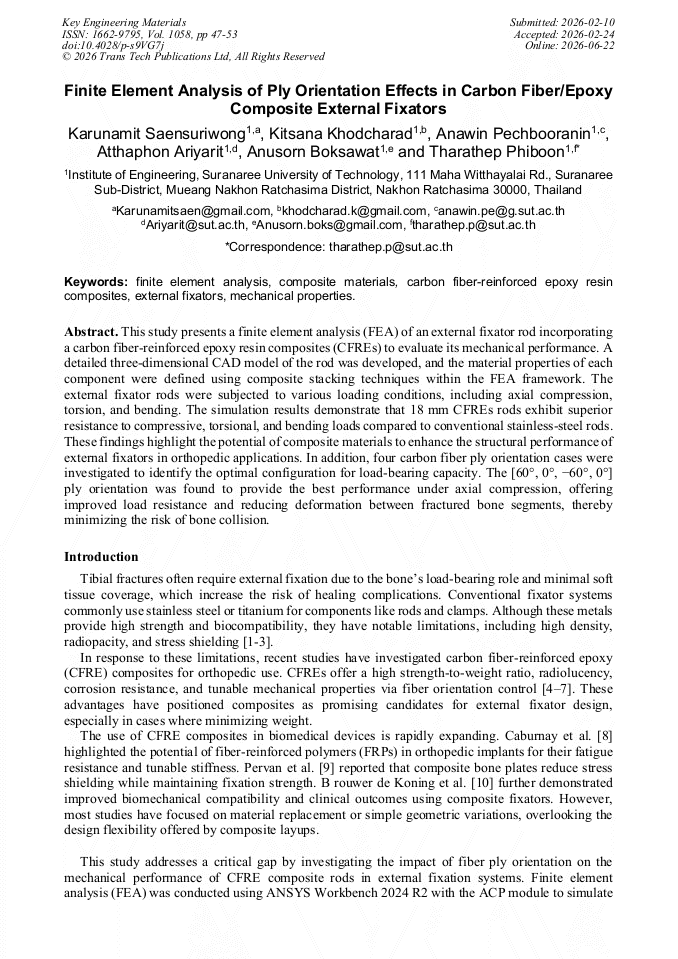
This study presents a finite element analysis (FEA) of an external fixator rod incorporating a carbon fiber-reinforced epoxy resin composites (CFREs) to evaluate its mechanical performance. A detailed three-dimensional CAD model of the rod was developed, and the material properties of each component were defined using composite stacking techniques within the FEA framework. The external fixator rods were subjected to various loading conditions, including axial compression, torsion, and bending. The simulation results demonstrate that 18 mm CFREs rods exhibit superior resistance to compressive, torsional, and bending loads compared to conventional stainless-steel rods. These findings highlight the potential of composite materials to enhance the structural performance of external fixators in orthopedic applications. In addition, four carbon fiber ply orientation cases were investigated to identify the optimal configuration for load-bearing capacity. The [60°, 0°, −60°, 0°] ply orientation was found to provide the best performance under axial compression, offering improved load resistance and reducing deformation between fractured bone segments, thereby minimizing the risk of bone collision.
You might also be interested in these eBooks

Info:

Periodical:

Pages:

47-53

Citation:

Online since:

June 2026

Export:

Price:

Permissions CCC:

Permissions PLS:

Сopyright:

© 2026 Trans Tech Publications Ltd. All Rights Reserved

Share:

Citation:

* - Corresponding Author

[1] C. M. Court-Brown, B. Caesar, and M. M. McQueen, "Epidemiology of adult fractures: A review," Injury, vol. 37, no. 8, p.691–697, Aug. 2006.

DOI: 10.1016/j.injury.2006.04.130

Google Scholar

[2] C. A. Rockwood and D. P. Green, Rockwood and Green's Fractures in Adults, 9th ed. Philadelphia, PA: Wolters Kluwer, 2019.

Google Scholar

[3] S. A. Green, "Complications of external skeletal fixation," Clin. Orthop. Relat. Res., vol. 180, p.109–116, Mar. 1983.

Google Scholar

[4] I. A. Pervan, N. Torić, M. Glavinić, and I. Kodvanj, "Mechanical properties of a composite connecting rod for external fixators," International Journal of Mechanical Engineering and Technology (IJMET), vol. 8, no. 1, p.217–224, Jan. 2017.

Google Scholar

[5] C. Caburnay, J. Bañaga, M. Aguilar, R. Roque, R. Ramos, and R. Valencerina, "Finite Element Analysis of a Composite External Fixator Using Unidirectional and Woven Carbon Fiber," in Proceedings of the International MultiConference of Engineers and Computer Scientists 2023, vol. II, Hong Kong, Mar. 2023, p.124–128.

Google Scholar

[6] T. Keller and D. T. Benson, "Biocompatibility and mechanical behavior of fiber-reinforced composites," in Comprehensive Biomaterials II, vol. 6, P. Ducheyne, Ed. Elsevier, 2017, p.403–425.

Google Scholar

[7] D. Gay, S. V. Hoa, and S. W. Tsai, Composite Materials: Design and Applications, 3rd ed. CRC Press, 2014.

Google Scholar

[8] E. V. Caburnay, L. M. Danao. E. D. Magdaluyo Jr., "Finite Element Analysis of a Composite External Fixator Using Unidirectional and Woven Carbon Fiber," in IMECS 2023, p.124–128.

Google Scholar

[9] Pervan, N., Mešić, E., & Čolić, M., "tress analysis of external fixator based on stainless steel and composite material," International Journal of Mechanical Engineering & Technology, vol. 8, no. 1, pp.189-199, 2017.

Google Scholar

[10] B rouwer de Koning, S. G., de Winter, N., Moosabeiki, V., Mirzaali, M. J., Berenschot, A., Witbreuk, M. M. E. H., & Lagerburg, V., esign considerations for patient-specific bone fixation plates: a literature review. Medical & Biological Engineering & Computing, vol. 61, no. 12, pp.3233-3252, 2023.

DOI: 10.1007/s11517-023-02900-4

Google Scholar