Effects of Actively Cooled Coolant for Grinding Ductile Materials

Article Preview

Abstract:

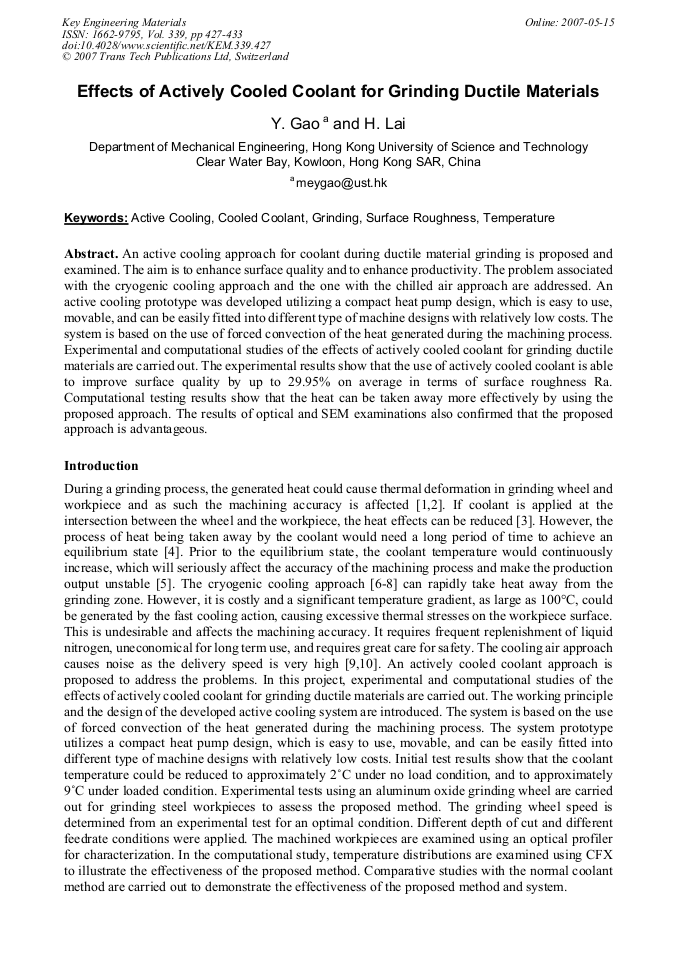
An active cooling approach for coolant during ductile material grinding is proposed and examined. The aim is to enhance surface quality and to enhance productivity. The problem associated with the cryogenic cooling approach and the one with the chilled air approach are addressed. An active cooling prototype was developed utilizing a compact heat pump design, which is easy to use, movable, and can be easily fitted into different type of machine designs with relatively low costs. The system is based on the use of forced convection of the heat generated during the machining process. Experimental and computational studies of the effects of actively cooled coolant for grinding ductile materials are carried out. The experimental results show that the use of actively cooled coolant is able to improve surface quality by up to 29.95% on average in terms of surface roughness Ra. Computational testing results show that the heat can be taken away more effectively by using the proposed approach. The results of optical and SEM examinations also confirmed that the proposed approach is advantageous.
You might also be interested in these eBooks

Info:

Periodical:

Pages:

427-433

Citation:

Online since:

May 2007

Authors:

Export:

Price:

Permissions CCC:

Permissions PLS:

Сopyright:

© 2007 Trans Tech Publications Ltd. All Rights Reserved

Share:

Citation:

[1] K. Ramesh, H. Huang and L. Yin: Int. J. Machine Tools and Manufacture, Vol. 44 (2004), p.1069.

Google Scholar

[2] S.B. Wang and K.H. Fuh: Proc. Institution of Mech. Eng. Part B, Vol. 212 (1998), p.383.

Google Scholar

[3] S.B. Wang and H.S. Kou: Int. Comm. in Heat and Mass Transfer, Vol. 24 (1997), p.771.

Google Scholar

[4] Y. Gao, S. Tse and H. Mak: Applied Thermal Eng., Vol. 23 (2003), p.523.

Google Scholar

[5] H.Z. Choi, S.W. Lee and H.D. Jeong: J. Materials Processing Tech., Vol. 111 (2001), p.265.

Google Scholar

[6] S. Paul and A.B. Chattopadhyay: Int. J. Machine Tools and Manufacture, Vol. 36 (1995), p.63.

Google Scholar

[7] S. Paul and A.B. Chattopadhyay: Int. J. Machine Tools and Manufacture, Vol. 35 (1995), p.109.

Google Scholar

[8] S. Paul and A.B. Chattopadhyay: Int. J. Machine Tools and Manufacture, Vol. 36 (1996), p.491.

Google Scholar

[9] K. Ramesh, S.H. Yeo, Z.W. Zhong and H. Huang: Proc. Institution of Mech. Engineers Part B, Vol. 217 (2003), p.409.

Google Scholar

[10] H.Z. Choi, S.W. Lee and H.D. Jeong: J. Materials Processing Tech, Vol. 127 (2002), p.155.

Google Scholar

[11] P. Hryniewwicz, A.Z. Szeri and S. Jahanmir: Int. J. Mech. Science, Vol. 42 (2000), p.2347.

Google Scholar

[12] K. Ramesh, S.H. Yeo, Z.W. Zhong and K.C. Sim: J. Materials Processing Technology, Vol. 114 (2001), p.240.

Google Scholar

[13] T. Jin, D.J. Stephenson and W.B. Rowe: Proc. Institution of Mech. Eng. Part B, Vol. 217 (2003), p.397.

Google Scholar

[14] V.K. Gviniashvili, N.H. Woolley and W.B. Rowe: Int. J. Machine Tools and Manufacture Vol. 44 (2004), p.629.

Google Scholar

[15] T. Nakayama, M. Wakuda and M. Ota: Key Engg. Materials, Vol. 257-258 (2004), p.273.

Google Scholar

[16] Y. Gao and H. Lai: Key Engg. Materials, Vol. 291-292 (2005), p.233.

Google Scholar