Seismic Requirements for the Welding and Inspection of the K-Area in Hot Rolled Products to AS/NZS 3679.1

Article Preview

Abstract:

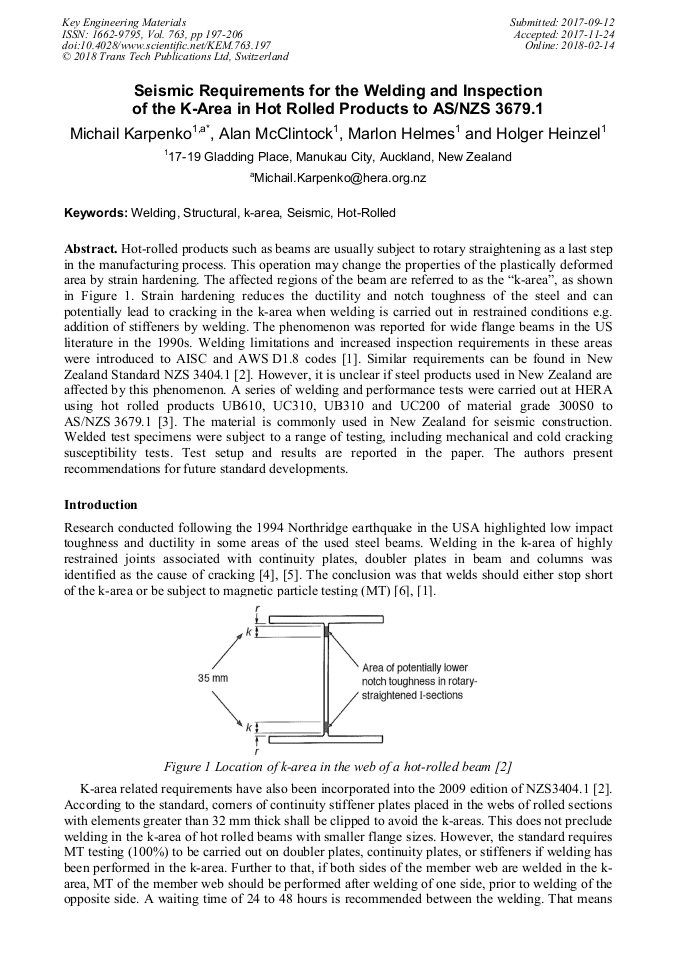
Hot-rolled products such as beams are usually subject to rotary straightening as a last step in the manufacturing process. This operation may change the properties of the plastically deformed area by strain hardening. The affected regions of the beam are referred to as the “k-area”, as shown in Figure 1. Strain hardening reduces the ductility and notch toughness of the steel and can potentially lead to cracking in the k-area when welding is carried out in restrained conditions e.g. addition of stiffeners by welding. The phenomenon was reported for wide flange beams in the US literature in the 1990s. Welding limitations and increased inspection requirements in these areas were introduced to AISC and AWS D1.8 codes [1]. Similar requirements can be found in New Zealand Standard NZS 3404.1 [2]. However, it is unclear if steel products used in New Zealand are affected by this phenomenon. A series of welding and performance tests were carried out at HERA using hot rolled products UB610, UC310, UB310 and UC200 of material grade 300S0 to AS/NZS 3679.1 [3]. The material is commonly used in New Zealand for seismic construction. Welded test specimens were subject to a range of testing, including mechanical and cold cracking susceptibility tests. Test setup and results are reported in the paper. The authors present recommendations for future standard developments.
You might also be interested in these eBooks

Info:

Periodical:

Pages:

197-206

Citation:

Online since:

February 2018

Export:

Price:

Permissions CCC:

Permissions PLS:

Сopyright:

© 2018 Trans Tech Publications Ltd. All Rights Reserved

Share:

Citation:

* - Corresponding Author

[1] AWS D1. 8 Structural Welding Code - Seismic Supplement., American Welding Society, (2009).

Google Scholar

[2] NZS 3404. 1: Steel structures Standard - Materials, fabrication, and construction., Standards New Zealand, (2009).

Google Scholar

[3] AS/NZS 3679. 1: Structural Steel - Part 1: Hot-rolled bars and sections., Standards Australia Limited/Standards New Zealand.

Google Scholar

[4] Recommended specifications and quality assurance guidelines for steel moment-frame construction for seismic applications, Report No. FEMA-353. Washington (DC): Federal Emergency Management Agency (FEMA). SAC Joint Venture, (2000).

Google Scholar

[5] State of the art report on base metals and fractures, Report No. FEMA-355A. Washington (DC): Federal Emergency Management Agency (FEMA). SAC Joint Venture. Guidelines Development Committee and United States. Federal Emergency Management Agency, (2000).

DOI: 10.4135/9781412952446.n202

Google Scholar

[6] ANSI/AISC 341-10 Seismic Provisions for Structural Steel Buildings., American Institute of Steel Construction, (2010).

DOI: 10.1201/b11248-16

Google Scholar

[7] G. C. Clifton and G. A. MacRae, New insights into steel building performance from the Christchurch natural laboratory, in Steel Innovations Conference, (2013).

Google Scholar

[8] W. Scholz, W. Woerner, and A. Short, HERA/NZWC Report R8-28: Earthquake Performance of Welded Moment Resisting Connection, HERA report, (2004).

Google Scholar

[9] J. Chau and J. Shin, Investigation of the effects of welding in the k-area of steel beams in NZ structures. Project report 2013-ME12., Heavy Engineering Research Association, (2013).

Google Scholar

[10] AS/NZS 3679. 1 Structural Steel - Part 1: Hot-rolled bars and sections., Standards Australia Limited/Standards New Zealand, (2016).

Google Scholar

[11] ISO  6507-1 Metallic materials – Vickers hardness test – Part 1: Test method., International Organization for Standardization, (2005).

Google Scholar

[12] AS 2205. 7. 1 Methods for destructive testing of welds in metal - Method 7. 1: Charpy V-notch impact fracture toughness test., Standards Australia, (2003).

Google Scholar

[13] AS 2205. 3. 1 Methods for destructive testing of welds in metal - Method 3. 1: Transverse guided bend test., Standards Australia, (2003).

Google Scholar

[14] Steel and Iron Test Sheets (SEP) 1390 Welding Bend Test., Association of German Metallurgists, (1996).

Google Scholar