Concrete Industry’s Transition from CEMI to CEMII – A Case Study on CO2 Footprint Reduction for a Self-Compacting Concrete Mix

Article Preview

Abstract:

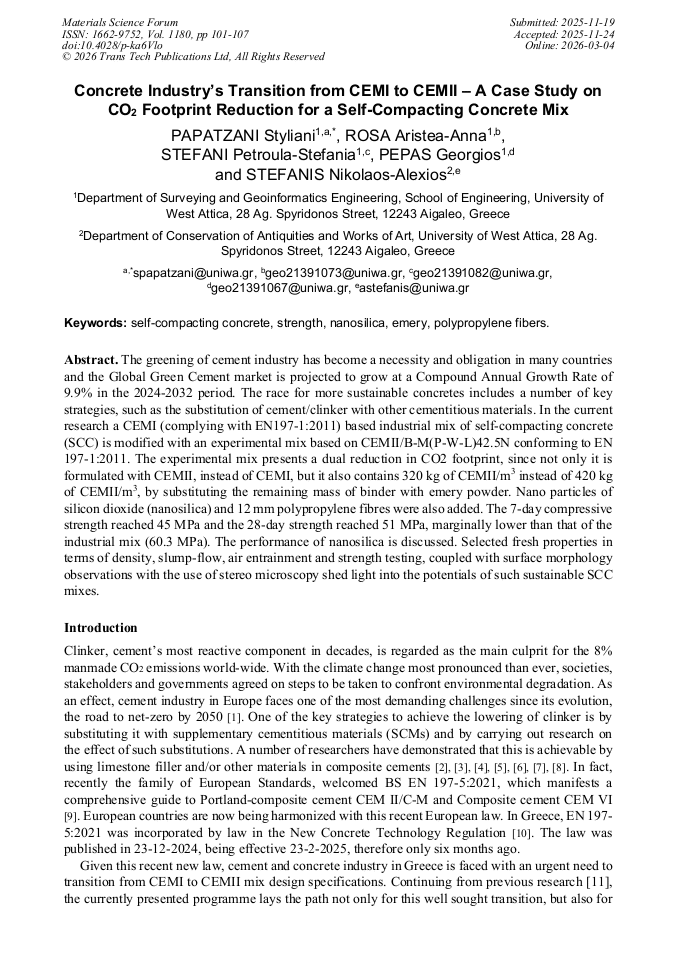
The greening of cement industry has become a necessity and obligation in many countries and the Global Green Cement market is projected to grow at a Compound Annual Growth Rate of 9.9% in the 2024-2032 period. The race for more sustainable concretes includes a number of key strategies, such as the substitution of cement/clinker with other cementitious materials. In the current research a CEMI (complying with EN197-1:2011) based industrial mix of self-compacting concrete (SCC) is modified with an experimental mix based on CEMII/B-M(P-W-L)42.5N conforming to EN 197-1:2011. The experimental mix presents a dual reduction in CO2 footprint, since not only it is formulated with CEMII, instead of CEMI, but it also contains 320 kg of CEMII/m3 instead of 420 kg of CEMII/m3, by substituting the remaining mass of binder with emery powder. nanoparticles of silicon dioxide (nanosilica) and 12 mm polypropylene fibres were also added. The 7-day compressive strength reached 45 MPa and the 28-day strength reached 51 MPa, marginally lower than that of the industrial mix (60.3 MPa). The performance of nanosilica is discussed. Selected fresh properties in terms of density, slump-flow, air entrainment and strength testing, coupled with surface morphology observations with the use of stereo microscopy shed light into the potentials of such sustainable SCC mixes.
You might also be interested in these eBooks

Info:

Periodical:

Materials Science Forum (Volume 1180)

Pages:

101-107

Citation:

Online since:

March 2026

Export:

Price:

Permissions CCC:

Permissions PLS:

Сopyright:

© 2026 Trans Tech Publications Ltd. All Rights Reserved

Share:

Citation:

* - Corresponding Author

[1] GCCA, "Concrete Future - Roadmap to Net Zero," 2021.

Google Scholar

[2] B. Lothenbach, K. Scrivener, and R. D. Hooton, "Supplementary cementitious materials," Cement and Concrete Research, vol. 41, no. 12, p.1244–1256, 2011.

DOI: 10.1016/j.cemconres.2010.12.001

Google Scholar

[3] B. Lothenbach, G. Le Saout, E. Gallucci, and K. Scrivener, "Influence of limestone on the hydration of Portland cements," Cement and Concrete Research, vol. 38, no. 6, p.848–860, 2008.

DOI: 10.1016/j.cemconres.2008.01.002

Google Scholar

[4] K. L. Scrivener and R. J. Kirkpatrick, "Innovation in use and research on cementitious material," Cement and Concrete Research, vol. 38, no. 2, p.128–136, 2008.

DOI: 10.1016/j.cemconres.2007.09.025

Google Scholar

[5] S. Papatzani and K. Paine, "Lowering cement clinker: A thorough, performance based study on the use of nanoparticles of SiO2 or montmorillonite in Portland limestone nanocomposites," The European Physical Journal Plus, vol. 133, no. 10, p.430, 2018.

DOI: 10.1140/epjp/i2018-12305-6

Google Scholar

[6] S. Papatzani and K. Paine, "Polycarboxylate/nanosilica-modified quaternary cement formulations – enhancements and limitations," Advances in Cement Research, vol. 30, no. 6, p.256–269, 2018.

DOI: 10.1680/jadcr.17.00111

Google Scholar

[7] S. Papatzani and K. Paine, "Optimization of Low-Carbon Footprint Quaternary and Quinary (37 % Fly Ash) Cementitious Nanocomposites with Polycarboxylate or Aqueous Nanosilica Particles," Advances in Materials Science and Engineering, vol. 2019, p.26, 2019.

DOI: 10.1155/2019/5931306

Google Scholar

[8] S. Papatzani, "Nanotechnologically modified cements: Effects on hydration, microstructure and physical properties," PhD Thesis, University of Bath, UK, 2014.

Google Scholar

[9] CEN, EN 197-5:2021 Cement Portland-composite cement CEM II/C-M and Composite cement CEM VI. 2021, p.14.

DOI: 10.3403/30415603

Google Scholar

[10] Ministerial Decree: Amendment of the New Concrete Technology Regulation - FEK 7060/Β/23-12-2024. 2024.

Google Scholar

[11] S. Papatzani, G. Hloupis, P. Giatra, and G. Aslanis, "The Effect of Nanosilica on the Fresh Properties of Sustainable Self-Compacting Concrete," Materials Science Forum, 2024.

DOI: 10.4028/p-wbzyy5

Google Scholar

[12] S. Papatzani and K. Paine, "Polycarboxylate / nanosilica modified quaternary cement formulations - enhancements and limitations," Advances in Cement Research, vol. 30, no. 6, p.256–269, 2018.

DOI: 10.1680/jadcr.17.00111

Google Scholar

[13] S. Papatzani, N.-A. Stefanis, and A.-F. Kloukinioti, "Can emery replace CEMII in masonry restoration mortars? Under review," in The 9th International Conference on Building Materials and Materials Engineering (ICBMM 2025), 2025.

Google Scholar

[14] E. BIBM, CEMBUREAU, ERMCO, EFCA, "The European Guidelines for Self-Compacting Concrete," 2005.

Google Scholar