p.61
p.79
p.87
p.99
p.105
p.111
p.119
p.129
p.141
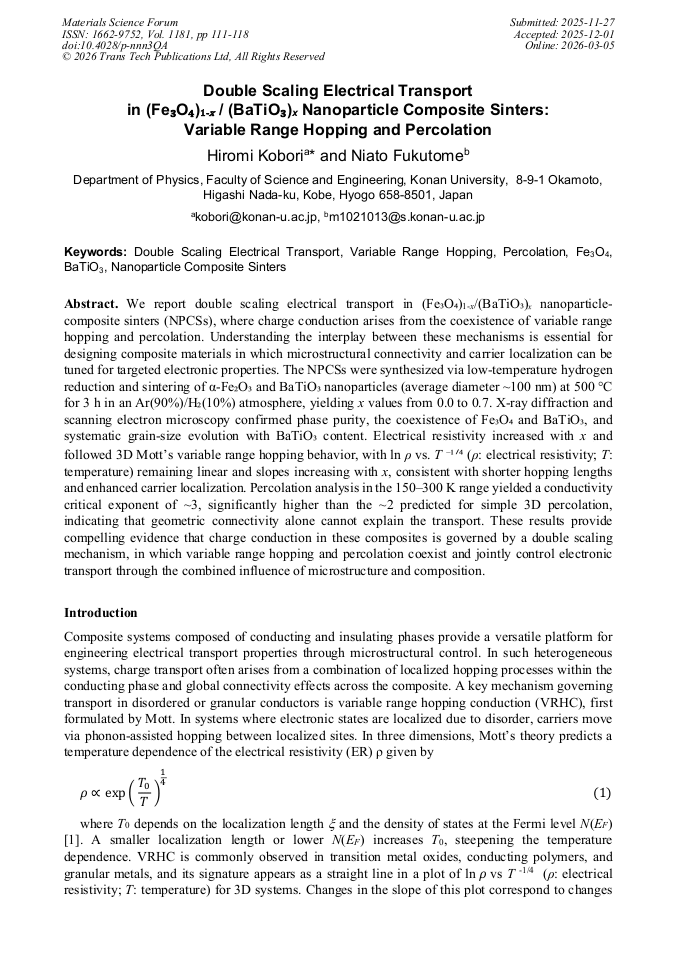
Double Scaling Electrical Transport in (Fe₃O₄)1-x/ (BaTiO₃)x Nanoparticle Composite Sinters: Variable Range Hopping and Percolation

Abstract:
We report double scaling electrical transport in (Fe₃O₄)1-x/(BaTiO₃)ₓ nanoparticle-composite sinters (NPCSs), where charge conduction arises from the coexistence of variable range hopping and percolation. Understanding the interplay between these mechanisms is essential for designing composite materials in which microstructural connectivity and carrier localization can be tuned for targeted electronic properties. The NPCSs were synthesized via low-temperature hydrogen reduction and sintering of α-Fe₂O₃ and BaTiO₃ nanoparticles (average diameter ~100 nm) at 500 °C for 3 h in an Ar (90%)/H₂(10%) atmosphere, yielding x values from 0.0 to 0.7. X-ray diffraction and scanning electron microscopy confirmed phase purity, the coexistence of Fe₃O₄ and BaTiO₃, and systematic grain-size evolution with BaTiO₃ content. Electrical resistivity increased with x and followed 3D Mott’s variable range hopping behavior, with ln ρ vs. T ⁻¹ᐟ⁴ (ρ: electrical resistivity; T: temperature) remaining linear and slopes increasing with x, consistent with shorter hopping lengths and enhanced carrier localization. Percolation analysis in the 150–300 K range yielded a conductivity critical exponent of ~3, significantly higher than the ~2 predicted for simple 3D percolation, indicating that geometric connectivity alone cannot explain the transport. These results provide compelling evidence that charge conduction in these composites is governed by a double scaling mechanism, in which variable range hopping and percolation coexist and jointly control electronic transport through the combined influence of microstructure and composition.
Info:
Periodical:
Pages:
111-118
DOI:
Citation:
Online since:
March 2026
Authors:
Price:
Сopyright:
© 2026 Trans Tech Publications Ltd. All Rights Reserved
Share:
Citation: