p.39
p.47
p.63
p.73
p.85
p.93
p.109
p.115
p.121
Synthesis and Application of nZVI Supported on Granular Activated Carbon (nZVI/GAC) Catalyst for the Degradation of Paraquat in Wastewater

Abstract:
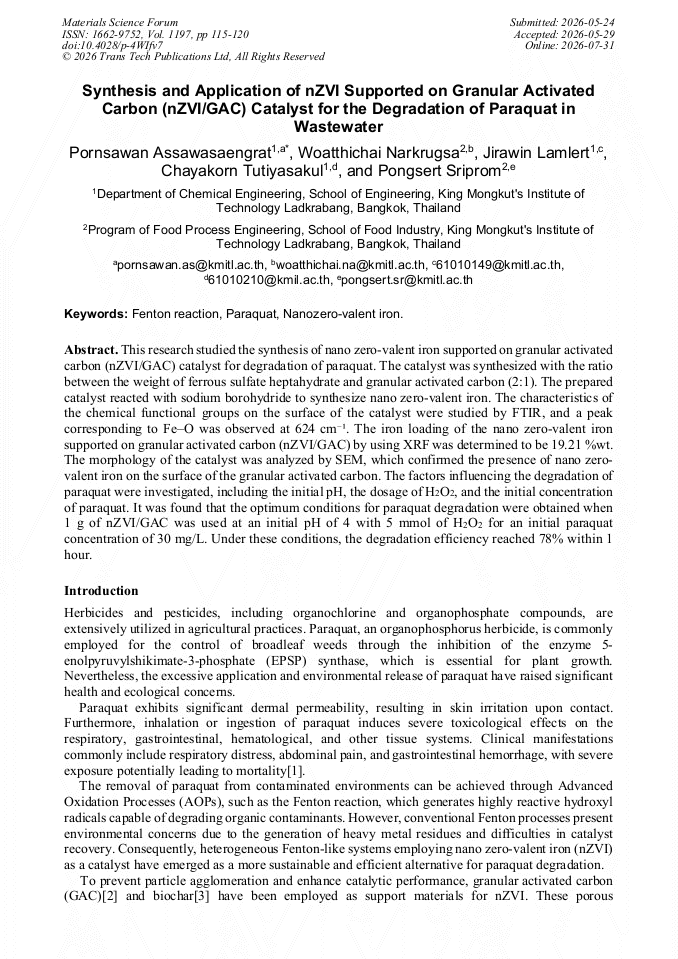
This research studied the synthesis of nanozero-valent iron supported on granular activated carbon (nZVI/GAC) catalyst for degradation of paraquat. The catalyst was synthesized with the ratio between the weight of ferrous sulfate heptahydrate and granular activated carbon (2:1). The prepared catalyst reacted with sodium borohydride to synthesize nanozero-valent iron. The characteristics of the chemical functional groups on the surface of the catalyst were studied by FTIR, and a peak corresponding to Fe–O was observed at 624 cm⁻¹. The iron loading of the nanozero-valent iron supported on granular activated carbon (nZVI/GAC) by using XRF was determined to be 19.21 %wt. The morphology of the catalyst was analyzed by SEM, which confirmed the presence of nanozero-valent iron on the surface of the granular activated carbon. The factors influencing the degradation of paraquat were investigated, including the initial pH, the dosage of H₂O₂, and the initial concentration of paraquat. It was found that the optimum conditions for paraquat degradation were obtained when 1 g of nZVI/GAC was used at an initial pH of 4 with 5 mmol of H2O2 for an initial paraquat concentration of 30 mg/L. Under these conditions, the degradation efficiency reached 78% within 1 hour.
Info:
Periodical:
Pages:
115-120
DOI:
Citation:
Online since:
July 2026
Keywords:
Price:
Permissions CCC:
Permissions PLS:
Сopyright:
© 2026 Trans Tech Publications Ltd. All Rights Reserved
Share:
Citation: