Revisiting the Viscoelastic Theory of Superionic Conductor Ag2+δSe and its Implication to Thermoelectric Materials

Article Preview

Abstract:

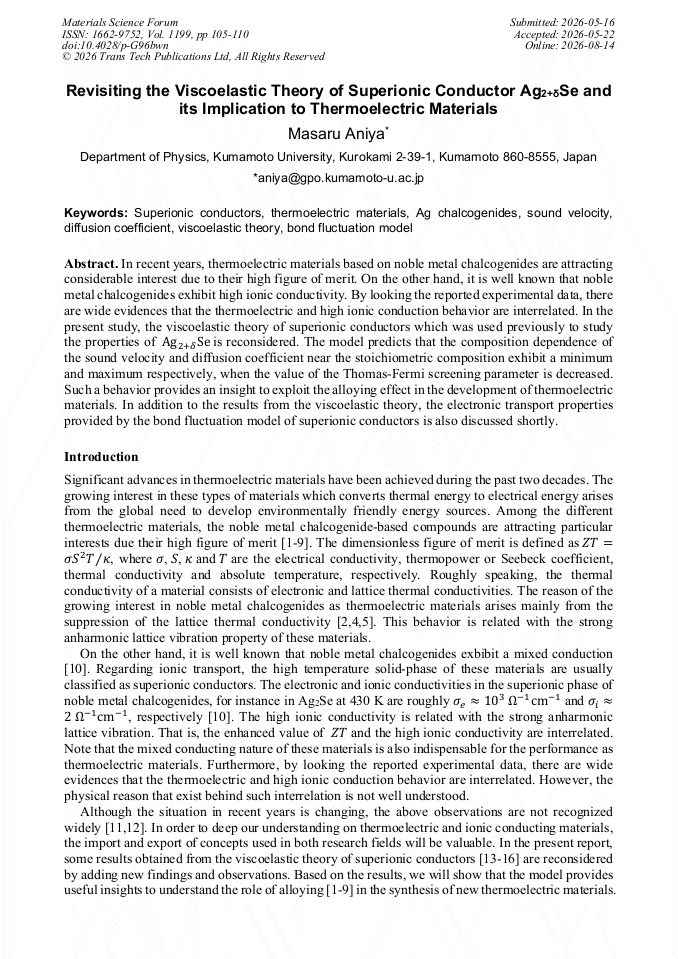
In recent years, thermoelectric materials based on noble metal chalcogenides are attracting considerable interest due to their high figure of merit. On the other hand, it is well known that noble metal chalcogenides exhibit high ionic conductivity. By looking the reported experimental data, there are wide evidences that the thermoelectric and high ionic conduction behavior are interrelated. In the present study, the viscoelastic theory of superionic conductors which was used previously to study the properties of Ag2+δSe is reconsidered. The model predicts that the composition dependence of the sound velocity and diffusion coefficient near the stoichiometric composition exhibit a minimum and maximum respectively, when the value of the Thomas-Fermi screening parameter is decreased. Such a behavior provides an insight to exploit the alloying effect in the development of thermoelectric materials. In addition to the results from the viscoelastic theory, the electronic transport properties provided by the bond fluctuation model of superionic conductors is also discussed shortly.
You might also be interested in these eBooks

Info:

Periodical:

Materials Science Forum (Volume 1199)

Pages:

105-110

Citation:

Online since:

August 2026

Authors:

Export:

Price:

Permissions CCC:

Permissions PLS:

Сopyright:

© 2026 Trans Tech Publications Ltd. All Rights Reserved

Share:

Citation:

* - Corresponding Author

[1] P. Qiu, T. Mao, Z. Huang, X. Xia, J. Liao, M.T. Agne, M. Gu, et al.: Joule Vol. 3 (2019), p.1538

Google Scholar

[2] M. Guan, K. Zhao, P. Qiu, D. Ren, et al.: ACS Appl. Mater. Interfaces Vol. 11 (2019), p.13433

Google Scholar

[3] K. Hirata, T. Matsunaga, S. Singh, et al.: J. Electron. Mater. Vol. 49 (2020), p.2895

Google Scholar

[4] T.J. Slade, S. Anand, M. Wood, J.P. Male, K. Imasato, et al.: Joule Vol. 5 (2021), p.1168

Google Scholar

[5] A. Basit, J. Xin, G. Murtaza, L. Wei, A. Hameed, et al.: EcoMat Vol. 5 (2023), p. e12391

Google Scholar

[6] T. Deng, P. Qiu, T. Yin, Z. Li, J. Yang, T. Wei, et al.: Adv. Mater. Vol. 36 (2024), p.2311278

Google Scholar

[7] M. Liu, X. Zhang, S. Zhang and Y. Pei: Nature Commun. Vol. 15 (2024), p.6580

Google Scholar

[8] T. Yin, T. Deng, P. Qiu, C. Sun, K. Shen, et al.: Mater. Today Phys. Vol. 43 (2024), p.101402

Google Scholar

[9] L. Wang, P. Miao, X.-L. Shi, L. Li, Z. Shen, et al.: J. Alloys Comp. Vol. 1035 (2025), p.181456

Google Scholar

[10] I. Rom and W. Sitte: Solid State Ionics Vol. 101-103 (1997), p.381

Google Scholar

[11] G.D. Mahan: J. Appl. Phys. Vol. 117 (2015), p.045101

Google Scholar

[12] M. Aniya: Springer Proc. Phys. Vol. 411 (2024), p.38

Google Scholar

[13] M. Aniya and T. Iseki: J. Non-Cryst. Solids Vol. 312-314 (2002), p.400

Google Scholar

[14] M. Aniya, F. Shimojo and T. Iseki: J. Non-Cryst. Solids Vol. 338-340 (2004), p.579

Google Scholar

[15] M. Ikeda and M. Aniya: Solid State Ionics Vol. 179 (2008), p.761

Google Scholar

[16] Sahara and M. Aniya: ICAST (2011), oral presentation

Google Scholar

[17] M. Aniya: Solid State Ionics Vol. 50 (1992), p.125

Google Scholar

[18] M. Aniya: Pure Appl. Chem. Vol. 91 (2019), p.1797

Google Scholar

[19] F. Sukegawa, M. Kobayashi and I. Yokota: Phys. Status Solidi (b) Vol. 109 (1982), p.717

Google Scholar

[20] M. Aniya and M. Kobayashi: Appl. Phys. A Vol. 49 (1989), p.641

Google Scholar

[21] S. Miyatani: J. Phys. Soc. Jpn. Vol. 13 (1958), p.341

Google Scholar

[22] Y. Tsuchiya: J. Phys.: Cond. Matt. Vol. 8 (1996), p.1897

Google Scholar

[23] T. Usuki, K. Abe, O. Uemura and Y. Kameda: J. Phys. Soc. Jpn. Vol. 70 (2001), p. (2061)

Google Scholar

[24] S. Ohno, A.C. Barnes and J.E. Enderby: J. Phys.: Cond. Matt. Vol. 6 (1994), p.5335

Google Scholar

[25] M. Aniya: J. Therm. Anal. Calorim. Vol. 99 (2010), p.109

Google Scholar