Properties of Concrete with Different Percentange of the Rice Husk Ash (RHA) as Partial Cement Replacement

Article Preview

Abstract:

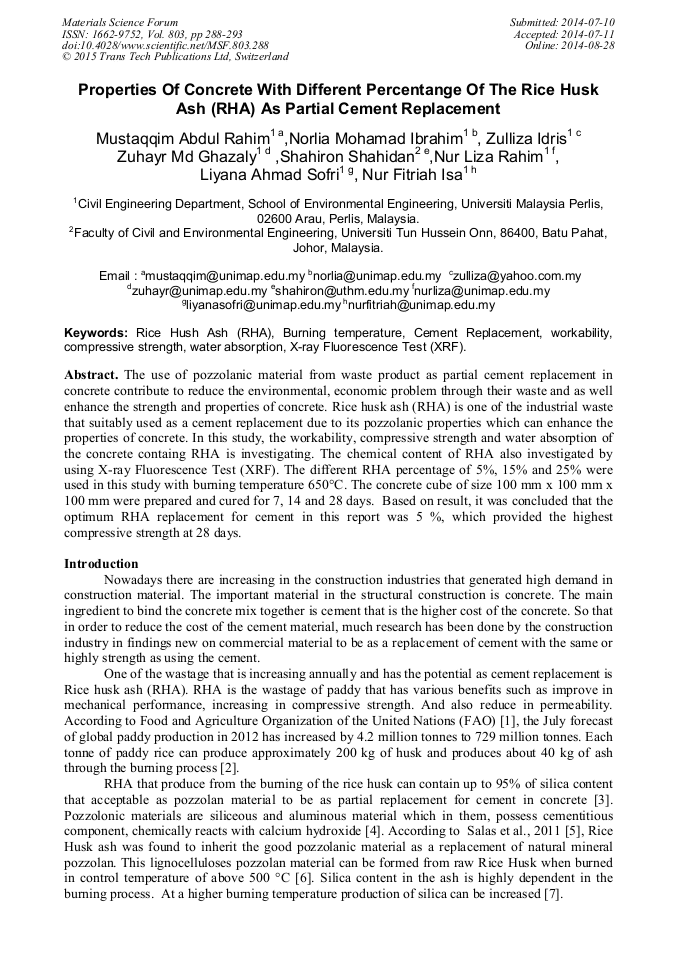
The use of pozzolanic material from waste product as partial cement replacement in concrete contribute to reduce the environmental, economic problem through their waste and as well enhance the strength and properties of concrete. Rice husk ash (RHA) is one of the industrial waste that suitably used as a cement replacement due to its pozzolanic properties which can enhance the properties of concrete. In this study, the workability, compressive strength and water absorption of the concrete containg RHA is investigating. The chemical content of RHA also investigated by using X-ray Fluorescence Test (XRF). The different RHA percentage of 5%, 15% and 25% were used in this study with burning temperature 650°C. The concrete cube of size 100 mm x 100 mm x 100 mm were prepared and cured for 7, 14 and 28 days. Based on result, it was concluded that the optimum RHA replacement for cement in this report was 5 %, which provided the highest compressive strength at 28 days.

You might also be interested in these eBooks

Info:

Periodical:

Pages:

288-293

Citation:

Online since:

August 2014

Export:

Price:

Permissions CCC:

Permissions PLS:

Сopyright:

© 2015 Trans Tech Publications Ltd. All Rights Reserved

Share:

Citation:

* - Corresponding Author

[1] Food & Agriculture Organization of the United Nation (FAO), (2012). Rice Publication Rice Market Monitor. Internet: www. fao. org/economic, February (2013).

Google Scholar

[2] Metha, P.K., (1992). Rice Husk Ash – A Unique Supplementary Cementing Material. In 1992 Proceeding of the International Symposium on Advances in Concrete Technology, CANMET/ACI, Athens Greece, pp.407-430.

DOI: 10.14359/968

Google Scholar

[3] E.A. Basha and A.S. Muntohar, (2003). Effect of the Cement-rice Husk Ash on the Plasticity and Compaction of Soil.

Google Scholar

[4] M. Tashima, C. A. R. Silva, J. L. Akasaki and M. B. Barbosa, Influence of Rice Husk Ash in Mechanical Characteristics of Concrete, Supplementary Cementing Materials, 2010, pp.780-790.

Google Scholar

[5] A. Salas, M. A. Ospina, S. Delvasto, R. Mejía de Gutierrez 2008. Study on the pozzolanic properties of silica obtained from rice husk by chemical and thermal process. physica status solidi (c) 10/2011; 4(11): 4311 - 4318.

DOI: 10.1002/pssc.200675924

Google Scholar

[6] N.L.M. Kamal, M.F. Nuruddin and N. Shafiq, 2010)The Influence Of Burning Temperatures and Percentage Inclusion of Microwave Incinerated Rice Husk Ash (MIRHA) On Normal Strength Concrete, International conference of construction and building technology (ICCBT).

DOI: 10.4028/www.scientific.net/amr.935.193

Google Scholar

[7] M. Sivaraja and S. Kandasamy, 2011. Potential Reuse of Waste Rice Husk as fibre composites in concrete. ASIAN JOURNAL OF CIVIL ENGINEERING (BUILDING AND HOUSING) VOL. 12, NO. 2 (2011) PAGES 205-217.

Google Scholar

[8] Malaysian Standard: MS 522: Part 1: 1989 Specifications for Ordinary Portland Cement.

Google Scholar

[9] British Standard 1881: Part 102 (1983). Method for Determination of Slump. London, British Standard Institution.

Google Scholar

[10] British Standard 1881: Part 122 (1983). Method for determination of Water Absorption. London, British Standard Institution.

Google Scholar

[11] British Standard 1881: Part 116 (1983). Method for Determination of Compressive Strength of Concrete Cubes. London, British Standard Institution.

Google Scholar