Integrated Phase Field and Machine Learning Study of Microstructure Evolution during Interface-Controlled Spinodal Decomposition

Article Preview

Abstract:

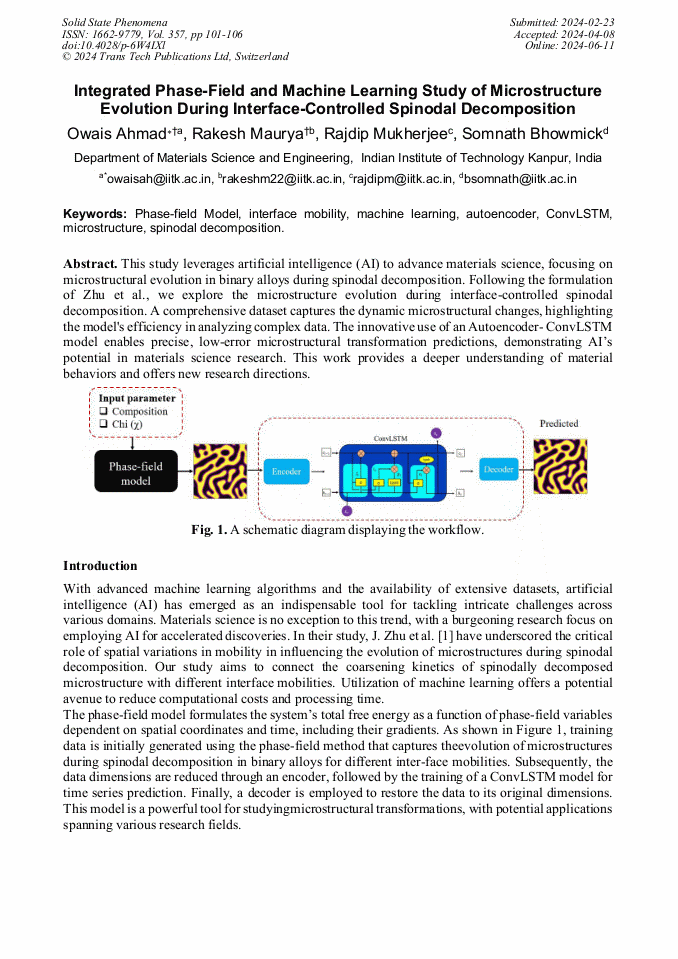
This study leverages artificial intelligence (AI) to advance materials science, focusing on microstructural evolution in binary alloys during spinodal decomposition. Following the formulation of Zhu et al., we explore the microstructure evolution during interface-controlled spinodal decomposition. A comprehensive dataset captures the dynamic microstructural changes, highlighting the model's efficiency in analyzing complex data. The innovative use of an Autoencoder- ConvLSTM model enables precise, low-error microstructural transformation predictions, demonstrating AI’s potential in materials science research. This work provides a deeper understanding of material behaviors and offers new research directions.

You might also be interested in these eBooks

Info:

Periodical:

Solid State Phenomena (Volume 357)

Pages:

101-106

Citation:

Online since:

June 2024

Export:

Price:

Permissions CCC:

Permissions PLS:

Сopyright:

© 2024 Trans Tech Publications Ltd. All Rights Reserved

Share:

Citation:

* - Corresponding Author

[1] J. Zhu, L.-Q. Chen, J. Shen, and V. Tikare, "Coarsening kinetics from a variable-mobility cahn-hilliard equation: Application of a semi-implicit fourier spectral method," Physical Review E, vol. 60, no. 4, p.3564, 1999.

DOI: 10.1103/physreve.60.3564

Google Scholar

[2] N. Moelans, B. Blanpain, and P. Wollants, "An introduction to phase-field modeling of microstructure evolution," Calphad, vol. 32, no. 2, p.268–294, 2008.

DOI: 10.1016/j.calphad.2007.11.003

Google Scholar

[3] J. W. Cahn and J. E. Hilliard, "Free energy of a nonuniform system. i. interfacial free energy," The Journal of chemical physics, vol. 28, no. 2, p.258–267, 1958.

DOI: 10.1063/1.1744102

Google Scholar

[4] L. Q. Chen and J. Shen, "Applications of semi-implicit fourier-spectral method to phase field equations," Computer Physics Communications, vol. 108, no. 2-3, p.147–158, 1998.

DOI: 10.1016/s0010-4655(97)00115-x

Google Scholar

[5] M. M. Taye, "Theoretical understanding of convolutional neural network: Concepts, architectures, applications, future directions," Computation, vol. 11, no. 3, p.52, 2023.

DOI: 10.3390/computation11030052

Google Scholar

[6] X. Shi, Z. Chen, H. Wang, D.-Y. Yeung, W.-K. Wong, and W.-c. Woo, "Convolutional lstm network: A machine learning approach for precipitation nowcasting," Advances in neural information processing systems, vol. 28, 2015.

Google Scholar

[7] O. Ahmad, N. Kumar, R. Mukherjee, and S. Bhowmick, "Accelerating microstructure modeling via machine learning: A method combining autoencoder and convlstm," Phys. Rev. Mater., vol. 7, p.083802, Aug 2023.

DOI: 10.1103/physrevmaterials.7.083802

Google Scholar