The Research on Automatic Liquor Blending Systems Based on Wavelet Neural Networks

Article Preview

Abstract:

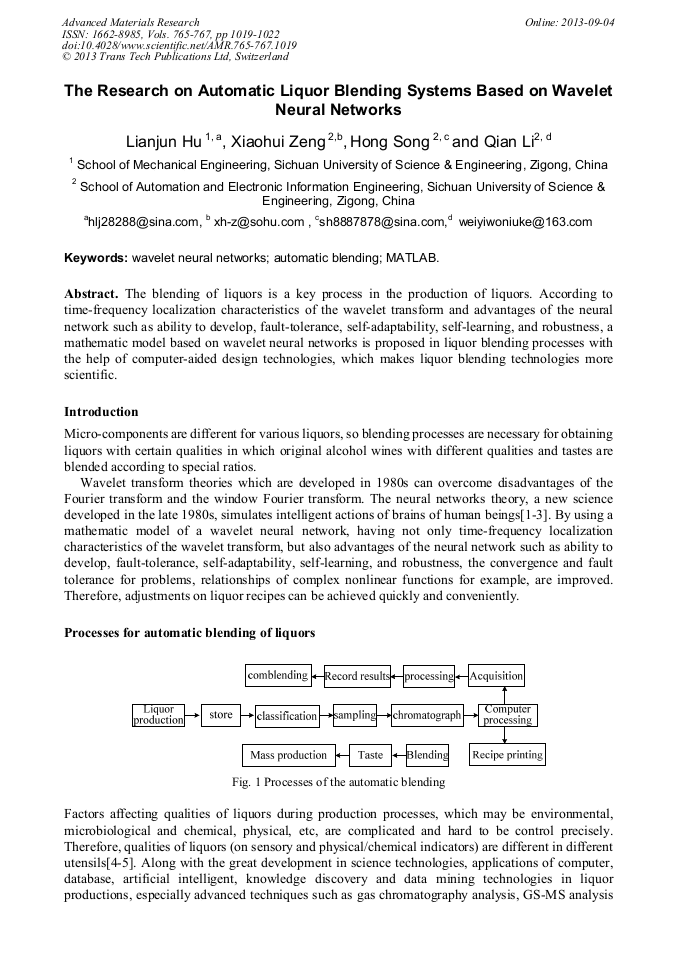
The blending of liquors is a key process in the production of liquors. According to time-frequency localization characteristics of the wavelet transform and advantages of the neural network such as ability to develop, fault-tolerance, self-adaptability, self-learning, and robustness, a mathematic model based on wavelet neural networks is proposed in liquor blending processes with the help of computer-aided design technologies, which makes liquor blending technologies more scientific.
You might also be interested in these eBooks

Info:

Periodical:

Advanced Materials Research (Volumes 765-767)

Pages:

1019-1022

Citation:

Online since:

September 2013

Export:

Price:

Permissions CCC:

Permissions PLS:

Сopyright:

© 2013 Trans Tech Publications Ltd. All Rights Reserved

Share:

Citation:

[1] Zaiyong Feng. Application and Comparison of Wavelet Neural Network with BP Network. Thesis of Master's Degree . Chengdu University of technology. (2007).

Google Scholar

[2] Liting Jing. Optimization and Application of Wavelet Neural Network. Thesis of Master's Degree . Jiangnan University. (2008).

Google Scholar

[3] Wei Zhou, Xiaoping Zhou. Quality Fingerprint Expert Discriminating System of Famous White Spirits. Analytical Chemistry Research Report. 2004,32(6): 735-745.

Google Scholar

[4] Dongsheng Zhang. An Intelligent Liquor Blending System Based on Neural Networks. Thesis of Master's Degree . Shandong University of Science and Technology. (2004).

Google Scholar

[5] Dahe Li. Key Techniques of Liquor Blending. Liquor Making Science & Technology. 2003, 3(117): 29-33.

Google Scholar

[6] Mingxiang Tang, Fulin Liu, Jian Ren. Aided Software for Liquor Blending Based on MATLAB. Food Research and Development. 2005, 26(6): 26-30.

Google Scholar