Enhancing Energy Harvesting from Low-Frequency Vibrations via Topology Optimization of Bimorph PVDF Cantilevers

Article Preview

Abstract:

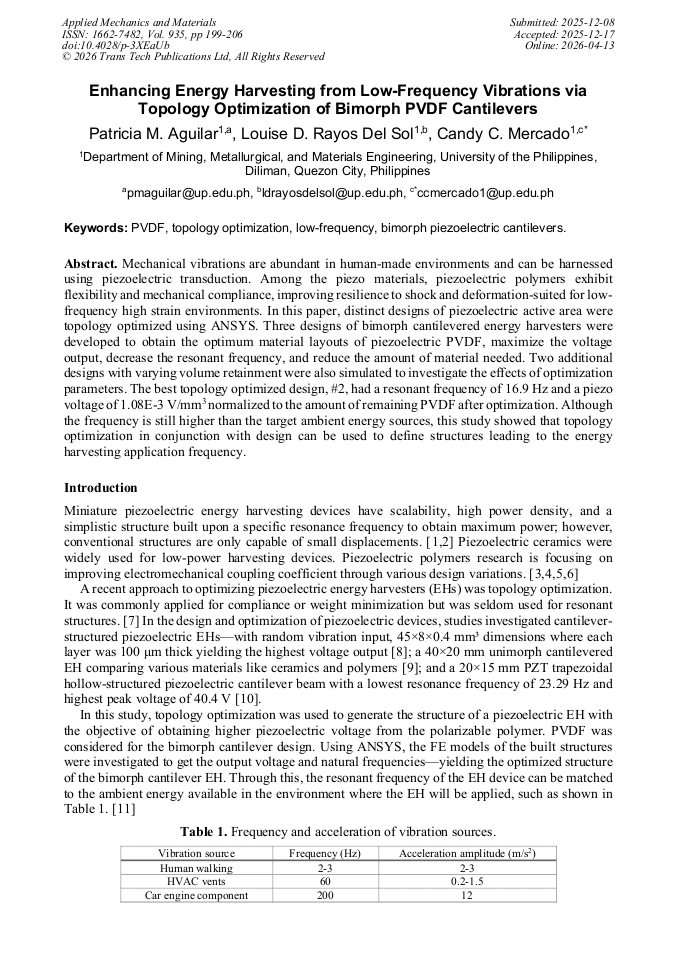
Mechanical vibrations are abundant in human-made environments and can be harnessed using piezoelectric transduction. Among the piezo materials, piezoelectric polymers exhibit flexibility and mechanical compliance, improving resilience to shock and deformation—suited for low-frequency high strain environments. In this paper, distinct designs of piezoelectric active area were topology optimized using ANSYS. Three designs of bimorph cantilevered energy harvesters were developed to obtain the optimum material layouts of piezoelectric PVDF, maximize the voltage output, decrease the resonant frequency, and reduce the amount of material needed. Two additional designs with varying volume retainment were also simulated to investigate the effects of optimization parameters. The best topology optimized design, #2, had a resonant frequency of 16.9 Hz and a piezo voltage of 1.08E-3 V/mm3 normalized to the amount of remaining PVDF after optimization. Although the frequency is still higher than the target ambient energy sources, this study showed that topology optimization in conjunction with design can be used to define structures leading to the energy harvesting application frequency.
You might also be interested in these eBooks

Info:

Periodical:

Pages:

199-206

Citation:

Online since:

April 2026

Export:

Price:

Permissions CCC:

Permissions PLS:

Сopyright:

© 2026 Trans Tech Publications Ltd. All Rights Reserved

Share:

Citation:

* - Corresponding Author

[1] S. Sukumaran, S. Chatbouri, D. Rouxel, E. Tisserand, F. Thiebaud, T. Ben Zineb, J. Intelligent Material Systems and Structures. 2021 Apr;32(7):746-80.

DOI: 10.1177/1045389x20966058

Google Scholar

[2] Z. Kang, X. Wang, Smart materials and structures. 2010 Jun 16;19(7):075018.

Google Scholar

[3] A. Aabid, M.A. Raheman, Y.E. Ibrahim, A. Anjum, M. Hrairi, B. Parveez, N. Parveen, M. Zayan, J. Sensors. 2021 Jun 16;21(12):4145.

DOI: 10.3390/s21124145

Google Scholar

[4] M. Smith, S. Kar-Narayan, International Materials Reviews. 2022 Jan;67(1):65-88.

Google Scholar

[5] H. Li, C. Tian, Z.D. Deng, Applied physics reviews. 2014 Dec 1;1(4).

Google Scholar

[6] G. Kalimuldina, N. Turdakyn, I. Abay, A. Medeubayev, A. Nurpeissova, D. Adair, Z. Bakenov, Sensors. 2020 Sep 12;20(18):5214.

DOI: 10.3390/s20185214

Google Scholar

[7] B. Zheng, C. Lu, H.Z. Huang, International Conference on Apperceiving Computing and Intelligence Analysis 2008 Dec 13 (pp.132-136). IEEE.

Google Scholar

[8] Y. Bai, P. Tofel, Z. Hadas, J. Smilek, P. Losak, P. Skarvada, R. Macku, Mechanical Systems and Signal Processing. 2018 Jun 1;106:303-18.

DOI: 10.1016/j.ymssp.2018.01.006

Google Scholar

[9] C. Kim, J.W. Shin, International Journal of Precision Engineering and Manufacturing. 2013 Nov;14(11):1925-31.

Google Scholar

[10] Q. Xu, A. Gao, Y. Li, Y. Jin, Micromachines. 2022 Apr 26;13(5):675.

Google Scholar

[11] H.C. Song, C.Y. Kang, S.J. Yoon, D.Y. Jeong, Journal of the Ceramic Society of Japan. 2009;117(1370):1074-7.

Google Scholar

[12] P. Roy, S. Kumar, D. Roy, International Journal of Non-Linear Mechanics. 2020 Nov 1;126:103542.

Google Scholar

[13] C.K. Neha, M. Hegde, V. Aher, V. Sai, S. Gatade, V. Hegde, Global Conference for Advancement in Technology (GCAT) 2019 Oct 18 (pp.1-7). IEEE.

DOI: 10.1109/gcat47503.2019.8978326

Google Scholar