Separation Status of Discarded or Obsolete TNT/RDX/Al Explosive Based on Material Properties
p.68
p.68
Biodegradation of Aniline by Alkaliphilic Strain Bacillus sp. Strain AN2 under High Salinity Condition
p.72
p.72
Computation for Equation of States of (Mg0.92, Fe0.08)SiO3 Perovskite Based on Mie-Grüneisen-Debye Model
p.76
p.76
Applied Technology in Feasibility Assessment of Photoplethysmograph Computing for Heart Rate Variability Application
p.83
p.83
Research on Image Segmentation Technology with Tissue Section Cell Segmentation Algorithm
p.88
p.88
Applied Technology with an Improved ICA Algortihm and its Application in Heart Rate Measurement
p.92
p.92
Facile Synthesis of Symmetrical Homonucleotides of Antiviral Nucleosides
p.96
p.96
A Synthetic Approach for the Preparation of P1-AZT-5′-P3-d4T-5′-Triphosphate
p.100
p.100
Synthesis of Phosphonate-Containing 2-Methyl-1,5-Diaminopentane Derivatives
p.104
p.104
Research on Image Segmentation Technology with Tissue Section Cell Segmentation Algorithm

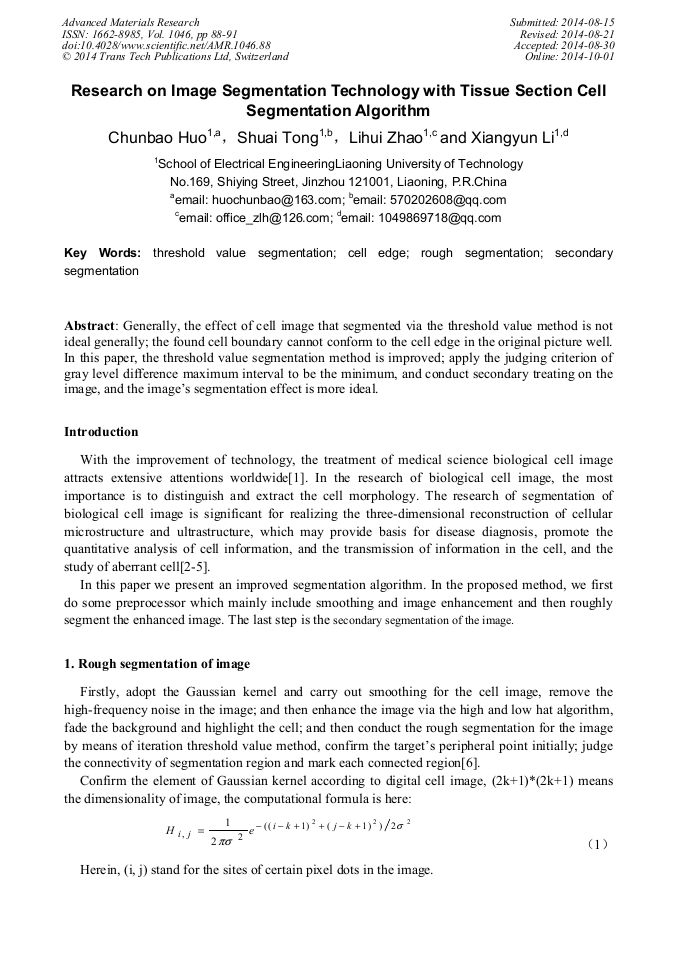
Abstract:
Generally, the effect of cell image that segmented via the threshold value method is not ideal generally; the found cell boundary cannot conform to the cell edge in the original picture well. In this paper, the threshold value segmentation method is improved; apply the judging criterion of gray level difference maximum interval to be the minimum, and conduct secondary treating on the image, and the image’s segmentation effect is more ideal.
You might also be interested in these eBooks

Info:
Periodical:
Advanced Materials Research (Volume 1046)
Pages:
88-91
DOI:
Citation:
Online since:
October 2014
Authors:
Price:
Сopyright:
© 2014 Trans Tech Publications Ltd. All Rights Reserved
Share:
Citation: