p.559
p.567
p.572
p.580
p.587
p.593
p.597
p.601
p.604
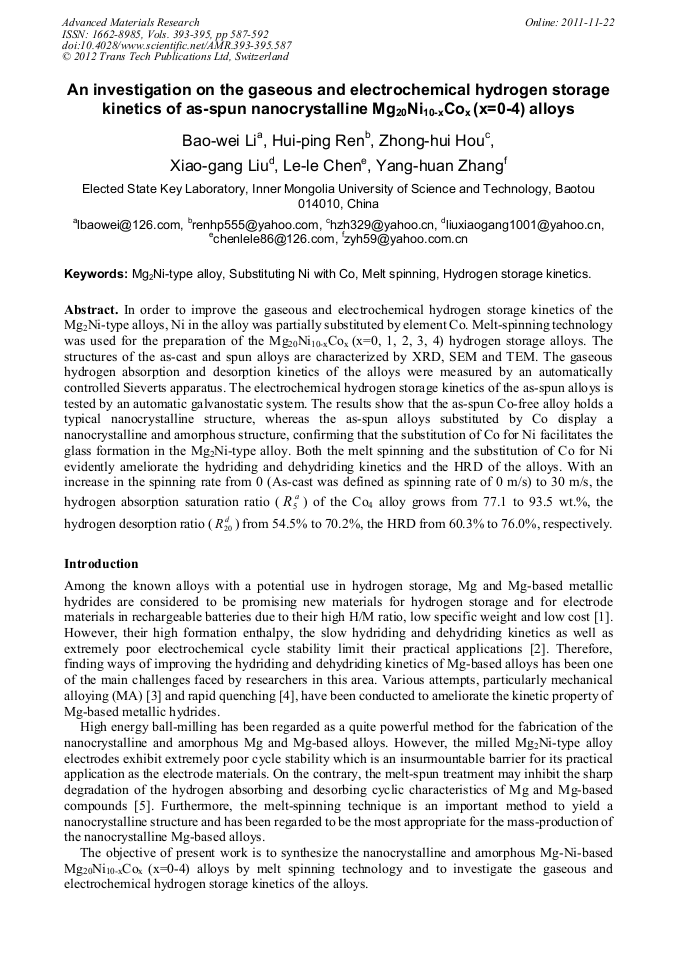
An Investigation on the Gaseous and Electrochemical Hydrogen Storage Kinetics of As-Spun Nanocrystalline Mg20Ni10-xCOx (x=0-4) Alloys

Abstract:
In order to improve the gaseous and electrochemical hydrogen storage kinetics of the Mg2Ni-type alloys, Ni in the alloy was partially substituted by element Co. Melt-spinning technology was used for the preparation of the Mg20Ni10-xCox (x=0, 1, 2, 3, 4) hydrogen storage alloys. The structures of the as-cast and spun alloys are characterized by XRD, SEM and TEM. The gaseous hydrogen absorption and desorption kinetics of the alloys were measured by an automatically controlled Sieverts apparatus. The electrochemical hydrogen storage kinetics of the as-spun alloys is tested by an automatic galvanostatic system. The results show that the as-spun Co-free alloy holds a typical nanocrystalline structure, whereas the as-spun alloys substituted by Co display a nanocrystalline and amorphous structure, confirming that the substitution of Co for Ni facilitates the glass formation in the Mg2Ni-type alloy. Both the melt spinning and the substitution of Co for Ni evidently ameliorate the hydriding and dehydriding kinetics and the HRD of the alloys. With an increase in the spinning rate from 0 (As-cast was defined as spinning rate of 0 m/s) to 30 m/s, the hydrogen absorption saturation ratio ( ) of the Co4 alloy grows from 77.1 to 93.5 wt.%, the hydrogen desorption ratio ( ) from 54.5% to 70.2%, the HRD from 60.3% to 76.0%, respectively.
Info:
Periodical:
Pages:
587-592
Citation:
Online since:
November 2011
Authors:
Price:
Сopyright:
© 2012 Trans Tech Publications Ltd. All Rights Reserved
Share:
Citation: