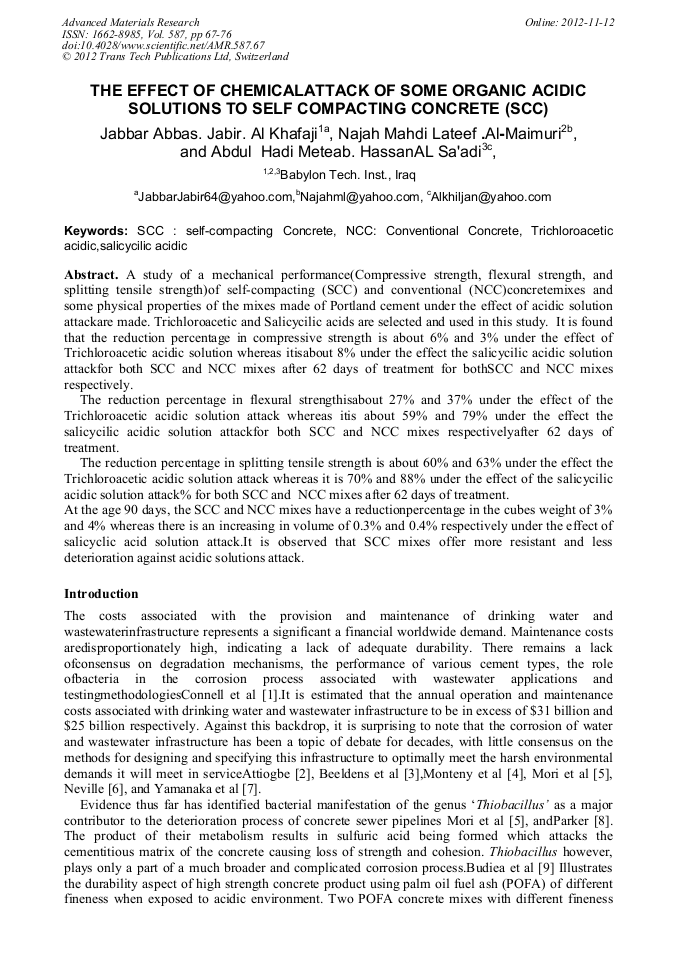
The Effect of Chemicalattack of some Organic Acidic Solutions to Self Compacting Concrete (SCC)

Article Preview

Abstract:

A study of a mechanical performance(Compressive strength, flexural strength, and splitting tensile strength)of self-compacting (SCC) and conventional (NCC)concretemixes and some physical properties of the mixes made of Portland cement under the effect of acidic solution attackare made. Trichloroacetic and Salicycilic acids are selected and used in this study. It is found that the reduction percentage in compressive strength is about 6% and 3% under the effect of Trichloroacetic acidic solution whereas itisabout 8% under the effect the salicycilic acidic solution attackfor both SCC and NCC mixes after 62 days of treatment for bothSCC and NCC mixes respectively. The reduction percentage in flexural strengthisabout 27% and 37% under the effect of the Trichloroacetic acidic solution attack whereas itis about 59% and 79% under the effect the salicycilic acidic solution attackfor both SCC and NCC mixes respectivelyafter 62 days of treatment. The reduction percentage in splitting tensile strength is about 60% and 63% under the effect the Trichloroacetic acidic solution attack whereas it is 70% and 88% under the effect of the salicycilic acidic solution attack% for both SCC and NCC mixes after 62 days of treatment. At the age 90 days, the SCC and NCC mixes have a reductionpercentage in the cubes weight of 3% and 4% whereas there is an increasing in volume of 0.3% and 0.4% respectively under the effect of salicyclic acid solution attack.It is observed that SCC mixes offer more resistant and less deterioration against acidic solutions attack.
You might also be interested in these eBooks

Info:

Periodical:

Pages:

67-76

Citation:

Online since:

November 2012

Export:

Price:

Permissions CCC:

Permissions PLS:

Сopyright:

© 2012 Trans Tech Publications Ltd. All Rights Reserved

Share:

Citation:

[1] O. M. Connell., C. McNally and M.G. Richardson: Biochemical Attack on Concrete in Wastewater Applications. School of Architecture, Landscape and Civil Engineering, University College Dublin, Newstead, Belfield, Dublin 4, Ireland, (2010).

Google Scholar

[2] EK. Attiogbe, and SH. Rizkalla: Response of concrete to sulfuric acid attack. ACI Mater J; 84(6): 481–488, (1988).

Google Scholar

[3] A. Beeldens, J. Monteny, E. Vincke, N. De Belie, D. Van Gemert, L. Taerwe, and W. Verstraete: Resistance to biogenic sulfuric acid corrosion of polymer-modified mortars". Cem Concr Comp; 23(1): 47-56, (2001).

DOI: 10.1016/s0958-9465(00)00039-1

Google Scholar

[4] J. Monteny, E. Vincke,A. Beeldens, N. De Belie, L. Taerwe, D. Van Gemert, and W. Verstraete: Chemical, microbiological, and in situ test methods for biogenic sulfuric acid corrosion of concrete". Cem Concr Res; 30(4): 623-634, 2000. `.

DOI: 10.1016/s0008-8846(00)00219-2

Google Scholar

[5] T. Mori, T. Nonaka, K. Tazaki, M. Koga,Y. Hikosaka, and S. Noda: Interactions of nutrients, moisture and pH on microbial corrosion of concrete sewer pipes., Water Res; 26(1): 29-37, (1992).

DOI: 10.1016/0043-1354(92)90107-f

Google Scholar

[6] A. Neville: The confused world of sulfate attack on concrete., Cem Concr Res; 34(8): 1275-1296, (2004).

DOI: 10.1016/j.cemconres.2004.04.004

Google Scholar

[7] T. Yamanaka, I. Aso, S. Togashi, M. Tanigawa, K. Shoji, T. Watanabe, N. Watanabe, K. Maki, and H. Suzuki: Corrosion by bacteria of concrete in sewerage systems and inhibitory effects of formats on their growth., Water Res; 36(10): 2636-2642, (2002).

DOI: 10.1016/s0043-1354(01)00473-0

Google Scholar

[8] CD. Parker: The isolation of a species of bacterium associated with the corrosion of concrete exposed to atmospheres containing hydrogen sulfide., Aust J Exp Biol Med Sci; 23: 81-90, (1945).

DOI: 10.1038/icb.1945.13

Google Scholar

[9] A. Budiea, M.W. Hussin, K. Muthusamy, and M. E. Ismail: Performance of High Strength POFA Concrete in Acidic Environment., Department of Structure and Material, Faculty of Civil Engineering, University Technology Malaysia, MALAYSIA. (2009).

Google Scholar

[10] Dan Babor and G. Micheal : Treated and Terminated Sulphuric Acid Attack., BuletinulInstitute Polytechnic Din Lasi Tomul LII (LVII), Fase, 3-4, (2007).

Google Scholar

[11] Xu. Aimin, S. Ahmed, and B. Pud: Test methods for Sulfate Resistance of Concrete and Mechanisim of Sulfate Attack., Arrb Transport Research Ltd Review Report 5 September (1998).

Google Scholar

[12] S. Turkel, B. Felekoglu, and S. Dulluc: Influence of Various Acids on the Physico-Mechanical Properties of Pozzolanic Mortars., Sadhana Journal Vol. 32, Part 6, December, PP. 683-691, © Printed in India, (2007).

DOI: 10.1007/s12046-007-0048-0

Google Scholar

[13] A. Bertron, J. Duchesne, and G. Escadeillas,: Attack of Cement Paste Exposed to Organic Acids in Mature., Laboratoire Mate´riaux et Durabilite´ des Constructions, INSA-UPS, Complexe Scientifique de Rangueil, 31077 Toulouse, France, Cement & Concrete Composites 27 898–909, (2005).

DOI: 10.1016/j.cemconcomp.2005.06.003

Google Scholar

[14] B. Alexandra, L. Steeves, and E. Gilles: Organic Acids Attack on Cementitious Materials., Mendeley Miscellaneous Papers, (2011).

Google Scholar