Reliability Analysis for Link Mechanism under Influence of Multiple Factors Based on Support Vector Machine
p.2904
p.2904
A Multilevel Hypergraph Partitioning Algorithm Based on Simulated Annealing
p.2908
p.2908
An Out-of-Core Method for CFD Simulation in Heterogeneous Environment
p.2912
p.2912
Determination of Occurrence Grades for Factors Affecting Congelation Failure on Basis of Fuzzy Comprehensive Assessment Method
p.2916
p.2916
A Mapping Framework between Design Information and Energy Information
p.2920
p.2920
Adaptive Genetic Algorithm for Hybrid Flow-Shop Scheduling
p.2925
p.2925
Forecasting the Exchange Rate Based on BP Neural Network in Combination with Simulated Annealing Algorithm
p.2930
p.2930
Design of the Risk Evaluation Indicator System and Weight of Special Equipment User
p.2935
p.2935
The Adaboost Algorithm Applied in ATM Automatic Identification System
p.2941
p.2941
A Mapping Framework between Design Information and Energy Information

Abstract:
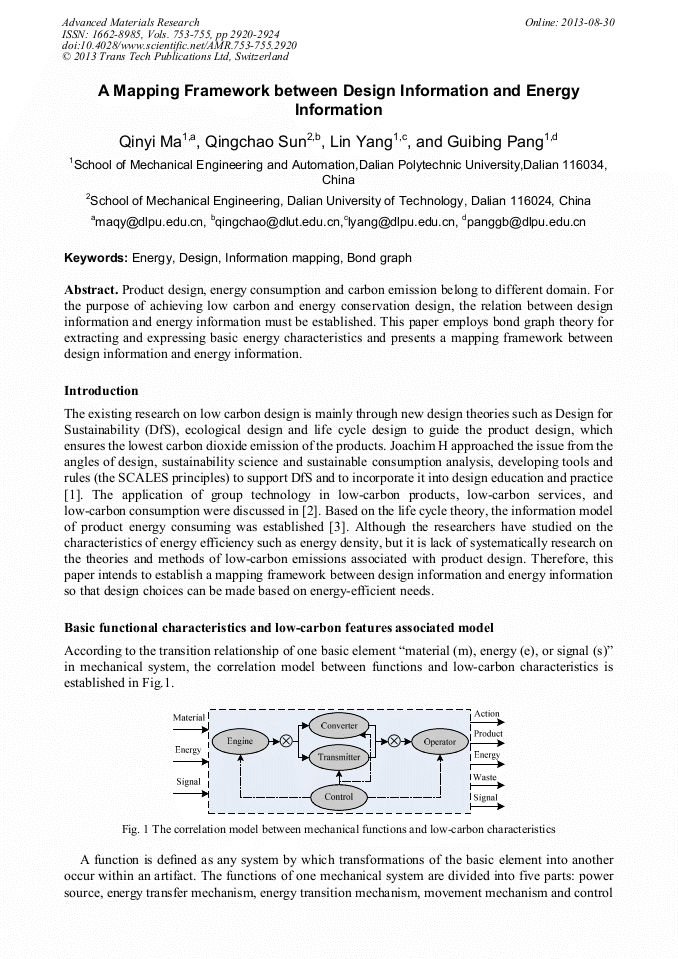
Product design, energy consumption and carbon emission belong to different domain. For the purpose of achieving low carbon and energy conservation design, the relation between design information and energy information must be established. This paper employs bond graph theory for extracting and expressing basic energy characteristics and presents a mapping framework between design information and energy information.
You might also be interested in these eBooks
Info:
Periodical:
Advanced Materials Research (Volumes 753-755)
Pages:
2920-2924
Citation:
Online since:
August 2013
Authors:
Keywords:
Price:
Сopyright:
© 2013 Trans Tech Publications Ltd. All Rights Reserved
Share:
Citation: