p.9
p.15
p.23
p.31
p.39
p.45
p.53
p.61
p.69
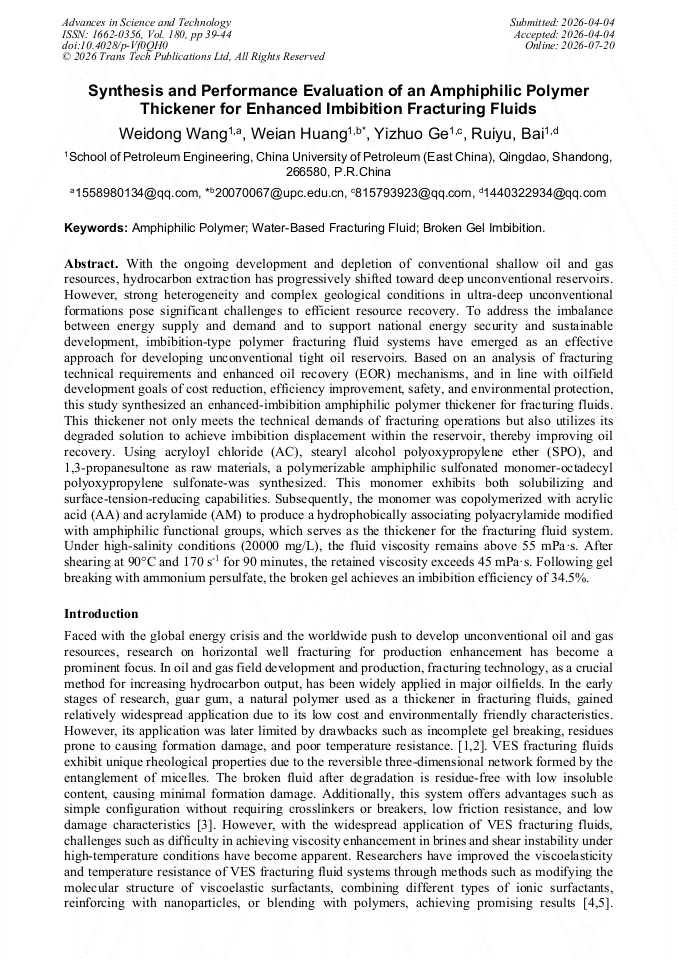
Synthesis and Performance Evaluation of an Amphiphilic Polymer Thickener for Enhanced Imbibition Fracturing Fluids

Abstract:
With the ongoing development and depletion of conventional shallow oil and gas resources, hydrocarbon extraction has progressively shifted toward deep unconventional reservoirs. However, strong heterogeneity and complex geological conditions in ultra‑deep unconventional formations pose significant challenges to efficient resource recovery. To address the imbalance between energy supply and demand and to support national energy security and sustainable development, imbibition‑type polymer fracturing fluid systems have emerged as an effective approach for developing unconventional tight oil reservoirs. Based on an analysis of fracturing technical requirements and enhanced oil recovery (EOR) mechanisms, and in line with oilfield development goals of cost reduction, efficiency improvement, safety, and environmental protection, this study synthesized an enhanced‑imbibition amphiphilic polymer thickener for fracturing fluids. This thickener not only meets the technical demands of fracturing operations but also utilizes its degraded solution to achieve imbibition displacement within the reservoir, thereby improving oil recovery. Using acryloyl chloride (AC), stearyl alcohol polyoxypropylene ether (SPO), and 1,3‑propanesultone as raw materials, a polymerizable amphiphilic sulfonated monomer-octadecyl polyoxypropylene sulfonate-was synthesized. This monomer exhibits both solubilizing and surface‑tension‑reducing capabilities. Subsequently, the monomer was copolymerized with acrylic acid (AA) and acrylamide (AM) to produce a hydrophobically associating polyacrylamide modified with amphiphilic functional groups, which serves as the thickener for the fracturing fluid system. Under high‑salinity conditions (20000 mg/L), the fluid viscosity remains above 55 mPa·s. After shearing at 90°C and 170 s-1 for 90 minutes, the retained viscosity exceeds 45 mPa·s. Following gel breaking with ammonium persulfate, the broken gel achieves an imbibition efficiency of 34.5%.
Info:
Periodical:
Pages:
39-44
DOI:
Citation:
Online since:
July 2026
Authors:
Price:
Permissions CCC:
Permissions PLS:
Сopyright:
© 2026 Trans Tech Publications Ltd. All Rights Reserved
Share:
Citation: