p.127
p.137
p.149
p.161
p.169
p.181
p.193
p.205
p.215
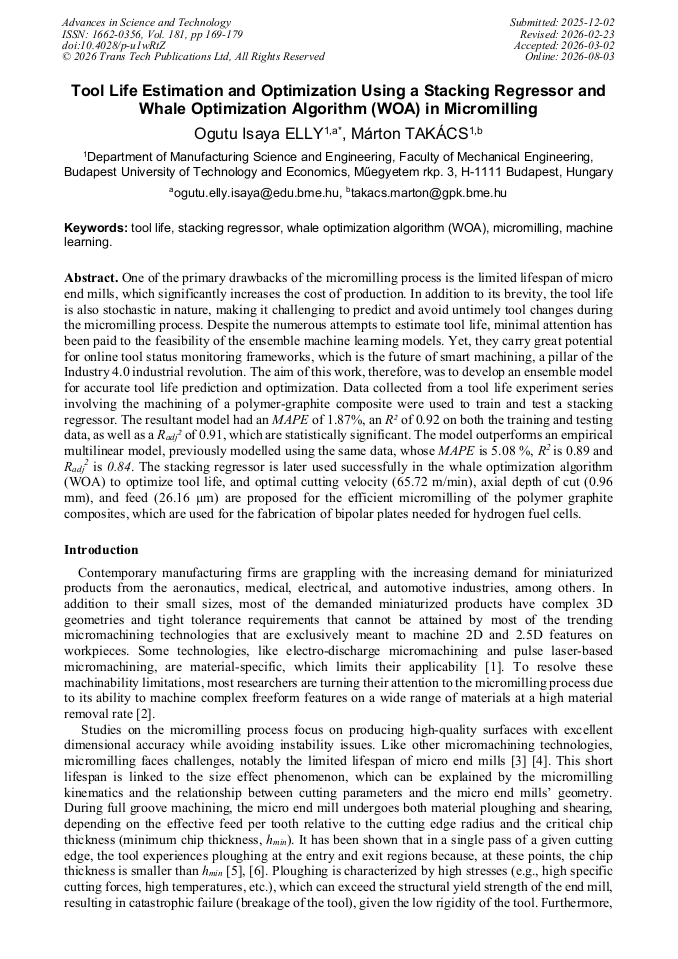
Tool Life Estimation and Optimization Using a Stacking Regressor and Whale Optimization Algorithm (WOA) in Micromilling

Abstract:
One of the primary drawbacks of the micromilling process is the limited lifespan of micro end mills, which significantly increases the cost of production. In addition to its brevity, the tool life is also stochastic in nature, making it challenging to predict and avoid untimely tool changes during the micromilling process. Despite the numerous attempts to estimate tool life, minimal attention has been paid to the feasibility of the ensemble machine learning models. Yet, they carry great potential for online tool status monitoring frameworks, which is the future of smart machining, a pillar of the Industry 4.0 industrial revolution. The aim of this work, therefore, was to develop an ensemble model for accurate tool life prediction and optimization. Data collected from a tool life experiment series involving the machining of a polymer-graphite composite were used to train and test a stacking regressor. The resultant model had an MAPE of 1.87%, an R² of 0.92 on both the training and testing data, as well as a Radj² of 0.91, which are statistically significant. The model outperforms an empirical multilinear model, previously modelled using the same data, whose MAPE is 5.08 %, R2 is 0.89 and Radj2 is 0.84. The stacking regressor is later used successfully in the whale optimization algorithm (WOA) to optimize tool life, and optimal cutting velocity (65.72 m/min), axial depth of cut (0.96 mm), and feed (26.16 µm) are proposed for the efficient micromilling of the polymer graphite composites, which are used for the fabrication of bipolar plates needed for hydrogen fuel cells.
Info:
Periodical:
Pages:
169-179
DOI:
Citation:
Online since:
August 2026
Authors:
Price:
Permissions CCC:
Permissions PLS:
Сopyright:
© 2026 Trans Tech Publications Ltd. All Rights Reserved
Share:
Citation: