Influence of Fiber and CO₂ Laser Cutting Parameters on the Material Properties of Wear-Resistant Hardox 450 Steel

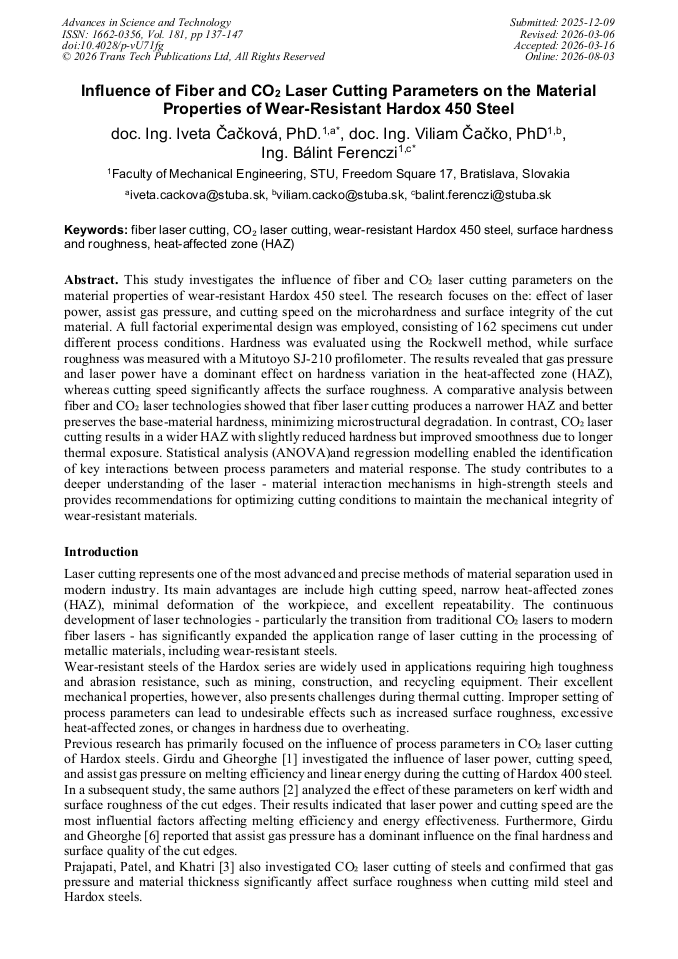
Article Preview

Abstract:

This study investigates the influence of fiber and CO₂ laser cutting parameters on the material properties of wear-resistant Hardox 450 steel. The research focuses on the: effect of laser power, assist gas pressure, and cutting speed on the microhardness and surface integrity of the cut material. A full factorial experimental design was employed, consisting of 162 specimens cut under different process conditions. Hardness was evaluated using the Rockwell method, while surface roughness was measured with a Mitutoyo SJ-210 profilometr. The results revealed that gas pressure and laser power have a dominant effect on hardness variation in the heat-affected zone (HAZ), whereas cutting speed significantly affects the surface roughness.A comparative analysis between fiber and CO₂ laser technologies showed that fiber laser cutting produces a narrower HAZ and better preserves the base-material hardness, minimizing microstructural degradation. In contrast, CO₂ laser cutting results in a wider HAZ with slightly reduced hardness but improved smoothness due to longer thermal exposure. Statistical analysis (ANOVA) and regression modelling enabled the identification of key interactions between process parameters and material response. The study contributes to a deeper understanding of the laser–material interaction mechanisms in high-strength steels and provides recommendations for optimizing cutting conditions to maintain the mechanical integrity of wear-resistant materials.
You might also be interested in these eBooks

Info:

Periodical:

Pages:

137-147

Citation:

Online since:

August 2026

Export:

Price:

Permissions CCC:

Permissions PLS:

Сopyright:

© 2026 Trans Tech Publications Ltd. All Rights Reserved

Share:

Citation:

* - Corresponding Author

[1] C. C. Girdu and C. Gheorghe, "Simulation of Melting Efficiency in Laser Cutting of Hardox 400 Steel," Materials, vol. 15, no. 20, 2022, Art. no. 7192. Available: https://www.mdpi.com/1996-1944/15/20/7192

DOI: 10.3390/ma15207192

Google Scholar

[2] C. C. Girdu and C. Gheorghe, "Energy Efficiency in CO2 Laser Processing of Hardox 400 Material," Materials, vol. 15, no. 13, 2022, Art. no. 4505. Available: https://www.mdpi.com/ 1996-1944/15/13/4505

DOI: 10.3390/ma15134505

Google Scholar

[3] B. D. Prajapati, M. Patel, and D. Khatri, "Parametric Investigation of CO2 Laser Cutting of Mild Steel and Hardox 400 Material," International Journal of Emerging Technology and Advanced Engineering, vol. 3, no. 4, 2013. Available: https://api.semanticscholar.org/ CorpusID:14084115

Google Scholar

[4] L. Dahil, M. Hadzistevic, and others, "Comparison of Advanced Cutting Techniques on Hardox 500 Steel Material and the Effect of Structural Properties of the Material," Metalurgija, vol. 53, no. 2, 2014, p.291–294. Available: https://hrcak.srce.hr/119533

Google Scholar

[5] M. J. Patel and M. D. Patel, "Parametric Investigation in CO2 Laser Cutting Quality of Hardox-400 Materials," International Journal of Engineering Science and Technology, vol. 3, no. 4, 2011. Available: https://www.idc-online.com/ technical_references/pdfs/ mechanical_engineering/ Parametric%20investigation.pdf

Google Scholar

[6] C. C. Girdu and C. Gheorghe, "Study of the Relationship between Entropy and Hardness in Laser Cutting of Hardox Steel," Materials, vol. 16, no. 13, 2023, Art. no. 4540. Available: https://www.mdpi.com/1996-1944/16/13/4540

DOI: 10.3390/ma16134540

Google Scholar

[7] C. C. Girdu, C. Gheorghe, and others, "Study of Input Parameters Influence on the Surface Quality at Laser Processing of Hardox 400 Steel," IOP Conference Series: Materials Science and Engineering, vol. 1009, 2021, Art. no. 012022. Available: https://iopscience.iop.org/article/

DOI: 10.1088/1757-899x/1009/1/012022

Google Scholar