Influence of Distinctive Firing Temperatures on Composite Mechanics of Rice Husk Ash and Stream Sediments

Article Preview

Abstract:

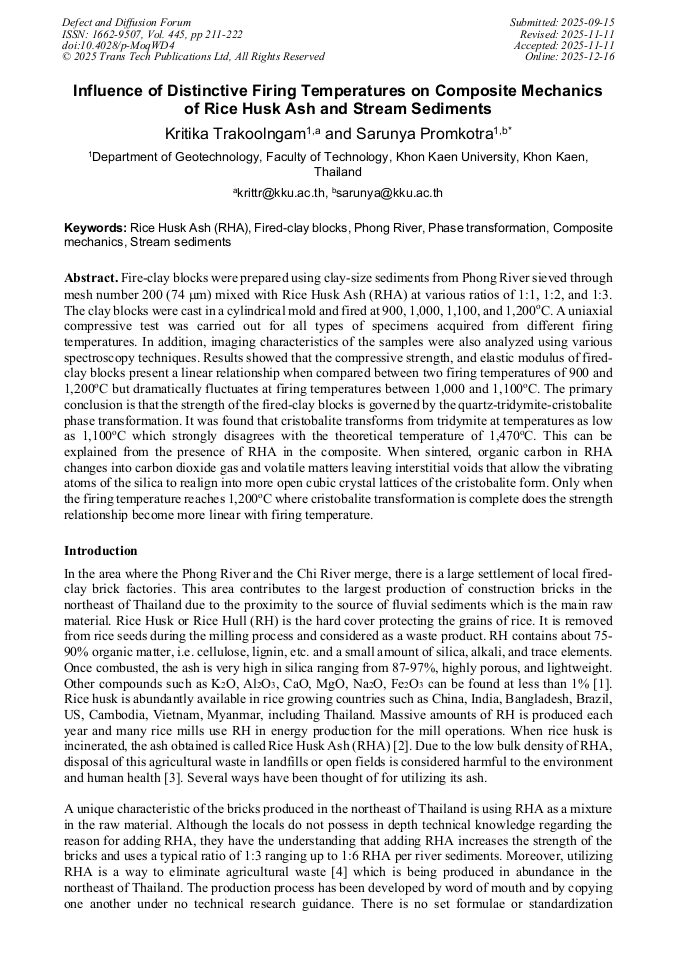
Fire-clay blocks were prepared using clay-size sediments from Phong River sieved through mesh number 200 (74 μm) mixed with Rice Husk Ash (RHA) at various ratios of 1:1, 1:2, and 1:3. The clay blocks were cast in a cylindrical mold and fired at 900, 1,000, 1,100, and 1,200°C. A uniaxial compressive test was carried out for all types of specimens acquired from different firing temperatures. In addition, imaging characteristics of the samples were also analyzed using various spectroscopy techniques. Results showed that the compressive strength, and elastic modulus of fired-clay blocks present a linear relationship when compared between two firing temperatures of 900 and 1,200°C but dramatically fluctuates at firing temperatures between 1,000 and 1,100°C. The primary conclusion is that the strength of the fired-clay blocks is governed by the quartz-tridymite-cristobalite phase transformation. It was found that cristobalite transforms from tridymite at temperatures as low as 1,100°C which strongly disagrees with the theoretical temperature of 1,470°C. This can be explained from the presence of RHA in the composite. When sintered, organic carbon in RHA changes into carbon dioxide gas and volatile matters leaving interstitial voids that allow the vibrating atoms of the silica to realign into more open cubic crystal lattices of the cristobalite form. Only when the firing temperature reaches 1,200°C where cristobalite transformation is complete does the strength relationship become more linear with firing temperature.
You might also be interested in these eBooks

Info:

Periodical:

Pages:

211-222

Citation:

Online since:

December 2025

Export:

Price:

Permissions CCC:

Permissions PLS:

Сopyright:

© 2025 Trans Tech Publications Ltd. All Rights Reserved

Share:

Citation:

* - Corresponding Author

[1] M. Sarangi, S. Bhattacharyyaa, R. Beherab, Effect of temperature on morphology and phase transformations of nanocrystalline silica obtained from rice husk, Phase Transitions: A Multinational Journal. 82(5) (2009) 377-386.

DOI: 10.1080/01411590902978502

Google Scholar

[2] A. Kumar, K. Mohanta, D. Kumar, O. Parkash, Properties and industrial applications of rice husk: A review, IJETAE. 2(10) (2012) 86-90.

Google Scholar

[3] R. Pode, Potential applications of rice husk ash waste from rice husk biomass power plant, Renewable and Sustainable Energy Reviews. 53 (2016) 1468-1485.

DOI: 10.1016/j.rser.2015.09.051

Google Scholar

[4] C. Lertsatitthanakorn, S. Atthajariyakul, S. Soponronnarit, Techno-economical evaluation of a rice husk ash (RHA) based sand--cement block for reducing solar conduction heat gain to a building, Construction and Building Materials. 23 (2009) 364-369.

DOI: 10.1016/j.conbuildmat.2007.11.017

Google Scholar

[5] ASTM International. Standard Test Method for Sieve Analysis of Fine and Coarse Aggregates, (ASTM C136/136M-14). ASTM International, 2014a.

Google Scholar

[6] Duval, D.J., Risbud, S.H., Shackelford, J.F. (2008). Mullite. In: Shackelford, J.F., Doremus, R.H. (eds) Ceramic and Glass Materials. Springer, Boston, MA

DOI: 10.1007/978-0-387-73362-3_2

Google Scholar

[7] W-C. Wei, J.W. Halloran, Transformation kinetics of diphasic aluminosilicate gels, JACerS. 71(7) (1988) 581–587.

DOI: 10.1111/j.1151-2916.1988.tb05923.x

Google Scholar

[8] ImageJ, Information on http://rsb.info.nih.gov/ij/.

Google Scholar

[9] K. Trakoolngam, S. Promkotra, Mechanical behavior of fired-clay bricks from stream sediments under uniaxial compressive loading, KEM. 690 (2016) 252-258.

DOI: 10.4028/www.scientific.net/kem.690.252

Google Scholar

[10] S. Sembiring, W. Simanjuntak, X-ray diffraction phase analyses of mullite derived from rice husk silica, Makara J. Sci. 16(2) (2012) 77-82.

DOI: 10.7454/mss.v16i2.1399

Google Scholar

[11] S. Promkotra, Applicable fine stream sediments from Upper Chi River produced fired clay bricks, AMM. (2013) 1041-1045.

DOI: 10.4028/www.scientific.net/amm.423-426.1041

Google Scholar

[12] P.J. Heaney, Structure and Chemistry of the Low-Pressure Silica Polymorphs, in: P.J. Heaney, C.T. Prewitt, G.V. Gibbs (Eds.), Reviews in Mineralogy, Vol. 29., Mineralogical Society of America, 1994, pp.1-40.

Google Scholar

[13] W.D. Kingery, H.K. Bowen, D.R. Uhlmann, Introduction to Ceramics, second ed., Wiley-Interscience, 1976.

Google Scholar

[14] W.A. Deer, R.A., Howie, and J. Zussman, An Introduction to the Rock-Forming Minerals, second ed., Longman Scientific & Technical, 1992.

Google Scholar