p.143
p.153
p.165
p.179
p.189
p.199
p.211
p.225
p.235
Performance Analysis of R1233zd and DMAC Binary Solution in a Diffusion Absorption Refrigeration System

Abstract:
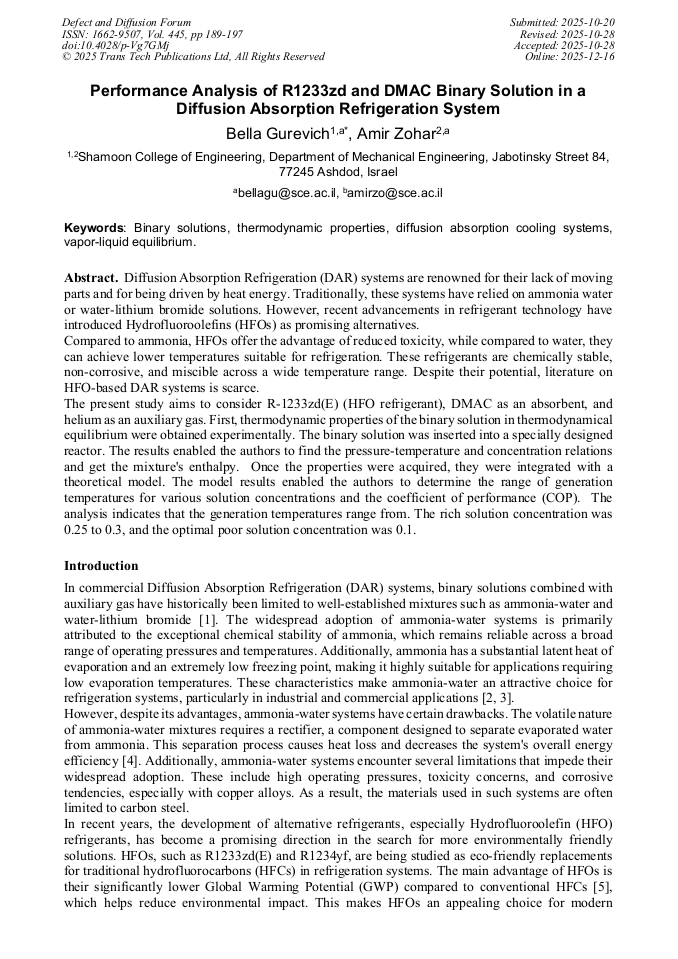
Diffusion Absorption Refrigeration (DAR) systems are renowned for their lack of moving parts and for being driven by heat energy. Traditionally, these systems have relied on ammonia water or water-lithium bromide solutions. However, recent advancements in refrigerant technology have introduced Hydrofluoroolefins (HFOs) as promising alternatives. Compared to ammonia, HFOs offer the advantage of reduced toxicity, while compared to water, they can achieve lower temperatures suitable for refrigeration. These refrigerants are chemically stable, non-corrosive, and miscible across a wide temperature range. Despite their potential, literature on HFO-based DAR systems is scarce.The present study aims to consider R-1233zd(E) (HFO refrigerant), DMAC as an absorbent, and helium as an auxiliary gas. First, thermodynamic properties of the binary solution in thermodynamical equilibrium were obtained experimentally. The binary solution was inserted into a specially designed reactor. The results enabled the authors to find the pressure-temperature and concentration relations and get the mixture's enthalpy. Once the properties were acquired, they were integrated with a theoretical model. The model results enabled the authors to determine the range of generation temperatures for various solution concentrations and the coefficient of performance (COP). The analysis indicates that the generation temperatures range from. The rich solution concentration was 0.25 to 0.3, and the optimal poor solution concentration was 0.1.
Info:
Periodical:
Pages:
189-197
DOI:
Citation:
Online since:
December 2025
Authors:
Price:
Сopyright:
© 2025 Trans Tech Publications Ltd. All Rights Reserved
Share:
Citation: