Laser Surface Texturing of Cylindrical Ejector Pins for Functionalization of Injection Molding Systems: A Preliminary Study

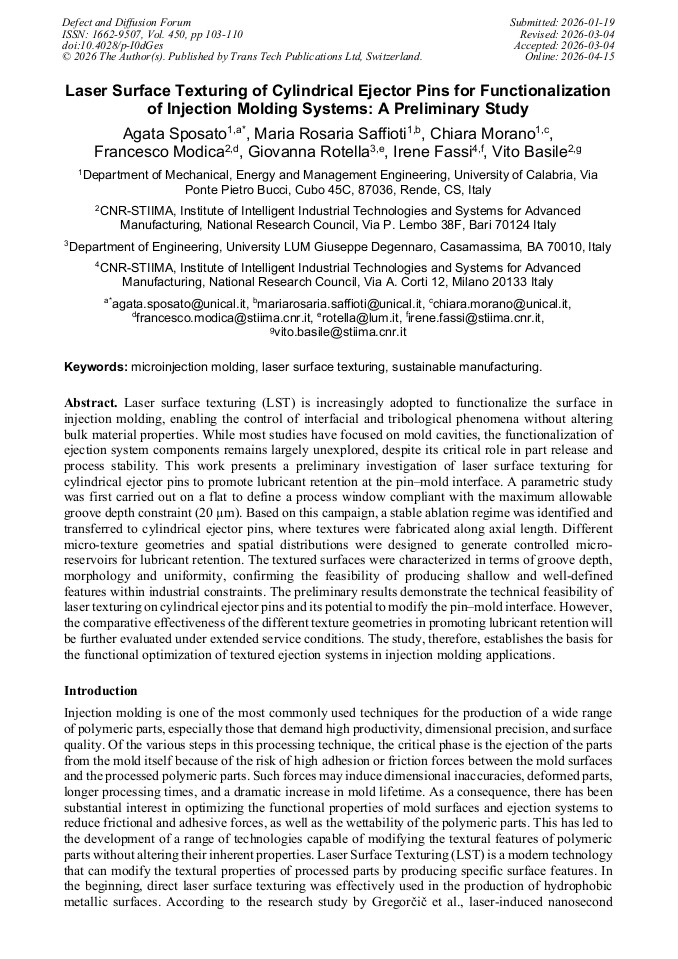
Article Preview

Abstract:

Laser surface texturing (LST) is increasingly adopted to functionalize the surface in injection molding, enabling the control of interfacial and tribological phenomena without altering bulk material properties. While most studies have focused on mold cavities, the functionalization of ejection system components remains largely unexplored, despite its critical role in part release and process stability. This work presents a preliminary investigation of laser surface texturing for cylindrical ejector pins to promote lubricant retention at the pin–mold interface. A parametric study was first carried out on a flat to define a process window compliant with the maximum allowable groove depth constraint (20 µm). Based on this campaign, a stable ablation regime was identified and transferred to cylindrical ejector pins, where textures were fabricated along axial length. Different micro-texture geometries and spatial distributions were designed to generate controlled micro-reservoirs for lubricant retention. The textured surfaces were characterized in terms of groove depth, morphology and uniformity, confirming the feasibility of producing shallow and well-defined features within industrial constraints. The preliminary results demonstrate the technical feasibility of laser texturing on cylindrical ejector pins and its potential to modify the pin–mold interface. However, the comparative effectiveness of the different texture geometries in promoting lubricant retention will be further evaluated under extended service conditions. The study, therefore, establishes the basis for the functional optimization of textured ejection systems in injection molding applications.

You have full access to the following eBook

Info:

* - Corresponding Author

[1] P. Gregorčič, B. Šetina-Batič, M. Hočevar, Controlling the stainless steel surface wettability by nanosecond direct laser texturing at high fluences, Applied Physics A, 2017.

DOI: 10.1007/s00339-017-1392-5

Google Scholar

[2] L. Yang, W. Ma, F. Gao, S. Xi, Effect of Different Laser Groove Texture Collation Frequency on Tribological Properties of 0Cr17Ni7Al Stainless Steel, Materials, 15(13), 4419, 2022.

DOI: 10.3390/ma15134419

Google Scholar

[3] E. R. Moldovan et al., Morphological Analysis of Laser Surface Texturing Effect on AISI 430 Stainless Steel, Materials, 15(13), 4580, 2022.

DOI: 10.3390/ma15134580

Google Scholar

[4] D. Masato, L. Piccolo, G. Lucchetta, M. Sorgato, Texturing Technologies for Plastics Injection Molding: A Review, Micromachines, 13(8), 1211, 2022.

DOI: 10.3390/mi13081211

Google Scholar

[5] L. Orazi, M. Sorgato, L. Piccolo, D. Masato, G. Lucchetta, Generation and Characterization of Laser Induced Periodic Surface Structures on Plastic Injection Molds, International Journal of Advanced Manufacturing Technology, 2020.

DOI: 10.1007/s40516-020-00115-1

Google Scholar

[6] L. Piccolo, M. Sorgato, A. Batal, S. Dimov, G. Lucchetta, D. Masato, Functionalization of Plastic Parts by Replication of Variable Pitch Laser-Induced Periodic Surface Structures, Micromachines, 11(4), 429, 2020.

DOI: 10.3390/mi11040429

Google Scholar

[7] P. Gao et al., Wetting Characteristics of Laser-Ablated Hierarchical Textures Replicated by Micro Injection Molding, Micromachines, 14(4), 863, 2023.

DOI: 10.3390/mi14040863

Google Scholar

[8] M. Sorgato, D. Masato, G. Lucchetta, Effects of machined cavity texture on ejection force in micro injection molding, Precision Engineering, 2017.

DOI: 10.1016/j.precisioneng.2017.06.019

Google Scholar

[9] Y. Kim et al., Investigation of Laser Surface Texturing and Injection Molding Parameters in Advanced High-Strength Steel–Polyamide Direct Joining, Steel Research International, 2024.

DOI: 10.1002/srin.202400686

Google Scholar

[10] Caruso, S., Umbrello, D. "Numerical and experimental validation of gas metal arc welding on AISI 441 ferritic stainless steel through mechanical and microstructural analysis". International Journal of Advanced Manufacturing Technology, 120, 7433-7444, (2022).

DOI: 10.1007/s00170-022-09208-x

Google Scholar

[11] Nie, G., Zhang, K., Outeiro, J., Caruso, S., Umbrello, D., Ding, H., Zhang, X., "Plastic strain threshold determination for white layer formation in hard turning of AISI 52100 steel using micro-grid technique and finite element simulations". Journal of Manufacturing Science and Engineering, Transaction of the ASME, 142(3), 034501 (2019).

DOI: 10.1115/1.4045798

Google Scholar