p.1
p.11
p.23
p.35
p.45
p.55
p.63
p.75
Interfacial Welding of Two Different Reinforced Thermoplastics via TACOMA

Abstract:
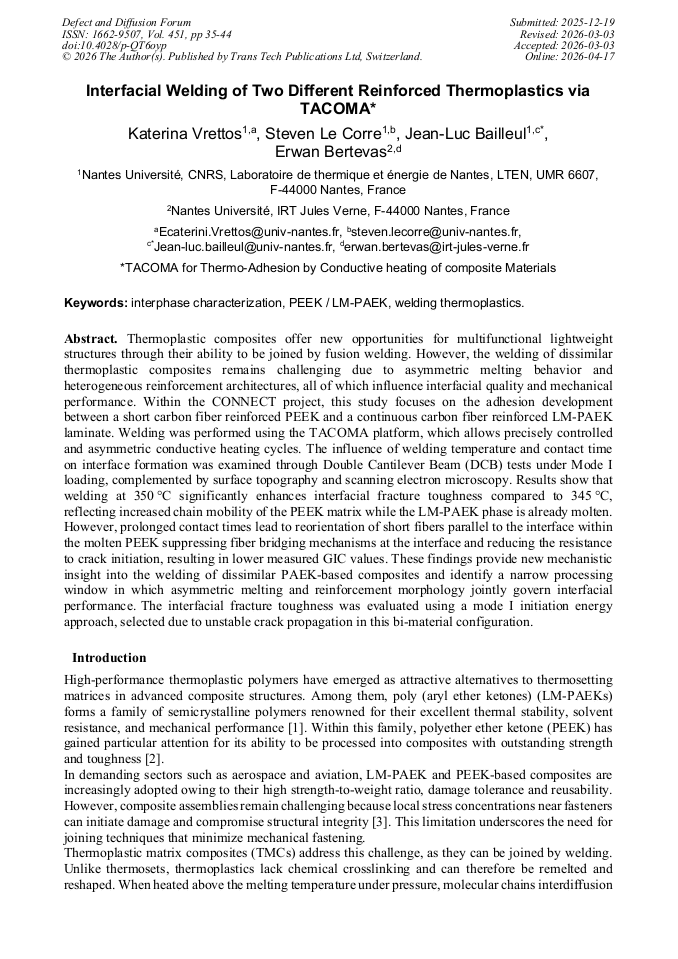
Thermoplastic composites offer new opportunities for multifunctional lightweight structures through their ability to be joined by fusion welding. However, the welding of dissimilar thermoplastic composites remains challenging due to asymmetric melting behavior and heterogeneous reinforcement architectures, all of which influence interfacial quality and mechanical performance. Within the CONNECT project, this study focuses on the adhesion development between a short carbon fiber reinforced PEEK and a continuous carbon fiber reinforced LM-PAEK laminate. Welding was performed using the TACOMA platform, which allows precisely controlled and asymmetric conductive heating cycles. The influence of welding temperature and contact time on interface formation was examined through Double Cantilever Beam (DCB) tests under Mode I loading, complemented by surface topography and scanning electron microscopy. Results show that welding at 350 °C significantly enhances interfacial fracture toughness compared to 345 °C, reflecting increased chain mobility of the PEEK matrix while the LM-PAEK phase is already molten. However, prolonged contact times lead to reorientation of short fibers parallel to the interface within the molten PEEK suppressing fiber bridging mechanisms at the interface and reducing the resistance to crack initiation, resulting in lower measured GIC values. These findings provide new mechanistic insight into the welding of dissimilar PAEK-based composites and identify a narrow processing window in which asymmetric melting and reinforcement morphology jointly govern interfacial performance. The interfacial fracture toughness was evaluated using a mode I initiation energy approach, selected due to unstable crack propagation in this bi-material configuration.
Info:
Periodical:
Pages:
35-44
DOI:
Citation:
Online since:
April 2026
Authors:
Permissions:
Share:
Citation: