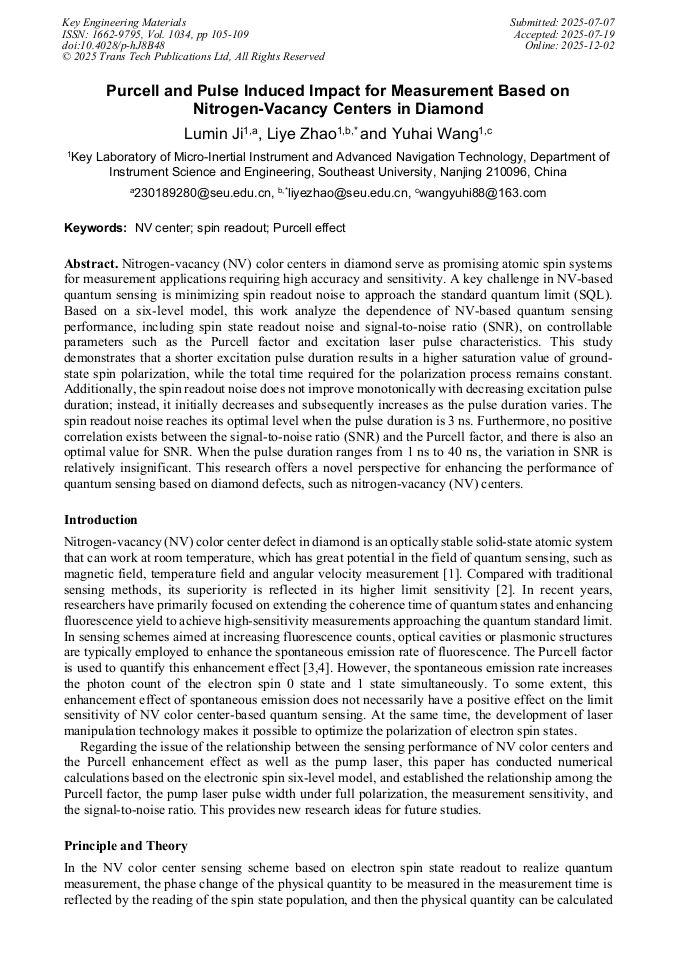
Purcell and Pulse Induced Impact for Measurement Based on Nitrogen-Vacancy Centers in Diamond

Article Preview

Abstract:

Nitrogen-vacancy (NV) color centers in diamond serve as promising atomic spin systems for measurement applications requiring high accuracy and sensitivity. A key challenge in NV-based quantum sensing is minimizing spin readout noise to approach the standard quantum limit (SQL). Based on a six-level model, this work analyze the dependence of NV-based quantum sensing performance, including spin state readout noise and signal-to-noise ratio (SNR), on controllable parameters such as the Purcell factor and excitation laser pulse characteristics. This study demonstrates that a shorter excitation pulse duration results in a higher saturation value of ground-state spin polarization, while the total time required for the polarization process remains constant. Additionally, the spin readout noise does not improve monotonically with decreasing excitation pulse duration; instead, it initially decreases and subsequently increases as the pulse duration varies. The spin readout noise reaches its optimal level when the pulse duration is 3 ns. Furthermore, no positive correlation exists between the signal-to-noise ratio (SNR) and the Purcell factor, and there is also an optimal value for SNR. When the pulse duration ranges from 1 ns to 40 ns, the variation in SNR is relatively insignificant. This research offers a novel perspective for enhancing the performance of quantum sensing based on diamond defects, such as nitrogen-vacancy (NV) centers.
You might also be interested in these eBooks

Info:

Periodical:

Pages:

105-109

Citation:

Online since:

December 2025

Export:

Price:

Permissions CCC:

Permissions PLS:

Сopyright:

© 2025 Trans Tech Publications Ltd. All Rights Reserved

Share:

Citation:

* - Corresponding Author

[1] J.F. Barry et al., "Sensitivity optimization for NV-diamond magnetometry," Rev Mod Phys, vol. 92, no. 1, p.015004, Mar. 2020.

DOI: 10.1103/RevModPhys.92.015004

Google Scholar

[2] C.L. Degen, F. Reinhard, and P. Cappellaro, "Quantum sensing," Rev Mod Phys, vol. 89, no. 3, p.035002, Jul. 2017.

DOI: 10.1103/RevModPhys.89.035002

Google Scholar

[3] A. Skljarow, H. Kübler, C.S. Adams, T. Pfau, R. Löw, and H. Alaeian, "Purcell-enhanced dipolar interactions in nanostructures," Phys Rev Res, vol. 4, no. 2, p.1–12, 2022.

DOI: 10.1103/PhysRevResearch.4.023073

Google Scholar

[4] S. Bogdanov et al., "Electron spin contrast of Purcell-enhanced nitrogen-vacancy ensembles in nanodiamonds," Phys Rev B, vol. 96, no. 3, p.1–7, 2017.

DOI: 10.1103/PhysRevB.96.035146

Google Scholar

[5] D. Hopper, H. Shulevitz, and L. Bassett, "Spin Readout Techniques of the Nitrogen-Vacancy Center in Diamond," Micromachines (Basel), vol. 9, no. 9, p.437, Aug. 2018.

DOI: 10.3390/mi9090437

Google Scholar

[6] M. Steiner, P. Neumann, J. Beck, F. Jelezko, and J. Wrachtrup, "Universal enhancement of the optical readout fidelity of single electron spins at nitrogen-vacancy centers in diamond," Phys Rev B, vol. 81, no. 3, p.035205, Jan. 2010.

DOI: 10.1103/PhysRevB.81.035205

Google Scholar

[7] E.M. PURCELL, "Spontaneous Emission Probabilities," in Briefwechsel, 1994, p.225–227.

DOI: 10.1007/978-1-4899-3805-3_30

Google Scholar

[8] Y. Song et al., "Pulse-width-induced polarization enhancement of optically pumped N-V electron spin in diamond," Photonics Res, vol. 8, no. 8, p.1289, Aug. 2020.

DOI: 10.1364/prj.386983

Google Scholar

[9] L. Robledo, H. Bernien, T. Van Der Sar, and R. Hanson, "Spin dynamics in the optical cycle of single nitrogen-vacancy centres in diamond," New J Phys, vol. 13, 2011.

DOI: 10.1088/1367-2630/13/2/025013

Google Scholar