Effect of Chemical Composition and Heat Treatment on the Mechanical Properties and Electrical Conductivity of Al–Mg–Si Alloys with a Mg/Si Ratio of 1

Article Preview

Abstract:

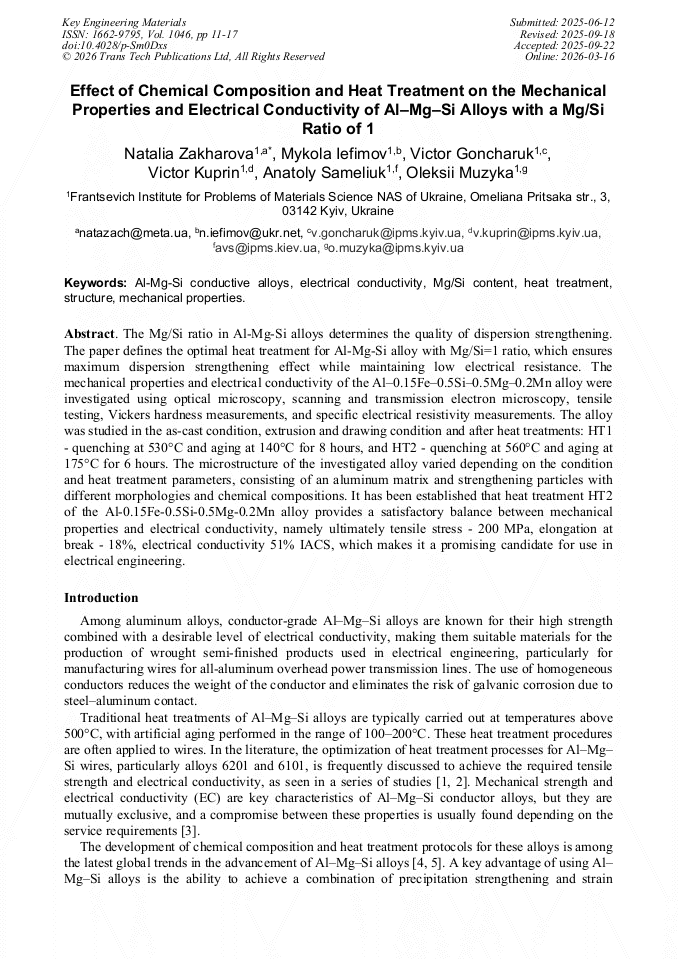
The mechanical properties and electrical conductivity of the Al–0.15Fe–0.5Si–0.5Mg–0.2Mn alloy with a Mg/Si ratio of 1 were investigated using optical microscopy, scanning and transmission electron microscopy, tensile testing, Vickers hardness measurements, and specific electrical resistivity measurements. To analyze the electrical conductivity data, the unit % IACS was used, calculated as a percentage relative to the conductivity of annealed copper. The alloy was studied in the as-cast condition, in the deformed condition (following extrusion and drawing), and after heat treatments: HT1 — solution treatment at 530°C and aging at 140°C for 8 hours, and HT2 - solution treatment at 560°C and aging at 175°C for 6 hours. The microstructure of the investigated alloy varied depending on the condition and heat treatment parameters, consisting of an aluminum matrix and strengthening particles with different morphologies and chemical compositions. For rods in the as-cast state, the conductivity was 55% IACS, ultimate tensile strength (UTS) — 150 MPa, and elongation — 14%. After HT1: 51% IACS, UTS — 140 MPa, elongation — 19%. After HT2: 51% IACS, UTS — 195 MPa, elongation — 19%.
You might also be interested in these eBooks

Info:

Periodical:

Pages:

11-17

Citation:

Online since:

March 2026

Export:

Price:

Permissions CCC:

Permissions PLS:

Сopyright:

© 2026 Trans Tech Publications Ltd. All Rights Reserved

Share:

Citation:

* - Corresponding Author

[1] Z. Martinova, G. Zlateva, Microstructure development during thermomechanical treatment of AlMgSi alloy, J. Min. Metall. Sect. B. 38 (2002) 153-162

DOI: 10.2298/JMMB0204153M

Google Scholar

[2] Z. Martinova, D. Damagaliev, M.Hirsh, The effect of room temperature pre-aging on tensile and electrical properties of thermomechanical treated AlMgSi alloy, J. Min. Metall. Sect. B. 38 (2002) 61-73

DOI: 10.2298/JMMB0202061M

Google Scholar

[3] B. Smyrak, B. Jurkiewicz, M. Zasadzi´nska, M. Gniełczyk, P. Jałowy, The Effect of Al-Mg-Si Wire Rod Heat Treatment on Its Electrical Conductivity and Strength, Metals. 10 (2020) 1027

DOI: 10.3390/met10081027

Google Scholar

[4] C.H. Liu, J. Chen, Y.X. Lai, D.H. Zhu, Y.Gu, J.H. Chen, Enhancing electrical conductivity and strength in Al alloys by modification of conventional thermo-mechanical process, Mater. Des. 87 (2015) 1-5

DOI: 10.1016/j.matdes.2015.07.133

Google Scholar

[5] S.N. Khangholi, M. Javidani, A. Maltais, X. Grant Chen's, Optimization of mechanical properties and electrical conductivity in Al–Mg–Si 6201 alloys with different Mg/Si ratios, J. Mat. Res. 35(2020) 2765-277

DOI: 10.1557/jmr.2020.249

Google Scholar

[6] J. Shengyu, R. Wang, Grain size-dependent Mg/Si ratio effect on the microstructure and mechanical/electrical properties of Al-Mg-Si-Sc alloys, J. Mat. Sci. Tech. 35 ( 2019) 1354-1363

DOI: 10.1016/j.jmst.2019.03.011

Google Scholar

[7] M. Baruah, A.Borah, Processing and Precipitation Strengthening of 6xxx Series Aluminium Alloys, Int. J. Mat. Sci. 1 (2020) 40-48

DOI: 10.22271/27078221.2020.v1.i1a.10

Google Scholar

[8] L. Lodgaard, N. Ryum, Precipitation of Dispersoids Containing Mn and/or Cr in Al–Mg–Si alloys, Mat. Sci. Eng. 283 (2000) 144-152

DOI: 10.1016/S0921-5093(00)00734-6

Google Scholar

[9] C. Liu, Q. Du, N. Parson, W. Poole, The Interaction Between Mn and Fe on the Precipitation of Mn/Fe Dispersoids in Al-Mg-Si-Mn-Fe Alloys, Scr. Mat. 152 (2018) 59-63

DOI: 10.1016/j.scriptamat.2018.04.012

Google Scholar

[10] Niels C. W. Kuijpers, F. Vermolen, C. Vuik, S. Van der Zwaag, A Model of the-AlFeSi to-Al(FeMn)Si Transformation in Al–Mg–Si Alloys, Mat. Trans. 44 (2003) 1448 -1456

DOI: 10.2320/matertrans.44.1448

Google Scholar

[11] C. Liu, Q. Du, N. Parson, W. Poole, The Interaction Between Mn and Fe on the Precipitation of Mn/Fe Dispersoids in Al-Mg-Si-Mn-Fe Alloys, Scr. Mat. 152 (2018) 59-63

DOI: 10.1016/j.scriptamat.2018.04.012

Google Scholar