p.281
p.285
p.289
p.293
p.297
p.301
p.305
p.309
p.313
Numerical Simulation of Quasi-Brittle Fracture in UHPFRC I-Beam as a Linear Complementarity Problem

Abstract:
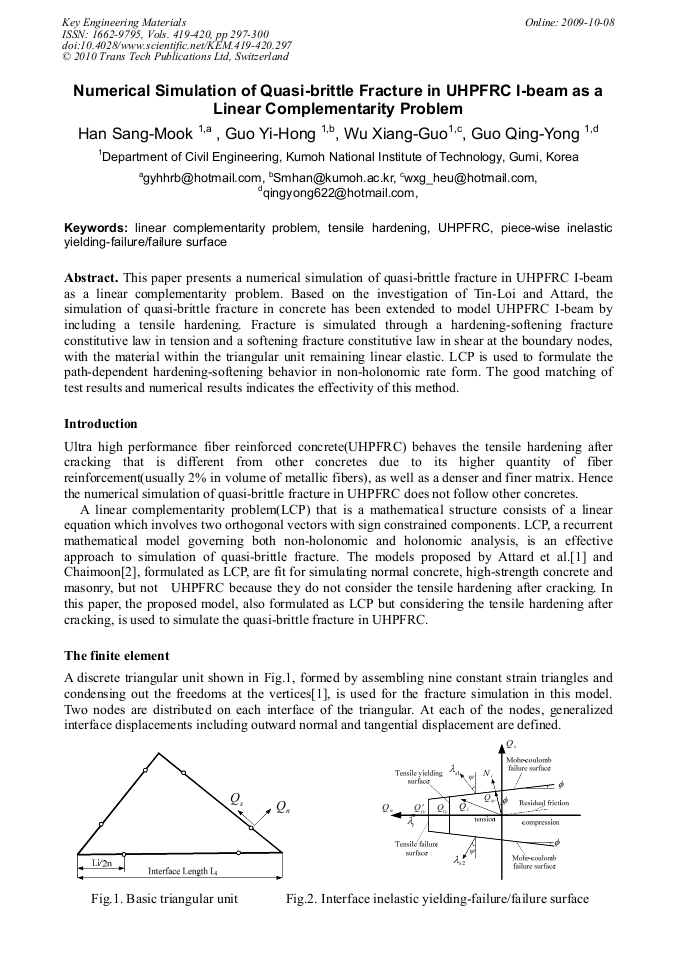
This paper presents a numerical simulation of quasi-brittle fracture in UHPFRC I-beam as a linear complementarity problem. Based on the investigation of Tin-Loi and Attard, the simulation of quasi-brittle fracture in concrete has been extended to model UHPFRC I-beam by including a tensile hardening. Fracture is simulated through a hardening-softening fracture constitutive law in tension and a softening fracture constitutive law in shear at the boundary nodes, with the material within the triangular unit remaining linear elastic. LCP is used to formulate the path-dependent hardening-softening behavior in non-holonomic rate form. The good matching of test results and numerical results indicates the effectivity of this method.
Info:
Periodical:
Pages:
297-300
Citation:
Online since:
October 2009
Authors:
Price:
Сopyright:
© 2010 Trans Tech Publications Ltd. All Rights Reserved
Share:
Citation: