Influence of Interfacial Transition Zone on Local and Overall Fracture Response of Cementitious Composites

Article Preview

Abstract:

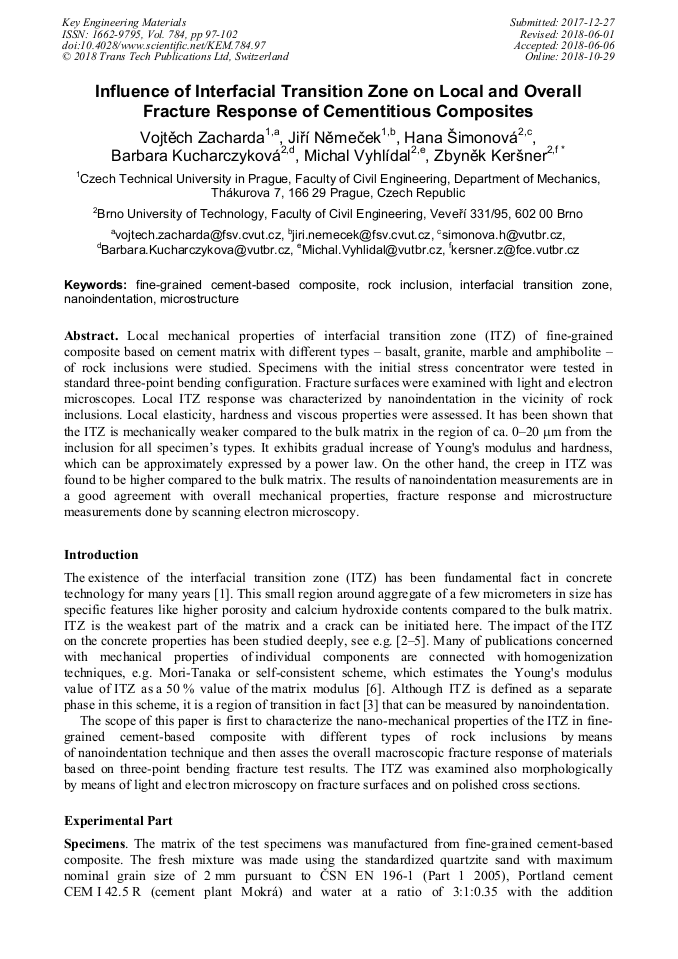
Mechanical fracture properties of interfacial transition zone (ITZ) of fine-grained composite based on cement matrix with different types – basalt, granite, marble and amphibolite – of rock inclusion were studied. Specimens with the initial stress concentrator were tested in standard three-point bending configuration. Fracture surfaces were examined with light and electron microscopes. Local ITZ response was characterized by nanoindentation in the vicinity of rock inclusions. Local elasticity, hardness and viscous properties were assessed. It has been shown that the ITZ is mechanically weaker compared to the bulk matrix in the region of ca. 0–20 μm from the inclusion for all specimen’s types. It exhibits gradual increase of elastic modulus and hardness, which can be approximately expressed by a power law. On the other hand, the creep in ITZ was found to be higher compared to the bulk matrix. The results of nanoindentation measurements are in a good agreement with overall mechanical properties, fracture response and microstructure measurements done by scanning electron microscopy.
You might also be interested in these eBooks

Info:

Periodical:

Pages:

97-102

Citation:

Online since:

October 2018

Export:

Price:

Permissions CCC:

Permissions PLS:

Сopyright:

© 2018 Trans Tech Publications Ltd. All Rights Reserved

Share:

Citation:

* - Corresponding Author

[1] J. Farran, Contribution mineralogique a l'etude de l'adherence entre les constituants hydrates des ciments et les materiaux enrobes, Revue des Materiaux de Construction. 491 (1956) 155–157, 492 (1956) 191–209.

Google Scholar

[2] RILEM 1998. A. Katz, et al. (Eds.) Second International Conference on the Interfacial Transition Zone in Cementitious Composites, E & FN Spon, New York, (1998).

Google Scholar

[3] K. L. Scrivener, A. K. Crumbie, P. Laugesen, The Interfacial Transition Zone (ITZ) between Cement Paste and Aggregate in Concrete, Interface Science. 12 (2004) 411–421.

DOI: 10.1023/b:ints.0000042339.92990.4c

Google Scholar

[4] G. Prokopski, J. Halbiniak, Interfacial transition zone in cementitious materials, Cem Concr Res. 30 (2000) 4, 579–583.

DOI: 10.1016/s0008-8846(00)00210-6

Google Scholar

[5] J. P. Ollivier, J. C. Maso, B. Bourdette, Interfacial Transition Zone in Concrete, Advn Cem Bas Mat. 2 (1995), 30–38.

DOI: 10.1016/1065-7355(95)90037-3

Google Scholar

[6] Z. Hashin, P. J. M. Monteiro, An inverse method to determine the elastic properties of the interphase between the aggregate and the cement paste, Cem Concr Res. 32 (2002) 1291−1300.

DOI: 10.1016/s0008-8846(02)00792-5

Google Scholar

[7] B. L. Karihaloo, Fracture Mechanics and Structural Concrete, Longman Scientific & Technical, New York, (1995).

Google Scholar

[8] W. Oliver, G. Pharr, An Improved Technique for Determining Hardness and Elastic-Modulus using Load and Displacement Sensing Indentation Experiments, J Mater Res. 7 (1992) 1564−1583.

DOI: 10.1557/jmr.1992.1564

Google Scholar