p.27
p.33
p.39
p.47
p.55
p.63
p.69
p.77
p.83
Application of Bi-Modal Milling Process to Fabricate Harmonic Structure Materials

Abstract:
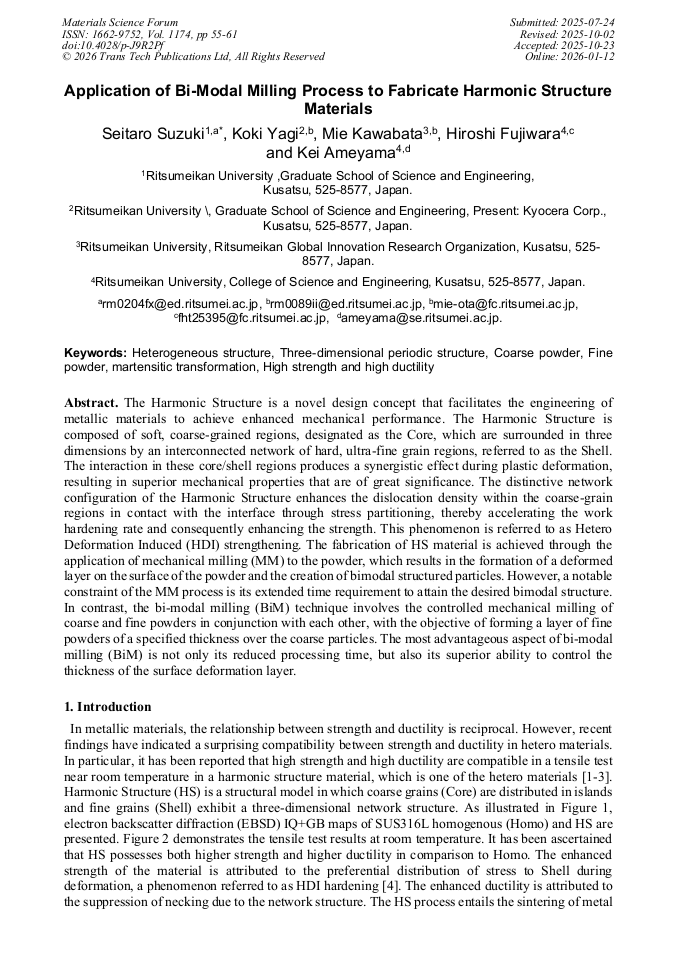
The Harmonic Structure [1] is a novel design concept that facilitates the engineering of metallic materials to achieve enhanced mechanical performance. The Harmonic Structure is composed of soft, coarse-grained regions, designated as the Core, which are surrounded in three dimensions by an interconnected network of hard, ultra-fine grain regions, referred to as the Shell. The interaction in these core/shell regions produces a synergistic effect during plastic deformation, resulting in superior mechanical properties that are of great significance. The distinctive network configuration of the Harmonic Structure enhances the dislocation density within the coarse-grain regions in contact with the interface through stress partitioning, thereby accelerating the work hardening rate and consequently enhancing the strength. This phenomenon is referred to as Hetero Deformation Induced (HDI) strengthening [2]. The fabrication of HS material is achieved through the application of mechanical milling (MM) to the powder, which results in the formation of a deformed layer on the surface of the powder and the creation of bimodal structured particles. However, a notable constraint of the MM process is its extended time requirement to attain the desired bimodal structure. In contrast, the bi-modal milling (BiM) technique involves the controlled mechanical milling of coarse and fine powders in conjunction with each other, with the objective of forming a layer of fine powders of a specified thickness over the coarse particles. The most advantageous aspect of bi-modal milling (BiM) is not only its reduced processing time, but also its superior ability to control the thickness of the surface deformation layer.
Info:
Periodical:
Pages:
55-61
DOI:
Citation:
Online since:
January 2026
Authors:
Price:
Сopyright:
© 2026 Trans Tech Publications Ltd. All Rights Reserved
Share:
Citation: