p.15
p.21
p.27
p.33
p.39
p.47
p.55
p.63
p.69
Finite Element Modeling of Electromagnetic Heating

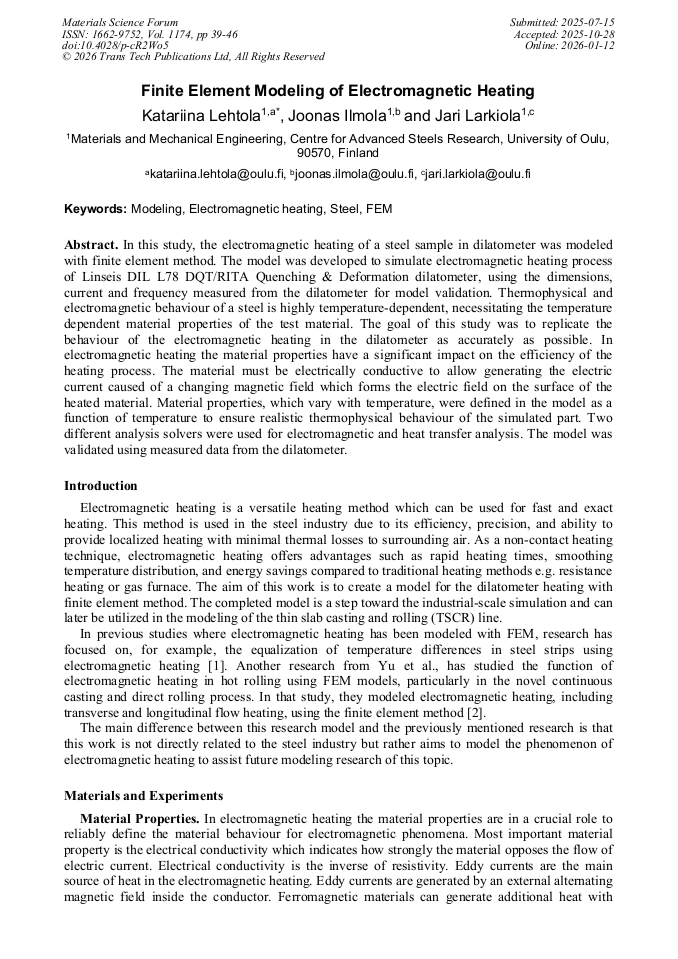
Abstract:
In this study, the electromagnetic heating of a steel sample in dilatometer was modeled with finite element method. The model was developed to simulate electromagnetic heating process of Linseis DIL L78 DQT/RITA Quenching & Deformation dilatometer, using the dimensions, current and frequency measured from the dilatometer for model validation. Thermophysical and electromagnetic behaviour of a steel is highly temperature-dependent, necessitating the temperature dependent material properties of the test material. The goal of this study was to replicate the behaviour of the electromagnetic heating in the dilatometer as accurately as possible. In electromagnetic heating the material properties have a significant impact on the efficiency of the heating process. The material must be electrically conductive to allow generating the electric current caused of a changing magnetic field which forms the electric field on the surface of the heated material. Material properties, which vary with temperature, were defined in the model as a function of temperature to ensure realistic thermophysical behaviour of the simulated part. Two different analysis solvers were used for electromagnetic and heat transfer analysis. The model was validated using measured data from the dilatometer.
Info:
Periodical:
Pages:
39-46
DOI:
Citation:
Online since:
January 2026
Authors:
Keywords:
Price:
Сopyright:
© 2026 Trans Tech Publications Ltd. All Rights Reserved
Share:
Citation: