Creep Rupture Strength and Microstructural Changes due to Creep of Mod.9Cr-1Mo Steel with High Initial Hardness

Article Preview

Abstract:

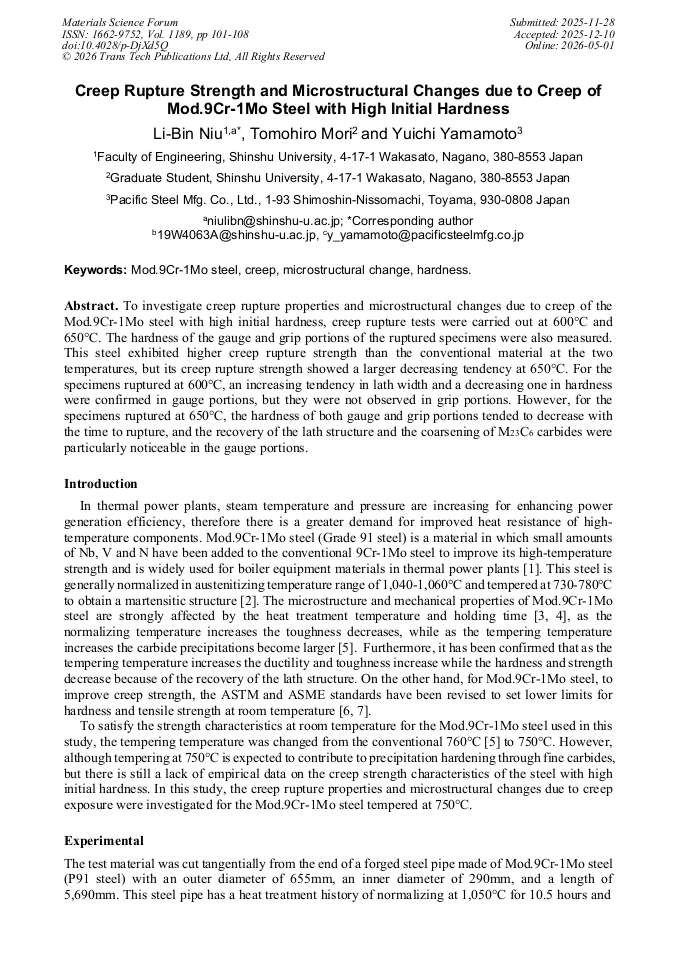
To investigate creep rupture properties and microstructural changes due to creep of the Mod.9Cr-1Mo steel with high initial hardness, creep rupture tests were carried out at 600°C and 650°C. The hardness of the gauge and grip portions of the ruptured specimens were also measured. This steel exhibited higher creep rupture strength than the conventional material at the two temperatures, but its creep rupture strength showed a larger decreasing tendency at 650°C. For the specimens ruptured at 600°C, an increasing tendency in lath width and a decreasing one in hardness were confirmed in gauge portions, but they were not observed in grip portions. However, for the specimens ruptured at 650°C, the hardness of both gauge and grip portions tended to decrease with the time to rupture, and the recovery of the lath structure and the coarsening of M23C6 carbides were particularly noticeable in the gauge portions.

You might also be interested in these eBooks

Info:

Periodical:

Materials Science Forum (Volume 1189)

Pages:

101-108

Citation:

Online since:

May 2026

Export:

Price:

Permissions CCC:

Permissions PLS:

Сopyright:

© 2026 Trans Tech Publications Ltd. All Rights Reserved

Share:

Citation:

* - Corresponding Author

[1] Y. Yamamoto, S. Seo, Modified 9Cr-1Mo Steel for Ultra-high Temperature and Pressure, The Piping Engineering, 38 (1996) 155-160.

Google Scholar

[2] C. Pandey, M. M. Mahapatra, P. Kumar, N. Saini, Some Studies on P91 Steel and Their Weldments, J. Alloys and Compounds, 743 (2018) 332-364.

DOI: 10.1016/j.jallcom.2018.01.120

Google Scholar

[3] C. Pandey, A. Giri, M. M. Mahapatra, Effect of Normalizing Temperature on Microstructural Stability and Mechanical Properties of Creep Strength Enhanced Ferritic P91 Steel, Materials Science & Engineering A, 657 (2016) 173-184.

DOI: 10.1016/j.msea.2016.01.066

Google Scholar

[4] K. Watanabe, S. Ida, K. Yoshimi, Influence of Carbides Precipitated by Low-temperature Tempering on Room-temperature Mechanical Properties of Grade 91 Steel, Tetsu-to-Hagane, 107 (2021) 825-834.

DOI: 10.2355/tetsutohagane.tetsu-2021-033

Google Scholar

[5] Y. Yamamoto, S. Seo, J. Matsumoto, Y. Kadoya, T. Nishimura, R. Magoshi, Production and Properties of Modified 9Cr-1Mo Steel Forging (F91) for Valve Bodies, Tetsu-to-Hagane, 85 (1999) 558-563.

DOI: 10.2355/tetsutohagane1955.85.7_558

Google Scholar

[6] ASTM, Annual Book of ASTM Standards, 2011.

Google Scholar

[7] ASME, Boiler and Pressure Vessel Code, 2013.

Google Scholar

[8] K. Sawada, K. Miyahara, H. Kushima, K. Kimura, S. Matsuoka, Contribution of Microstructural Factors to Hardness Change during Creep Exposure in Mod.9Cr-1Mo Steel, ISIJ Inter., 45 (2005) 1934-1939.

DOI: 10.2355/isijinternational.45.1934

Google Scholar

[9] Y. Kadoya, E.Shimizu, Behaviour of Dislocation Substructures during High Temperature Creep of High-Cr Ferritic Steels, Tetsu-to-Hagane, 86 (2000) 189-195.

DOI: 10.2355/tetsutohagane1955.86.3_189

Google Scholar

[10] K. Sawada, K. Maruyama, R. Komine, Y. Nagae, Microstructural Changes during Creep and Life Assessment of Mod.9Cr-1Mo Steel, Tetsu-to-Hagane, 83 (1997) 466-471.

DOI: 10.2355/tetsutohagane1955.83.7_466

Google Scholar

[11] Y. Kadoya, Y. Hirakawa, H. Yoshida, K. Miyajima, Creep Life Evaluation Based on Hardness Method of High-Cr Ferritic Steels, Tetsu-to-Hagane, 92 (2006) 97-104.

DOI: 10.2355/tetsutohagane1955.92.2_97

Google Scholar

[12] G. Tian, B. Mao, Y. Xu, L. Fu, Z. Zhang, Y. Wang, A. Shan, Investigation on gradual degradation of mechanical property and microstructure in 9% Cr heat-resistant steels via interrupted creep test, J. Mater. Sci., 58 (2023) 4637-4656.

DOI: 10.1007/s10853-023-08296-8

Google Scholar