p.3
p.9
p.15
p.23
p.29
p.43
p.53
p.75
Mechanical Properties of Cast ABS Composites Reinforced with Polymer-Derived SiCNO Ceramic Powder

Abstract:
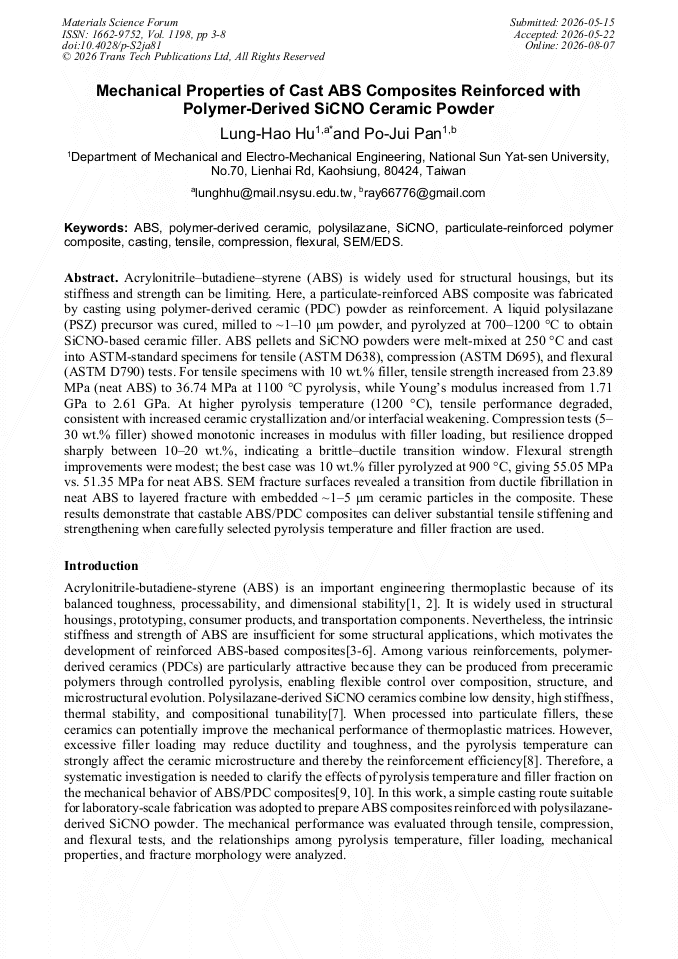
Acrylonitrile–butadiene–styrene (ABS) is widely used for structural housings, but its stiffness and strength can be limiting. Here, a particulate-reinforced ABS composite was fabricated by casting using polymer-derived ceramic (PDC) powder as reinforcement. A liquid polysilazane (PSZ) precursor was cured, milled to ~1–10 μm powder, and pyrolyzed at 700–1200 °C to obtain SiCNO-based ceramic filler. ABS pellets and SiCNO powders were melt-mixed at 250 °C and cast into ASTM-standard specimens for tensile (ASTM D638), compression (ASTM D695), and flexural (ASTM D790) tests. For tensile specimens with 10 wt.% filler, tensile strength increased from 23.89 MPa (neat ABS) to 36.74 MPa at 1100 °C pyrolysis, while Young’s modulus increased from 1.71 GPa to 2.61 GPa. At higher pyrolysis temperature (1200 °C), tensile performance degraded, consistent with increased ceramic crystallization and/or interfacial weakening. Compression tests (5–30 wt.% filler) showed monotonic increases in modulus with filler loading, but resilience dropped sharply between 10–20 wt.%, indicating a brittle–ductile transition window. Flexural strength improvements were modest; the best case was 10 wt.% filler pyrolyzed at 900 °C, giving 55.05 MPa vs. 51.35 MPa for neat ABS. SEM fracture surfaces revealed a transition from ductile fibrillation in neat ABS to layered fracture with embedded ~1–5 μm ceramic particles in the composite. These results demonstrate that castable ABS/PDC composites can deliver substantial tensile stiffening and strengthening when carefully selected pyrolysis temperature and filler fraction are used.
Info:
Periodical:
Pages:
3-8
DOI:
Citation:
Online since:
August 2026
Authors:
Price:
Permissions CCC:
Permissions PLS:
Сopyright:
© 2026 Trans Tech Publications Ltd. All Rights Reserved
Share:
Citation: