Effect of Equal Channel Angular Pressing on Different Face Center Cubic (FCC) Metals

Article Preview

Abstract:

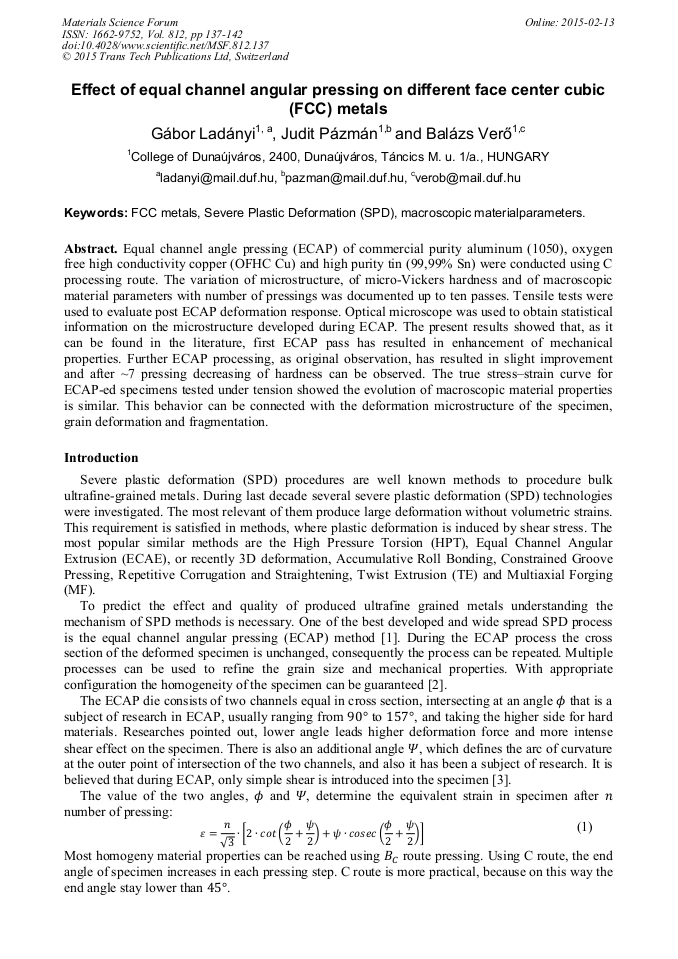
Equal channel angle pressing (ECAP) of commercial purity aluminum (1050), oxygen free high conductivity copper (OFHC Cu) and high purity tin (99,99% Sn) were conducted using C processing route. The variation of microstructure, of micro-Vickers hardness and of macroscopic material parameters with number of pressings was documented up to ten passes. Tensile tests were used to evaluate post ECAP deformation response. Optical microscope was used to obtain statistical information on the microstructure developed during ECAP. The present results showed that, as it can be found in the literature, first ECAP pass has resulted in enhancement of mechanical properties. Further ECAP processing, as original observation, has resulted in slight improvement and after ~7 pressing decreasing of hardness can be observed. The true stress–strain curve for ECAP-ed specimens tested under tension showed the evolution of macroscopic material properties is similar. This behavior can be connected with the deformation microstructure of the specimen, grain deformation and fragmentation.
You might also be interested in these eBooks

Info:

Periodical:

Pages:

137-142

Citation:

Online since:

February 2015

Export:

Price:

Permissions CCC:

Permissions PLS:

Сopyright:

© 2015 Trans Tech Publications Ltd. All Rights Reserved

Share:

Citation:

[1] R. Z. Valiev, T. G. Langdon, Principles of equal-channel amgular pressing as a processing tool for grain refinement, Progress in Materials Science 51 (2006) 881-981.

DOI: 10.1016/j.pmatsci.2006.02.003

Google Scholar

[2] P. Sun, P. Kao, C. Chang, Effect of deformation route on microstructural development in aluminum processed by equal channel angular extrusion. Metall. Trans. A 35 (2004) 1359–1368.

DOI: 10.1007/s11661-004-0311-5

Google Scholar

[3] M.A. Meyers, A. Mishra, D.J. Benson, Mechanical properties of nanocrystalline materials, Progress in Materials Science 51 (2006) 427–556.

DOI: 10.1016/j.pmatsci.2005.08.003

Google Scholar

[4] T. Csanádi, N. Q. Chinh, J. Gubicza, T. G. Langdon, Plastic behavior of fcc metals over a wide range of strain: Macroscopic and microscopic descriptions and their relationship, Acta Materialia 59 (2011) 2385-2391.

DOI: 10.1016/j.actamat.2010.12.034

Google Scholar

[5] E.A. El-Danaf, M.S. Soliman, A.A. Almajid, M.M. El-Rayes, Enhancement of mechanical properties and grain size refinement of commercial purity aluminum 1050 processed by ECAP, Materials Science and Engineering A 458 (2007) 226–234.

DOI: 10.1016/j.msea.2006.12.077

Google Scholar

[6] Mahmoud S. S, Ehab A., El-Danafa A., Abdulhakim A., Effect of Equal-Channel Angular Pressing Process on Properties of 1050 Al Alloy, Materials and Manufacturing Processes Vol. 27, Issue 7, (2011) 746-750.

DOI: 10.1080/10426914.2012.663150

Google Scholar