p.114
p.120
p.127
p.133
p.140
p.147
p.153
p.160
p.166
Thermal Stability and Mechanical Characteristics of Densified Ti3AlC2-Based Material

Abstract:
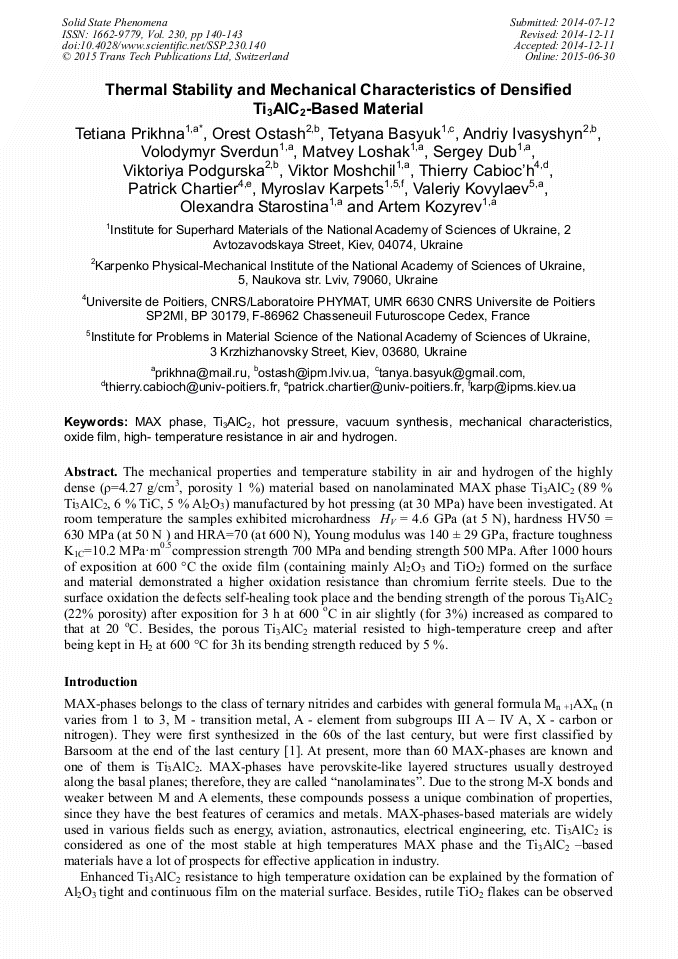
The mechanical properties and temperature stability in air and hydrogen of the highly dense (ρ=4.27 g/cm3, porosity 1 %) material based on nanolaminated MAX phase Ti3AlC2 (89 % Ti3AlC2, 6 % TiC, 5 % Al2O3) manufactured by hot pressing (at 30 MPa) have been investigated. At room temperature the samples exhibited microhardness HV = 4.6 GPa (at 5 N), hardness HV50 = 630 MPa (at 50 N ) and HRA=70 (at 600 N), Young modulus was 140 ± 29 GPa, fracture toughness K1C=10.2 MPa·m0.5compression strength 700 MPa and bending strength 500 MPa. After 1000 hours of exposition at 600 °C the oxide film (containing mainly Al2O3 and TiO2) formed on the surface and material demonstrated a higher oxidation resistance than chromium ferrite steels. Due to the surface oxidation the defects self-healing took place and the bending strength of the porous Ti3AlC2 (22% porosity) after exposition for 3 h at 600 oC in air slightly (for 3%) increased as compared to that at 20 oC. Besides, the porous Ti3AlC2 material resisted to high-temperature creep and after being kept in H2 at 600 °C for 3h its bending strength reduced by 5 %.
Info:
Periodical:
Pages:
140-143
DOI:
Citation:
Online since:
June 2015
Price:
Сopyright:
© 2015 Trans Tech Publications Ltd. All Rights Reserved
Share:
Citation: