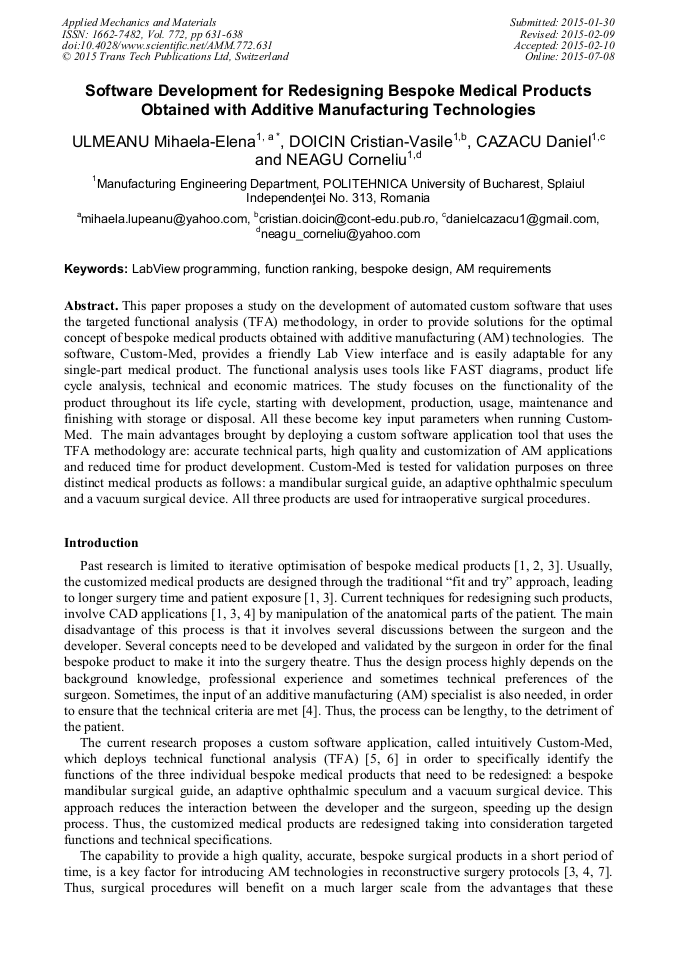
Software Development for Redesigning Bespoke Medical Products Obtained with Additive Manufacturing Technologies

Article Preview

Abstract:

This paper proposes a study on the development of automated custom software that uses the targeted functional analysis (TFA) methodology, in order to provide solutions for the optimal concept of bespoke medical products obtained with additive manufacturing (AM) technologies. The software, Custom-Med, provides a friendly Lab View interface and is easily adaptable for any single part medical product. The functional analysis uses tools like FAST diagrams, product life cycle analysis, technical and economic matrices. The study focuses on the functionality of the product throughout its life cycle, starting with development, production, usage, maintenance and finishing with storage or disposal. These become key input parameters when running Custom-Med. The main advantages brought by deploying a custom software application tool that uses the TFA methodology are: accurate technical parts, high quality, and customization for AM applications and reduced time for product development. Custom-Med is tested for validation purposes on three distinct medical products which are: a mandibular surgical guide, an adaptive ophthalmic speculum and vacuum surgical device. All three products are used for intraoperative surgical procedures.
You might also be interested in these eBooks

Info:

Periodical:

Pages:

631-638

Citation:

Online since:

July 2015

Export:

Price:

Permissions CCC:

Permissions PLS:

Сopyright:

© 2015 Trans Tech Publications Ltd. All Rights Reserved

Share:

Citation:

* - Corresponding Author

[1] L. Ciocca, M. Fantini, Computer-aided design and manufacturing construction of a surgical template for craniofacial implant positioning to support a definitive nasal prosthesis, Clinical Oral Implants Research, John Wiley & Sons A/S Publishing (2010).

DOI: 10.1111/j.1600-0501.2010.02066.x

Google Scholar

[2] K. Ulrich, S. Eppinger, Product Design and Development, 4th Edition McGraw Hill Publishing Company Ltd. (2009).

Google Scholar

[3] G.H. Snyder, M. Cotteleer, B. Kotek, 3D Opportunity in medical technology: Additive manufacturing comes to life, Deloitte University Press (2014).

Google Scholar

[4] T. Wohlers, Wohlers Report 2013: Additive Manufacturing State of the Industry Annual Worldwide Progress Report, Wohlers Associates, Inc., Colorado, USA (2013).

Google Scholar

[5] V.A. Lentz, B. Lerner, Functional Analysis for Existing Products: a Detailed Procedure, Connecticut, USA (2005).

Google Scholar

[6] J. D. Bolton, D. J. Gerhardt, Value Methodology: A Pocket Guide to Reduce Cost and Improve Value Through Function Analysis, L.D. Miles Value Foundation (2009).

Google Scholar

[7] M.E. Lupeanu, A.E.W. Rennie, C. Neagu, Additive Manufacturing Technologies and Functional Analysis used in Product Development Optimization, Proceedings of the 12th Rapid Design, Prototyping & Manufacturing Conference, UK, ISBN 978-0-9566643-1-0, pp.105-112 (2011).

Google Scholar

[8] M.E. Lupeanu, H. Brooks, A.E.W. Rennie, D. Hill, Research on deploying technical functional analysis for additive manufacturing of a surgical device for intravitreal interventions, UPB Scientific Bulletin, Series D –Mechanical Engineering, ISSN 1454 2358, Series D, Vol. 75, Iss. 1, pp.141-160 (2013).

Google Scholar

[9] O. Bretscher, Linear Algebra with Applications, 3rd Ed., Upper Saddle River NJ: Prentice Hall (1995).

Google Scholar

[10] J. Wolberg, Data Analysis Using the Method of Least Squares: Extracting the Most Information from Experiments, Springer (2005).

Google Scholar