Performance Evaluation of a Wood-Polymer Composite Extruder

Article Preview

Abstract:

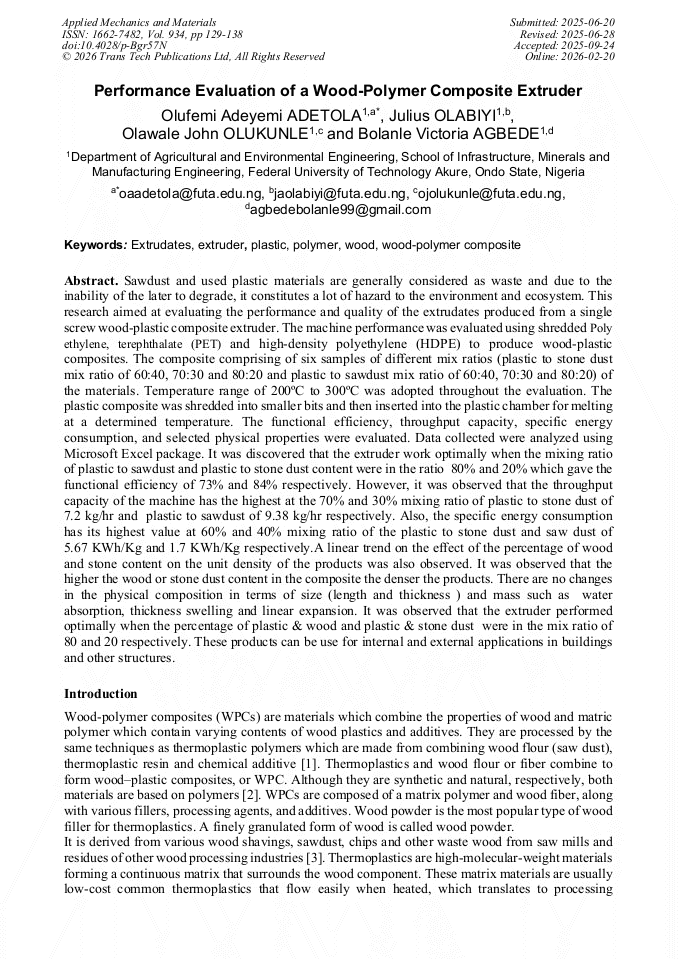
Sawdust and used plastic materials are generally considered as waste and due to the inability of the later to degrade, it constitutes a lot of hazard to the environment and ecosystem. This research aimed at evaluating the performance and quality of the extrudates produced from a single screw wood-plastic composite extruder. The machine performance was evaluated using shredded Poly ethylene, terephthalate (PET) and high-density polyethylene (HDPE) to produce wood-plastic composites. The composite comprising of six samples of different mix ratios (plastic to stone dust mix ratio of 60:40, 70:30 and 80:20 and plastic to sawdust mix ratio of 60:40, 70:30 and 80:20) of the materials. Temperature range of 200°C to 300°C was adopted throughout the evaluation. The plastic composite was shredded into smaller bits and then inserted into the plastic chamber for melting at a determined temperature. The functional efficiency, throughput capacity, specific energy consumption, and selected physical properties were evaluated. Data collected were analyzed using Microsoft Excel package. It was discovered that the extruder work optimally when the mixing ratio of plastic to sawdust and plastic to stone dust content were in the ratio 80% and 20% which gave the functional efficiency of 73% and 84% respectively. However, it was observed that the throughput capacity of the machine has the highest at the 70% and 30% mixing ratio of plastic to stone dust of 7.2 kg/hr and plastic to sawdust of 9.38 kg/hr respectively. Also, the specific energy consumption has its highest value at 60% and 40% mixing ratio of the plastic to stone dust and saw dust of 5.67 KWh/Kg and 1.7 KWh/Kg respectively. A linear trend on the effect of the percentage of wood and stone content on the unit density of the products was also observed. It was observed that the higher the wood or stone dust content in the composite the denser the products. There are no changes in the physical composition in terms of size (length and thickness ) and mass such as water absorption, thickness swelling and linear expansion. It was observed that the extruder performed optimally when the percentage of plastic & wood and plastic & stone dust were in the mix ratio of 80 and 20 respectively. These products can be use for internal and external applications in buildings and other structures.

You might also be interested in these eBooks

Info:

Periodical:

Pages:

129-138

Citation:

Online since:

February 2026

Export:

Price:

Permissions CCC:

Permissions PLS:

Сopyright:

© 2026 Trans Tech Publications Ltd. All Rights Reserved

Share:

Citation:

* - Corresponding Author

[1] C. Clemons, Wood-Plastic Composites in the United States: the Interfacing of Two Industries. For. Prod. J. 52 (2002) 10–18.

Google Scholar

[2] W. Krzysztof, B. Kamila, J. W. Krzysztof, L. Adrian, N. Andrzej, Computer Modeling for Single-Screw Extrusion of Wood–Plastic Composites. Polym.10:3 (2018) 295.

Google Scholar

[3] A. Anil, S. V. Ali, Wood Reinforced Polymer Composites Wood in Civil Engineering Intech-open, (2017) 149-170.

Google Scholar

[4] N. K. Oksman, M. Sain, Wood-Polymer Composites; Woodhead Publishing Ltd.: Cambridge, UK, 2008.

Google Scholar

[5] A. Nuryawan, N. O. Hutauruk, E. Y. S. Purba, N. Masruchin, R. Batubara, I. Risnasari, F. K. Sartio, K. Rahmawaty, M. Basyuni, D. Mckay, Properties of wood composite plastics made from predominant Low Density Polyethylene (LDPE) plastics and their degradability in nature. Plus One, 15 (2020) 8-15

DOI: 10.1371/journal.pone.0236406

Google Scholar

[6] S. Kristoffer, Characteristics of Wood Plastic Composites based on Modified Wood-Moisture Properties, Biological Resistance and Micromorphology, (2012).

Google Scholar

[7] M. Hietala, Extrusion Processing of Wood based Bio-composites, (2013).

Google Scholar

[8] W. A. Akinfiresoye, O. J. Olukunle, A. A. Akintade, Development of a Wood Plastic Composite Extruder Int. J. Waste Resour. 7 (2018) 295.

DOI: 10.4172/2252-5211.1000295

Google Scholar

[9] C. C. Ugoamadi, O. K. Ihesiulor, Optimization of the Development of a Plastic Recycling Machine. Nig. J. Tech. 30:3 (2011) 67-81.

Google Scholar

[10] W. A. Akinfiresoye, O. J. Olukunle, A. A. Akintade, Development of a Wood Plastic Composite Extruder Int. J. of Waste Resour. 7(2017), 195-201.

DOI: 10.4172/2252-5211.1000295

Google Scholar

[11] K. O. Oladejo, T. E. Omoniyi, Dimensional Stability and Mechanical Properties of Wood Plastic Composites Produced from Sawdust of Anogeissus leiocarpus (Ayin) with Recycled Polyethylene Teraphthalate (PET) Chips. Eur. J. of Appl. Eng. and Sci. Res., 5:1 (2017) 28-33.

Google Scholar

[12] S. Glass, S. Zelinka, Moisture relations and physical properties of wood. Chapter 4 in FPL-GTR-282, (2021) 4-1.

Google Scholar

[13] J. E. Winandy, N. M. Stark, C. M. Clemons, Consideration in Recycling Of Wood-Plastic Composites, 5th Global Wood and Natural Fiber Composites Symposium. Kassel – Germany, 2004.

Google Scholar

[14] AWC, National design specification for wood construction with commentary, 2018 edition. ANSI/AWC NDS-2018. Leesburg, VA: American Wood Council, (2018) 297

Google Scholar

[15] M. Fredriksson, E. E. Thybring, 2018. Scanning or desorption isotherms? Characterising sorption hysteresis of wood. Cellulose. 25:8 (2018) 4477–4485.

DOI: 10.1007/s10570-018-1898-9

Google Scholar