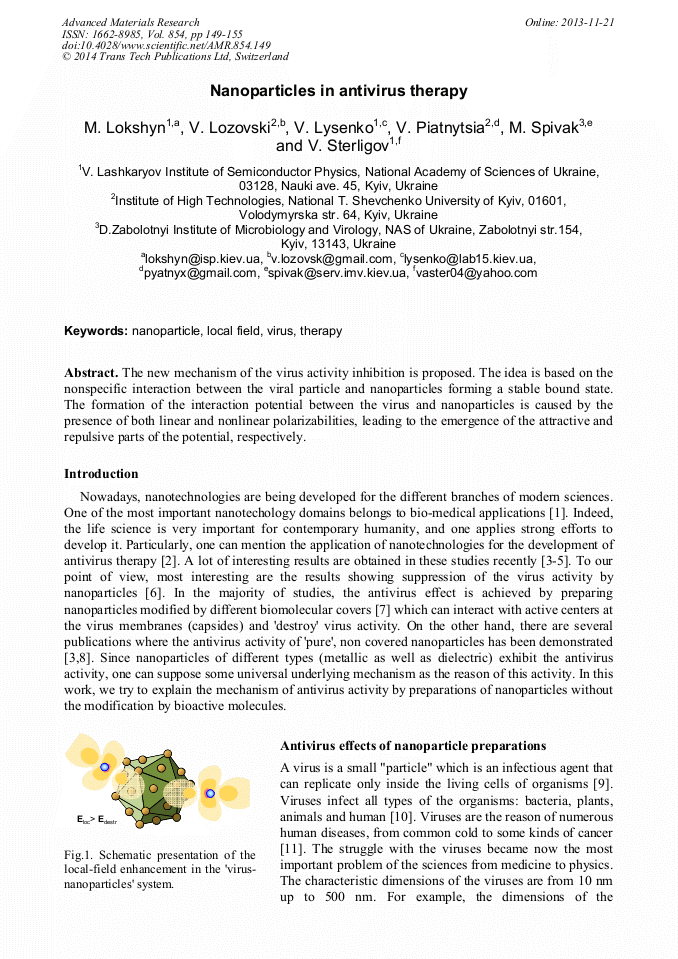
[1]
V. Labhasetwar, D.L. Leslie-Pelecky (Eds. ), Biomedical applications of nanotechnology, Willey, Haboken NJ, (2007).
Google Scholar
[2]
T. Mamo, E.A. Moseman, N. Kolishetti, C. Salvador-Morales, Jinjun Shi, D.R. Kuritzkes, R. Langer, U. von Andrian, and O.C. Farokhzad, Emerging nanotechnology approaches for HIV/AIDS treatment and prevention, Nanomedicine 5 (2010) 269-285.
DOI: 10.2217/nnm.10.1
Google Scholar
[3]
N.A. Mazurkova, Y.E. Spitsyna, N.V. Shikina, Z.R. Ismagilov, S.N. Zagrebel'nyi and E.I. Ryabchikova, Interaction of titanium dioxide nanoparticles with influenza virus, Nanotechnologies in Russia 5 (2010) 417–420.
DOI: 10.1134/s1995078010050174
Google Scholar
[4]
S. Wang, M. Tan, Z. Zhong, M. Chen, and Y. Wang, Nanotechnologies for Curcumin: An Ancient Puzzler Meets Modern Solutions, J. Nanomaterials 2011 (2011) 723178.
DOI: 10.1155/2011/723178
Google Scholar
[5]
A. Salvador, M. Igartua, R.M. Hernández, and J.L. Pedraz, An overview on the field of micro- and nanotechnologies for synthetic peptide-based vaccines, J. of Drug Delivery 2011 (2011), 181646.
DOI: 10.1155/2011/181646
Google Scholar
[6]
J.L. Speshock, R.C. Murdock, L.K. Braydich-Stolle, A.M. Schrand, S.M. Hussain, Interaction of silver nanoparticles with Tacaribe virus, J. Nanobiotechnol. 8 (2010) 19.
DOI: 10.1186/1477-3155-8-19
Google Scholar
[7]
S. Galdiero, A. Falanga, M. Vitiello, M. Cantisani, V. Marra and M. Galdiero, Silver nanoparticles as potential antiviral agents, Molecules 16 (2011) 8894-8918.
DOI: 10.3390/molecules16108894
Google Scholar
[8]
V. Lozovski, V. Lysenko, V. Piatnytsia, O. Scherbakov, N. Zholobak, M. Spivak, Physical point of view for antiviral effect caused by the interaction between the viruses and nanoparticles, J. Bionanoscience 6 (2012) 109–112.
DOI: 10.1166/jbns.2012.1084
Google Scholar
[9]
D.H. Crowford, Viruses: a very short introduction, Oxford University Press, Oxford, (2011).
Google Scholar
[10]
E.V. Koonin, T.G. Senkevich, V.V. Dolja, The ancient virus world and evolution of cells, Biol. Direct. 1 (2006) 29.
Google Scholar
[11]
C. Carrillo-Infante, G. Abbadessa, L. Bagella, A. Giordano, Viral infections as a cause of cancer (review), Int. J Oncol. 30 (2007) 1521-1528.
DOI: 10.3892/ijo.30.6.1521
Google Scholar
[12]
O. Keller, Local fields in the electrodynamics of mesoscopic media, Phys. Rep. 268 (1996) 85–262.
Google Scholar
[13]
C. Girard, C. Joachim and S. Gauthier, The physics of the near-field, Rep. Progr. Phys. 63 (2000) 893-938.
DOI: 10.1088/0034-4885/63/6/202
Google Scholar
[14]
K. -H. Dostert, M. Álvarez, K. Koynov, A. del Campo, H. -J. Butt, and M. Kreiter, Near field guided chemical nanopattering, Langmuir 28 (2012) 3699–3703.
DOI: 10.1021/la300009a
Google Scholar
[15]
M. Xiao, S. Bozhevolnyi and O. Keller, Numerical study of configurational resonances in optical microscopy with mesoscopic metallic probe, Applied Phys. A 62 (1996) 115-121.
DOI: 10.1007/bf01575709
Google Scholar
[16]
G. Pellegrini, V. Bello, G. Mattei and P. Mazzoldi, Local-field enhancement and plasmon tuning in bimetallic nanoplanets, Optics Express 15 (2007) 10097-10102.
DOI: 10.1364/oe.15.010097
Google Scholar
[17]
Y.L. Gang, L. Liu, J. Kim, Y.X. Mejia and L.P. Lee, Nanophotonic crescent moon structures with sharp edge for ultrasensitive biomolecular detections by local electromagnetic field enhancement effect, Nano Lett. 5 (2005) 119-124.
DOI: 10.1021/nl048232+
Google Scholar
[18]
V. Lozovski and V. Piatnytsia, The potential of the interaction between of two nonpoint nanoparticles, J. Comput. Theor. Nanosci. 10 (2013) 1–11.
DOI: 10.1166/jctn.2013.3200
Google Scholar
[19]
B.J. Marquis, Z. Liu, K.L. Braun and C.L. Haynes, Investigation of noble metal nanoparticle ζ-potential effects on single-cell exocytosis function in vitro with carbon-fiber microelectrode amperometry, Analyst 136 (2011) 3478-3486.
DOI: 10.1039/c0an00785d
Google Scholar
[20]
B.J. Kirby, E.F. Hasselbrink, Electrophoresis, in: Practice, Electrophoresis, Zeta potential of microfluidic substrates: 1. Theory, experimental techniques, and effects on separations vol. 25, Wiley-VCH Verlag GmbH & Co. KGaA, Weinheim, 2004, pp.187-202.
DOI: 10.1002/elps.200305754
Google Scholar
[21]
Y. Kim, R.C. Jonson, J. Li, J.T. Hupp, and G.C. Schatz, Synthesis, linear extinction, and preliminary resonant, hyuper-Raylength scattering studies of gold-core/silver-shell nanoparticles: comparisons of theory and experiment, Chem. Phys. Lett. 352 (2002).
DOI: 10.1016/s0009-2614(01)01506-8
Google Scholar
[22]
P.K. Jain, K.S. Lee, I.H. El-Sayed, and M.A. El-Sayed, Calculated absorption and scattering properties of gold nanoparticles of different size, shape and composition: applications in biological imaging and biomedicine, J. Phys. Chem. B 110 (2006).
DOI: 10.1021/jp057170o
Google Scholar
[23]
V. Lozovski, The effective susceptibility concept in the electrodynamics of nano-systems, J. Computat. Theor. Nanosci. 7 (2010 ) 2077-(2093).
Google Scholar
[24]
Yu. Barash, Van der Vaals forces, Nauka, Moskow, (1988).
Google Scholar
[25]
J. Zhu, S.K. Özdemir, L. He, D. -R. Chen, and L. Yang, Single virus and nanoparticle size spectrometry by whispering-gallery-mode microcavities, Opt. Express 19 (2011) 16195-16206.
DOI: 10.1364/oe.19.016195
Google Scholar