Assessing Outdoor Microclimate through On-Site Data and Simulation: The Case Study of Sistelo, Portugal

Article Preview

Abstract:

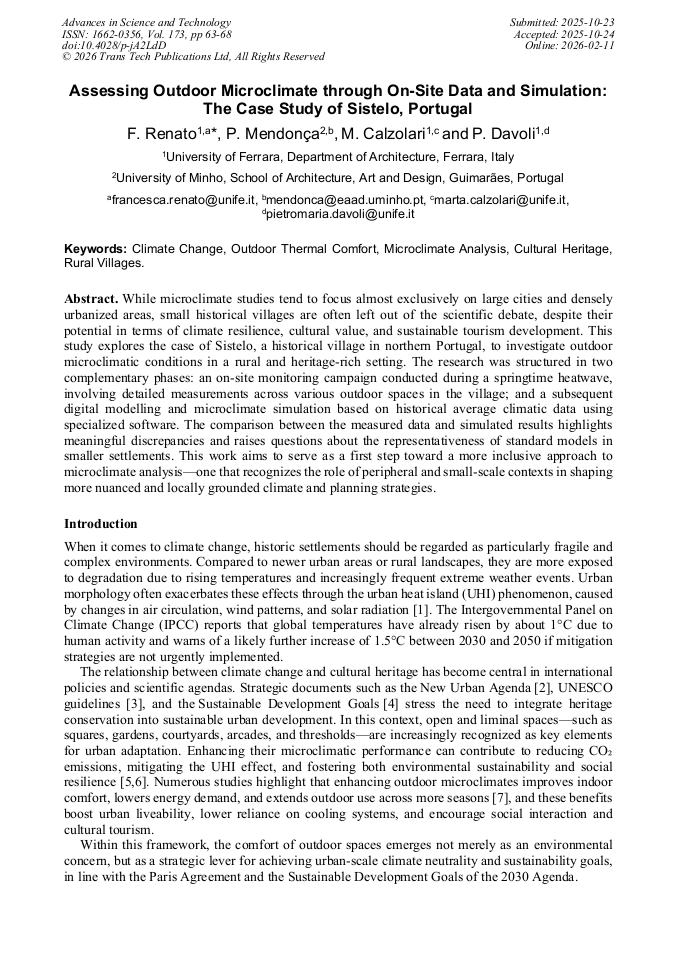
While microclimate studies tend to focus almost exclusively on large cities and densely urbanized areas, small historical villages are often left out of the scientific debate, despite their potential in terms of climate resilience, cultural value, and sustainable tourism development. This study explores the case of Sistelo, a historical village in northern Portugal, to investigate outdoor microclimatic conditions in a rural and heritage-rich setting. The research was structured in two complementary phases: an on-site monitoring campaign conducted during a springtime heatwave, involving detailed measurements across various outdoor spaces in the village; and a subsequent digital modelling and microclimate simulation based on historical average climatic data using specialized software. The comparison between the measured data and simulated results highlights meaningful discrepancies and raises questions about the representativeness of standard models in smaller settlements. This work aims to serve as a first step toward a more inclusive approach to microclimate analysis—one that recognizes the role of peripheral and small-scale contexts in shaping more nuanced and locally grounded climate and planning strategies.

You might also be interested in these eBooks

Info:

Periodical:

Pages:

63-68

Citation:

Online since:

February 2026

Export:

Price:

Permissions CCC:

Permissions PLS:

Сopyright:

© 2026 Trans Tech Publications Ltd. All Rights Reserved

Share:

Citation:

* - Corresponding Author

[1] B. Givoni, Climate Considerations in Building and Urban Design, Van Nostrand Reinhold, New York, NY, USA (1998).

Google Scholar

[2] United Nations, New Urban Agenda, adopted at the United Nations Conference on Housing and Sustainable Urban Development (Habitat III), Quito, Ecuador, 20 October 2016.

DOI: 10.1177/0169796x15600604c

Google Scholar

[3] UNESCO, "Policy Document on the Impact of Climate Change on World Heritage Properties", adopted by the General Assembly of States Parties to the World Heritage Convention, Paris, UNESCO, 2015.

Google Scholar

[4] United Nations, "Transforming our world: the 2030 Agenda for Sustainable Development", Resolution adopted by the General Assembly on 25 September 2015 (A/RES/70/1).

Google Scholar

[5] Y. Tian, B. Hong, Z. Zhang, S. Wu and T. Yuan, "Factors influencing resident and tourist outdoor thermal comfort: A comparative study in China's cold region," Science of the Total Environment, vol. 808 (2022).

DOI: 10.1016/j.scitotenv.2021.152079

Google Scholar

[6] C. Piselli, V.L. Castaldo, I. Pigliautile, A.L. Pisello and F. Cotana, "Outdoor comfort conditions in urban areas: On citizens' perspective about microclimate mitigation of urban transit areas," Sustainable Cities and Society, vol. 39, p.16–36 (2018).

DOI: 10.1016/j.scs.2018.02.004

Google Scholar

[7] M.H. Elnabawi and N. Hamza, "Behavioural perspectives of outdoor thermal comfort in urban areas: a critical review," Atmosphere, vol. 11, p.51 (2020).

DOI: 10.3390/atmos11010051

Google Scholar

[8] D. Lai, et al., "A comprehensive review of thermal comfort studies in urban open spaces," Science of the Total Environment, Nov. 10 (2020).

Google Scholar

[9] Z. Liu, J. Li and T. Xi, "A Review of Thermal Comfort Evaluation and Improvement in Urban Outdoor Spaces," Buildings, vol. 13, no. 12, p.3050 (2023).

DOI: 10.3390/buildings13123050

Google Scholar

[10] M. Nikolopoulou and S. Lykoudis, "Thermal comfort in outdoor urban spaces: Analysis across different European countries," Building and Environment (2006).

DOI: 10.1016/j.buildenv.2005.05.031

Google Scholar

[11] ISO 7726, Ergonomics of the thermal environment — Instruments for measuring physical quantities, International Organization for Standardization (1998).

Google Scholar

[12] T.-P. Lin and A. Matzarakis, "Tourism climate and thermal comfort in Sun Moon Lake, Taiwan," International Journal of Biometeorology (2008).

DOI: 10.1007/s00484-007-0122-7

Google Scholar

[13] G. Jendritzky, R. de Dear and G. Havenith, "UTCI—Why another thermal index?," International Journal of Biometeorology (2012).

DOI: 10.1007/s00484-011-0513-7

Google Scholar

[14] S. Huttner and M. Bruse, Theoretical and methodological basics of the model ENVI-met, ENVI-met Version 3 Documentation (2009)

Google Scholar