Development of Ultrasonic Pulse Velocity-Based Multi-Stage Model and Field Manual for Early Frost Damage Diagnosis

Article Preview

Abstract:

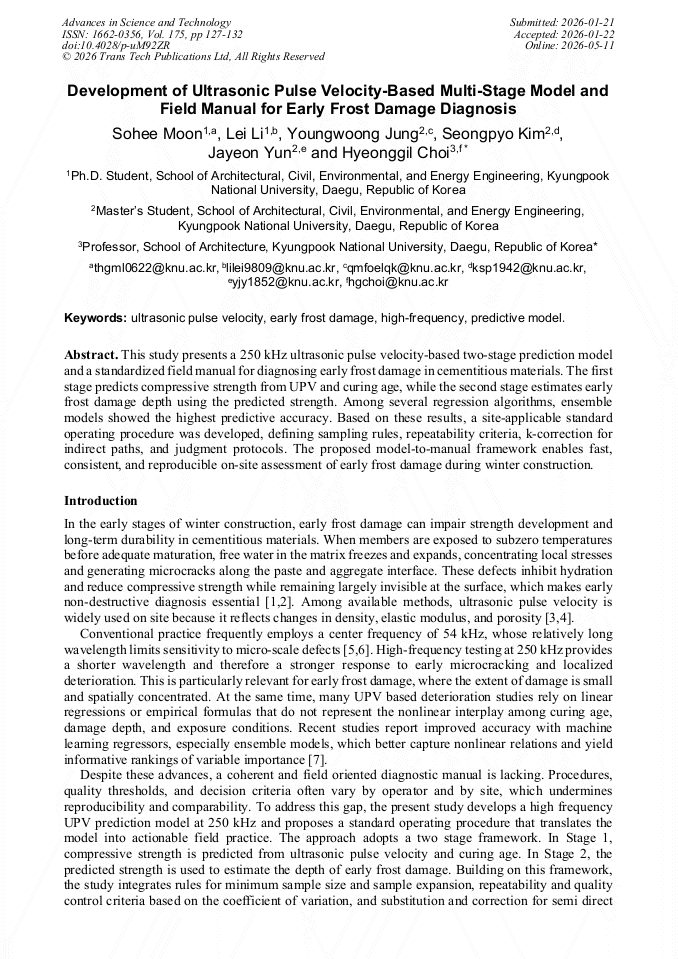
This study presents a 250 kHz ultrasonic pulse velocity-based two-stage prediction model and a standardized field manual for diagnosing early frost damage in cementitious materials. The first stage predicts compressive strength from UPV and curing age, while the second stage estimates early frost damage depth using the predicted strength. Among several regression algorithms, ensemble models showed the highest predictive accuracy. Based on these results, a site-applicable standard operating procedure was developed, defining sampling rules, repeatability criteria, k-correction for indirect paths, and judgment protocols. The proposed model-to-manual framework enables fast, consistent, and reproducible on-site assessment of early frost damage during winter construction.

You might also be interested in these eBooks

Info:

Periodical:

Pages:

127-132

Citation:

Online since:

May 2026

Export:

Price:

Permissions CCC:

Permissions PLS:

Сopyright:

© 2026 Trans Tech Publications Ltd. All Rights Reserved

Share:

Citation:

* - Corresponding Author

[1] Abayou, A., Yasien, A. M., & Bassuoni, M. T. (2019). Properties of nanosilica-modified concrete cast and cured under cyclic freezing/low temperatures. Advances in Civil Engineering Materials, 8(3), 287-306.

DOI: 10.1520/acem20190013

Google Scholar

[2] Karagol, F., Demirboga, R., & Khushefati, W. H. (2015). Behavior of fresh and hardened concretes with antifreeze admixtures in deep-freeze low temperatures and exterior winter conditions. Construction and Building Materials, 76, 388-395.

DOI: 10.1016/j.conbuildmat.2014.12.011

Google Scholar

[3] Revilla-Cuesta, V., Skaf, M., Serrano-López, R., & Ortega-López, V. (2021). Models for compressive strength estimation through non-destructive testing of highly self-compacting concrete containing recycled concrete aggregate and slag-based binder. Construction and Building Materials, 280, 122454.

DOI: 10.1016/j.conbuildmat.2021.122454

Google Scholar

[4] Pereira, N., & Romão, X. (2018). Assessing concrete strength variability in existing structures based on the results of NDTs. Construction and Building Materials, 173, 786-800.

DOI: 10.1016/j.conbuildmat.2018.04.055

Google Scholar

[5] Chandam, G., Ahn, E., & Shin, M. (2024). Influence of aggregate size on relative velocity change of high-frequency ultrasound in progress of concrete curing. Construction and Building Materials, 447, 138062.

DOI: 10.1016/j.conbuildmat.2024.138062

Google Scholar

[6] Bogas, J. A., Gomes, M. G., & Gomes, A. (2013). Compressive strength evaluation of structural lightweight concrete by non-destructive ultrasonic pulse velocity method. Ultrasonics, 53(5), 962-972.

DOI: 10.1016/j.ultras.2012.12.012

Google Scholar

[7] Selcuk, S., & Tang, P. (2023). A metaheuristic-guided machine learning approach for concrete strength prediction with high mix design variability using ultrasonic pulse velocity data. Developments in the Built Environment, 15, 100220.

DOI: 10.1016/j.dibe.2023.100220

Google Scholar