p.67
p.73
p.81
p.87
p.95
p.103
p.111
p.121
p.127
Development of Ni-W Electrodeposited Gradient Coatings and Their Application for Industrial Energy Efficiency Optimization

Abstract:
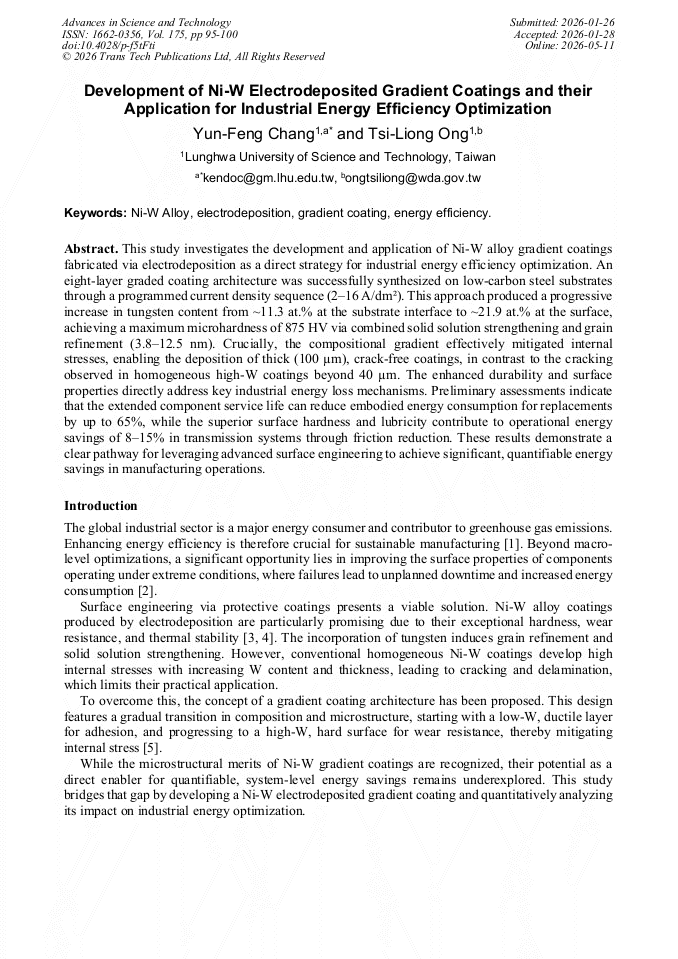
This study investigates the development and application of Ni-W alloy gradient coatings fabricated via electrodeposition as a direct strategy for industrial energy efficiency optimization. An eight-layer graded coating architecture was successfully synthesized on low-carbon steel substrates through a programmed current density sequence (2–16 A/dm²). This approach produced a progressive increase in tungsten content from ~11.3 at.% at the substrate interface to ~21.9 at.% at the surface, achieving a maximum microhardness of 875 HV via combined solid solution strengthening and grain refinement (3.8–12.5 nm). Crucially, the compositional gradient effectively mitigated internal stresses, enabling the deposition of thick (100 µm), crack-free coatings, in contrast to the cracking observed in homogeneous high-W coatings beyond 40 µm. The enhanced durability and surface properties directly address key industrial energy loss mechanisms. Preliminary assessments indicate that the extended component service life can reduce embodied energy consumption for replacements by up to 65%, while the superior surface hardness and lubricity contribute to operational energy savings of 8–15% in transmission systems through friction reduction. These results demonstrate a clear pathway for leveraging advanced surface engineering to achieve significant, quantifiable energy savings in manufacturing operations..
Info:
Periodical:
Pages:
95-100
DOI:
Citation:
Online since:
May 2026
Authors:
Keywords:
Price:
Сopyright:
© 2026 Trans Tech Publications Ltd. All Rights Reserved
Share:
Citation: