Development of Acoustic Device Using Giant Magnetostrictive Material: Consideration of Acoustic Characteristics of Sound Generated by Wall Surface Vibrations

Article Preview

Abstract:

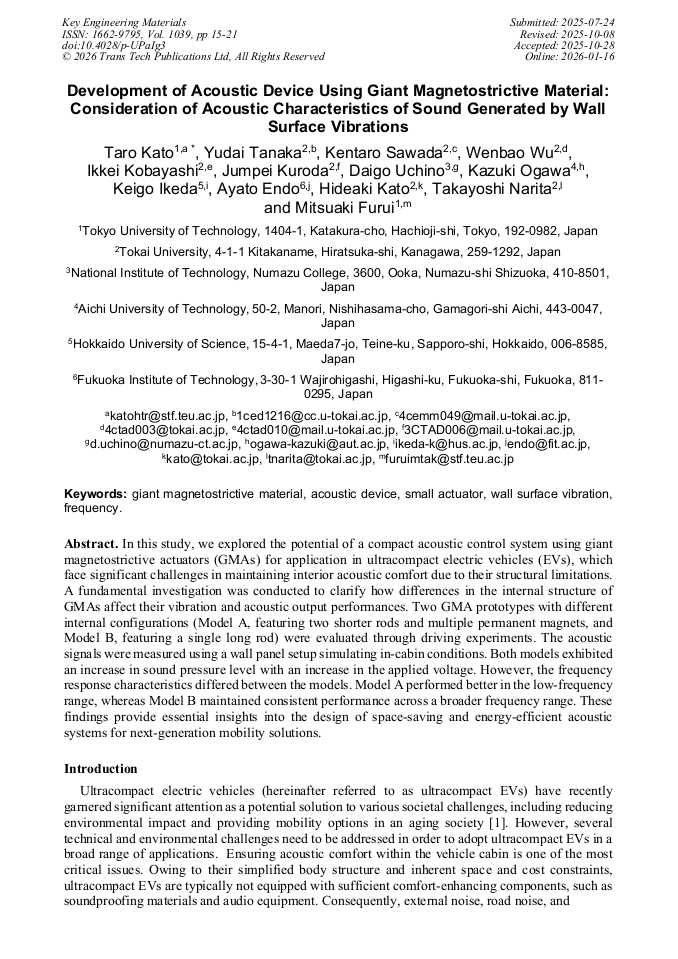
In this study, we explored the potential of a compact acoustic control system using giant magnetostrictive actuators (GMAs) for application in ultracompact electric vehicles (EVs), which face significant challenges in maintaining interior acoustic comfort due to their structural limitations. A fundamental investigation was conducted to clarify how differences in the internal structure of GMAs affect their vibration and acoustic output performances. Two GMA prototypes with different internal configurations (Model A, featuring two shorter rods and multiple permanent magnets, and Model B, featuring a single long rod) were evaluated through driving experiments. The acoustic signals were measured using a wall panel setup simulating in-cabin conditions. Both models exhibited an increase in sound pressure level with an increase in the applied voltage. However, the frequency response characteristics differed between the models. Model A performed better in the low-frequency range, whereas Model B maintained consistent performance across a broader frequency range. These findings provide essential insights into the design of space-saving and energy-efficient acoustic systems for next-generation mobility solutions.
You might also be interested in these eBooks

Info:

Periodical:

Pages:

15-21

Citation:

Online since:

January 2026

Export:

Price:

Permissions CCC:

Permissions PLS:

Сopyright:

© 2026 Trans Tech Publications Ltd. All Rights Reserved

Share:

Citation:

* - Corresponding Author

[1] C. Guo, Beckey P., Y. Loo, K. Feng, O. Gao, K. Zhang, Fifteen pathways between electric vehicles and public health transportation-health conceptual framework, Environ. Health, 2 (2024) 848-853.

DOI: 10.1021/envhealth.4c00156

Google Scholar

[2] D.F. Comesana, M. Korbasiewicz, Evaluation of electric vehicle interior noise focused on sound source identification and transfer path analysis, Conference Paper of AAC 2015, 2015.

Google Scholar

[3] T. Kato, R. Naganuma, K. Bando, I. Kobayashi, J. Kuroda, D. Uchino, K. Ogawa, K. Ikeda, A. Endo, X. Liu, H. Kato, T. Narita, M. Furui, A study on giant magnetostrictive actuator used in active noise control system for ultra-compact electric vehicles (analytical consideration on output performance of the actuator), Lecture Notes in Mechanical Engineering, 2024, 749-755.

DOI: 10.1007/978-3-031-70392-8_106

Google Scholar

[4] T. Kato, H. Okazaki, I. Kobayashi, J. Kuroda, D. Uchino, K. Ogawa, K. Ikeda, A. Endo, H. Kato, T. Narita, M. Furui, Development of giant magnetostrictive materials for an active noise control system in an ultracompact electric vehicle, Mater. Sci. Forum, 1107 (2023) 135-140.

DOI: 10.4028/p-qpvq6z

Google Scholar

[5] F. Maehara, T. Kitamura, T. Kato, D. Uchino, K. Ogawa, K. Ikeda, A. Endo, T. Narita, H. Kato, Interior acoustic control system using boundary vibration with giant magnetostrictive actuator: Fundamental consideration on the control algorithm, IFAC-PapersOnLine, 55 (2022) 472-477.

DOI: 10.1016/j.ifacol.2022.10.557

Google Scholar

[6] T. Kato, R. Suzuki, R. Miyao, H. Kato, T. Narita, A fundamental consideration of active noise control system by small actuator for ultra-compact EV, Actuators, 7 (2018) 49.

DOI: 10.3390/act7030049

Google Scholar

[7] L. X. Hui, G. Lei, S. Haoran, H. Yong, Micro-displacement amplifier of giant magnetostrictive actuator using flexure hinges, J. Magn. Magn. Mater. 556 (2022) 169415.

DOI: 10.1016/j.jmmm.2022.169415

Google Scholar

[8] Z. Zhou, Z. He, G. Xue, J. Zhou, C. Rong, G. Liu, Analysis of working characteristics of giant magnetostrictive actuator for direct-drive fuel injector, AIP Adv. 12 (2022) 075216.

DOI: 10.1063/5.0098073

Google Scholar

[9] C. Chu, R. Zhu, X. Jia, Controller design of a brake by-wire system based on giant magnetostrictive material for an intelligent vehicle, Sustainability, 14 (2022) 11057.

DOI: 10.3390/su141711057

Google Scholar