Assessment of Adhesion Degradation in A1050/Epoxy Resin Interface under High-Humidity and High-Temperature Aging Conditions

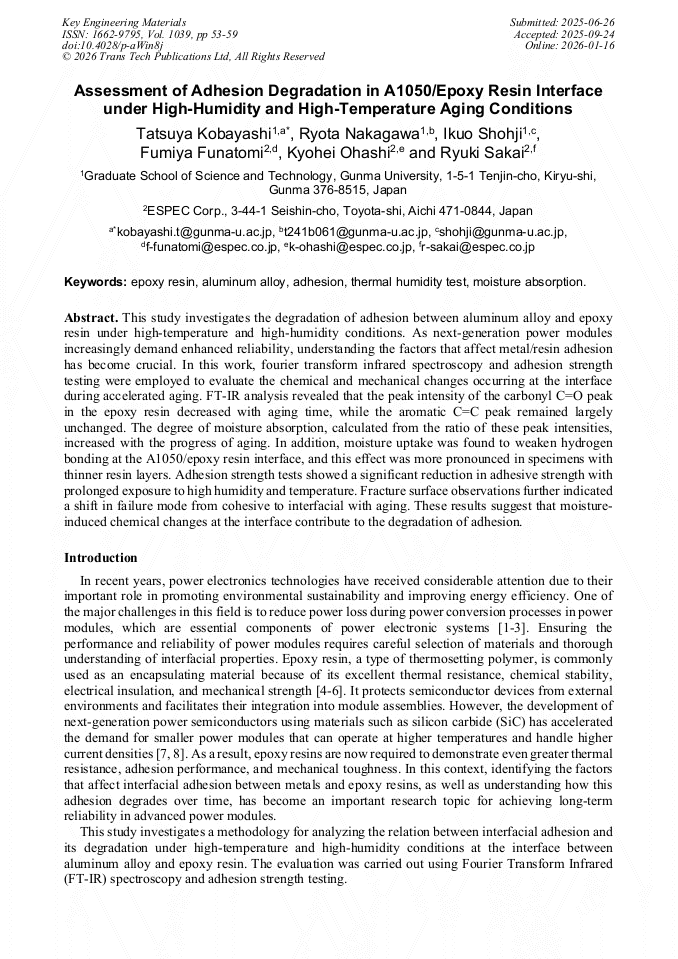
Article Preview

Abstract:

This study investigates the degradation of adhesion between aluminum alloy and epoxy resin under high-temperature and high-humidity conditions. As next-generation power modules increasingly demand enhanced reliability, understanding the factors that affect metal/resin adhesion has become crucial. In this work, fourier transform infrared spectroscopy and adhesion strength testing were employed to evaluate the chemical and mechanical changes occurring at the interface during accelerated aging. FT-IR analysis revealed that the peak intensity of the carbonyl C=O peak in the epoxy resin decreased with aging time, while the aromatic C=C peak remained largely unchanged. The degree of moisture absorption, calculated from the ratio of these peak intensities, increased with the progress of aging. In addition, moisture uptake was found to weaken hydrogen bonding at the A1050/epoxy resin interface, and this effect was more pronounced in specimens with thinner resin layers. Adhesion strength tests showed a significant reduction in adhesive strength with prolonged exposure to high humidity and temperature. Fracture surface observations further indicated a shift in failure mode from cohesive to interfacial with aging. These results suggest that moisture-induced chemical changes at the interface contribute to the degradation of adhesion.
You might also be interested in these eBooks

Info:

Periodical:

Pages:

53-59

Citation:

Online since:

January 2026

Export:

Price:

Permissions CCC:

Permissions PLS:

Сopyright:

© 2026 Trans Tech Publications Ltd. All Rights Reserved

Share:

Citation:

* - Corresponding Author

[1] T. Kobayashi, T. Kuzuya, T. Ando, Recent development of joining materials, methods of reliability evaluations and conductive materials for electronic components, Materials Transactions, 65 (2024) 1178-1182.

DOI: 10.2320/matertrans.mt-m2024054

Google Scholar

[2] T. Kobayashi, R. Goto, I. Shohji, Fabrication and characterization of zinc-coated aluminum particle joining materials via zincate treatment, Journal of Materials Science, 59 (2024) 20812-20823.

DOI: 10.1007/s10853-024-10421-0

Google Scholar

[3] J.L. Afonso, M. Tanta, J. Gabriel Oliveira Pinto, L.F.C. Monteiro, L. Machado, Tiago J.C. Sousa, V. Monteiro, A review on power electronics technologies for power quality improvement, Energies, 14 (2021) 8585.

DOI: 10.3390/en14248585

Google Scholar

[4] F. A. M. M. Gonçalves, M. Santos, T. Cernadas, P. Alves, P. Ferreira, Influence of fillers on epoxy resins properties: a review, Journal of Materials Science, 57 (2022) 15183-15212.

DOI: 10.1007/s10853-022-07573-2

Google Scholar

[5] Z. Sun, J. Li, M. Yu, M. Kathaperumal, C.P. Wong, A review of the thermal conductivity of silver-epoxy nanocomposites as encapsulation material for packaging applications, Chemical Engineering Journal, 446 (2022) 137319.

DOI: 10.1016/j.cej.2022.137319

Google Scholar

[6] H. Gao, P. Liu, High-temperature encapsulation materials for power modules: technology and future development trends, IEEE Transactions on Components, Packaging and Manufacturing Technology, 12 (2022) 1867-1881.

DOI: 10.1109/tcpmt.2022.3225960

Google Scholar

[7] X. Lan, N. Zhao, Development of a steady state electrothermal cosimulation model of SiC power modules, International Journal of Heat and Mass Transfer, 226 (2024) 125460.

DOI: 10.1016/j.ijheatmasstransfer.2024.125460

Google Scholar

[8] X. Zhang, X. Zhao, W. Li, Z. Wang, A. Liao, Y. Song, Y. Wang, L. Zhang, Ultra-thermostable embedded liquid cooling in SiC 3D packaging power modules of electric vehicles, Energy Conversion and Management, 276 (2023) 116499.

DOI: 10.1016/j.enconman.2022.116499

Google Scholar

[9] Y. Tomita, I. Shohji, S. Koyama, S. Shimizu, Degradation behaviors of adhesion strength of structural adhesive for weld-bonding under high temperature and humidity conditions, Procedia Engineering, 184 (2017) 231-237.

DOI: 10.1016/j.proeng.2017.04.090

Google Scholar

[10] Y. Izumi, Characteriation of chemical bonding of metal surface and epoxy resin at organic/inorganic interface, Journal of Smart Processing, 9 (2020) 9-13.

Google Scholar