Effect of Power and Scanning Speed on the Morphology of a Single Track Melt Pool under Dynamic Laser Beam Focusing in Additive Manufacturing

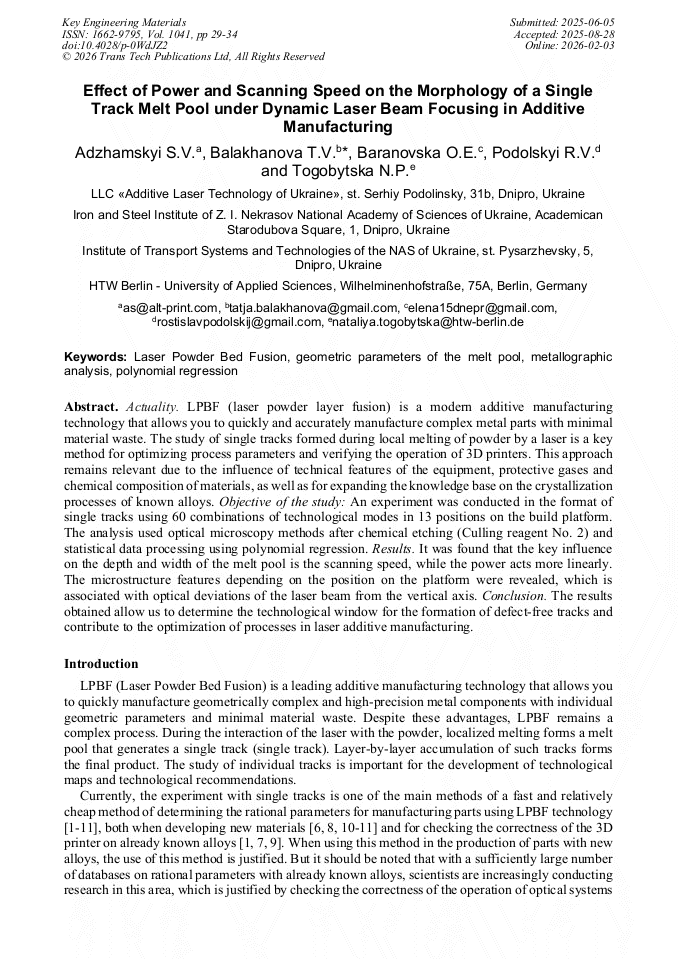
Article Preview

Abstract:

Actuality. LPBF (laser powder layer fusion) is a modern additive manufacturing technology that allows you to quickly and accurately manufacture complex metal parts with minimal material waste. The study of single tracks formed during local melting of powder by a laser is a key method for optimizing process parameters and verifying the operation of 3D printers. This approach remains relevant due to the influence of technical features of the equipment, protective gases and chemical composition of materials, as well as for expanding the knowledge base on the crystallization processes of known alloys. Objective of the study: An experiment was conducted in the format of single tracks using 60 combinations of technological modes in 13 positions on the build platform. The analysis used optical microscopy methods after chemical etching (Culling reagent No. 2) and statistical data processing using polynomial regression. Results. It was found that the key influence on the depth and width of the melt pool is the scanning speed, while the power acts more linearly. The microstructure features depending on the position on the platform were revealed, which is associated with optical deviations of the laser beam from the vertical axis. Conclusion. The results obtained allow us to determine the technological window for the formation of defect-free tracks and contribute to the optimization of processes in laser additive manufacturing.

You might also be interested in these eBooks

Info:

Periodical:

Pages:

29-34

Citation:

Online since:

February 2026

Export:

Price:

Permissions CCC:

Permissions PLS:

Сopyright:

© 2026 Trans Tech Publications Ltd. All Rights Reserved

Share:

Citation:

* - Corresponding Author

[1] S. Adjamskiy, G. Kononenko, R. Podolskyi, S. Badyuk, Implementation Of Selective Laser Melting Technology In Ukraine, Naukova Dumka, Kyiv, 2022

DOI: 10.15407/978-966-00-1856-3

Google Scholar

[2] J.J.S. Dilip, M. A. Anam, D. Pal, B. Stucker, A short study on the fabrication of single track deposits in SLM and characterization, Solid Freeform Fabrication 2016: Proceedings of the 26th Annual International. Solid Freeform Fabrication Symposium – An Additive Manufacturing Conference. (2016) 1644-1659.

DOI: 10.32656/2018_29sff_symposium

Google Scholar

[3] H. Gong, H. Gu, K. Zeng, J.J.S. Dilip, D. Pal, B. Stucker, Melt Pool Characterization for Selective Laser Melting of Ti-6Al-4V Pre-alloyed Powder, Solid Freeform Fabrication Symposium. (2014) 256-267

Google Scholar

[4] C. Teng, H. Gong, A. Szabo, J. J. S. Dilip, K. Ashby, S. Zhang, N. Patil, D. Pal. B. Stucke, Simulating Melt Pool Shape and Lack of Fusion Porosity for Selective Laser Melting of Cobalt Chromium Components, Journal of Manufacturing Science and Engineering. 139 (2017) Р. 011009-1 -011009-11

DOI: 10.1115/1.4034137

Google Scholar

[5] J.-H. Wang, J. Ren, W. Liu, X.-Y. Wu, M.-X. Gao, P.-K. Bai, Effect of Selective Laser Melting Process Parameters on Microstructure and Properties of Co-Cr Alloy, Materials. 11 (2018) 1546

DOI: 10.3390/ma11091546

Google Scholar

[6] Y. Guo, L. Jia, B. Kong, N. Wang, H. Zhang, Single track and single layer formation in selective laser melting of niobium solid solution alloy. Chinese Journal of Aeronautics. 31 (2018) 860–866

DOI: 10.1016/j.cja.2017.08.019

Google Scholar

[7] Z. Hu, B. Nagarajan, X. Song, R. Huang, W. Zhai, J. Wei, Formation of SS316L Single Tracks in Micro Selective Laser Melting: Surface, Geometry, and Defects, Advances in Materials Science and Engineering. 2019 (2019) 9451406

DOI: 10.1155/2019/9451406

Google Scholar

[8] S.V. Chernyshikhin, D.G. Firsov, I.V. Shishkovsky, Selective Laser Melting of Pre-Alloyed NiTi Powder: Single-Track Study and FE Modeling with Heat Source Calibration, Materials. 14 (2021) 7486

DOI: 10.3390/ma14237486

Google Scholar

[9] J. Katagiri, M.Kusano, S.Minamoto, H.Kitano, K.Daimaru, M.Tsujii, M.Watanabe, Melt Pool Shape Evaluation by Single-Track Experiments and Finite-Element Thermal Analysis: Balling and Lack of Fusion Criteria for Generating Process Window of Inconel738LC, Materials. 16 (2023) 1729

DOI: 10.3390/ma16041729

Google Scholar

[10] A. Mauduit, H. Gransac, S. Pillot, Influence of the Manufacturing Parameters in Selective Laser Melting on Properties of Aluminum Alloy AlSi7Mg0.6 (A357), Annales de Chimie Science des Matériaux. 45 (2021) 1-10

DOI: 10.18280/acsm.450101

Google Scholar

[11] A. Mauduit, H.Gransac, P.Auguste, S.Pillot, Study of AlSi7Mg0.6 alloy by selective laser melting:Mechanical properties, microstructure, heat treatment, Journal of Casting & Materials Engineering. 3 (2019) 1

DOI: 10.7494/jcme.2019.3.1.1

Google Scholar

[12] H. Amano, T. Ishimoto, R. Suganuma, K. Aiba, S. H. Sun, R. Ozasa, T. Nakano, Effect of a helium gas atmosphere on the mechanical properties of Ti-6Al-4V alloy built with laser powder bed fusion: A comparative study with argon gas, Additive Manufacturing. 48 (2021) 102444

DOI: 10.1016/j.addma.2021.102444

Google Scholar

[13] S.V. Adzhamskyi, G.A. Kononenko, R.V. Podolskyi, Mechanical Properties of Inconel 718 Alloy Produced Using Selective Laser Melting Technology with Dynamic Focusing on Application Surface, Materials Science. 59 (2023) 420–425

DOI: 10.1007/s11003-024-00793-8

Google Scholar