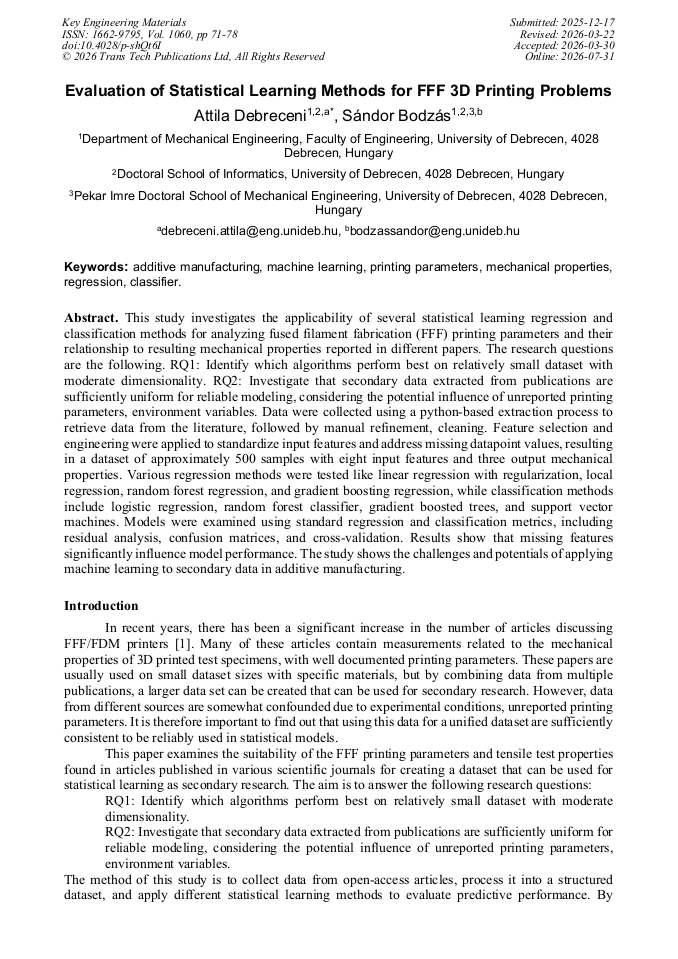
Evaluation of Statistical Learning Methods for FFF 3D Printing Problems

Article Preview

Abstract:

This study investigates the applicability of several statistical learning regression and classification methods for analyzing fused filament fabrication (FFF) printing parameters and their relationship to resulting mechanical properties reported in different papers. The research questions are the following. RQ1: Identify which algorithms perform best on relatively small dataset with moderate dimensionality. RQ2: Investigate that secondary data extracted from publications are sufficiently uniform for reliable modeling, considering the potential influence of unreported printing parameters, environment variables. Data were collected using a python-based extraction process to retrieve data from the literature, followed by manual refinement, cleaning. Feature selection and engineering were applied to standardize input features and address missing datapoint values, resulting in a dataset of approximately 500 samples with eight input features and three output mechanical properties. Various regression methods were tested like linear regression with regularization, local regression, random forest regression, and gradient boosting regression, while classification methods include logistic regression, random forest classifier, gradient boosted trees, and support vector machines. Models were examined using standard regression and classification metrics, including residual analysis, confusion matrices, and cross-validation. Results show that missing features significantly influence model performance. The study shows the challenges and potentials of applying machine learning to secondary data in additive manufacturing.

You might also be interested in these eBooks

Info:

Periodical:

Pages:

71-78

Citation:

Online since:

July 2026

Export:

Price:

Permissions CCC:

Permissions PLS:

Сopyright:

© 2026 Trans Tech Publications Ltd. All Rights Reserved

Share:

Citation:

* - Corresponding Author

[1] W. Bai, H. Fang, Y. Wang, Q. Zeng, G. Hu, G. Bao and Y. Wan, "Academic Insights and Perspectives in 3D Printing: A Bibliometric Review," Applied Sciences , vol. 11, no. 18, 2021.

DOI: 10.3390/app11188298

Google Scholar

[2] J. Gareth, W. Daniela, H. Trevor and T. Rober, An Introduction to Statistical Learning with Applications in R, New York: Springer, 2021.

Google Scholar

[3] J. D. Kelleher, B. . M. Namee and A. D'Arcy, Fundamentals of Machine Learning for Predictive Data Analytics, MIT Press, 2020.

Google Scholar

[4] D. A. Freedman, Statistical Models: Theory and Practice, Cambridge: Cambridge University Press, 2009.

Google Scholar

[5] C. M. John and H. Trevor, Statistical models in S, London: Chapman & Hall , 1997.

Google Scholar

[6] M. Crowley and B. Ghojogh, "The Theory Behind Overfitting, Cross Validation, Regularization, Bagging, and Boosting: Tutorial," 2023. [Online]. Available: https://arxiv.org/abs/1905.12787. [Accessed 09 12 2025].

Google Scholar

[7] M. Mohri, A. Rostamizadeh and A. Talw, Foundations of Machine Learning, London: 2012, The MIT Press.

Google Scholar

[8] A. Rogier, T. Donderes, G. J. van der Heijden, T. Stijnen and K. G. Moons, "Review: A gentle introduction to imputation of missing value," Jornual of Clinical Epidemiology, pp.1087-1091, 2006.

DOI: 10.1016/j.jclinepi.2006.01.014

Google Scholar

[9] N. Yang, Z. Zheng and T. Wang, "Model Loss and Distribution Analysis of Regression Problems in Machine Learning," ICMLC '19, pp.1-5, 2019.

Google Scholar

[10] S. Uddin and H. Lu, "Dataset meta-level and statistical features affect machine learning performance," Scientific Reports, no. 14, 2024.

DOI: 10.1038/s41598-024-51825-x

Google Scholar

[11] P. N. SubbaNarasimha, B. Arinze and M. Anandarajan, "The predictive accuracy of artificial neural networks and multiple regression in the case of skewed data: exploration of some issues," Expert Systems with Applications, vol. 19, no. 2, pp.117-123, 2000.

DOI: 10.1016/s0957-4174(00)00026-9

Google Scholar

[12] J. Daoud, "Multicollinearity and Regression Analysis," Journal of Physics: Conference Series, vol. 949, 2017.

Google Scholar