Thermal Gravimetric Characterization of Dynamic Thermal Aged Polymer-Modified K+- Rich Bentonite Composites in Aqueous Environment: Water-Based Drilling Fluid Application

Article Preview

Abstract:

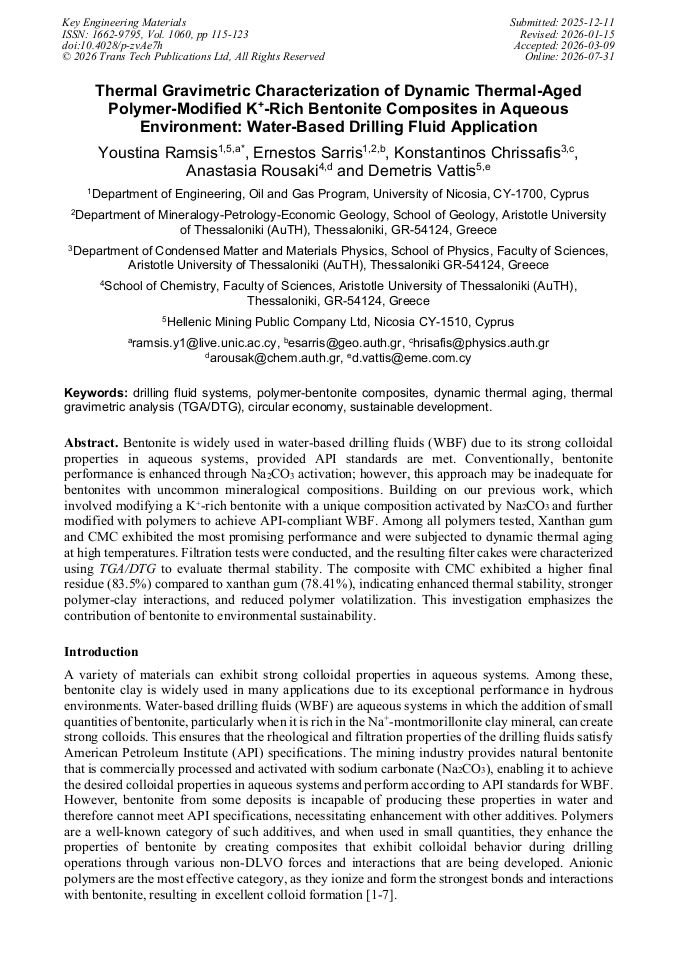
Bentonite is widely used in water-based drilling fluids (WBF) due to its strong colloidal properties in aqueous systems, provided API standards are met. Conventionally, bentonite performance is enhanced through Na2CO3 activation; however, this approach may be inadequate for bentonites with uncommon mineralogical compositions. Building on our previous work, which involved modifying a K⁺-rich bentonite with a unique composition activated by Na2CO3 and further modified with polymers to achieve API-compliant WBF. Among all polymers tested, Xanthan gum and CMC exhibited the most promising performance and were subjected to dynamic thermal aging at high temperatures. Filtration tests were conducted, and the resulting filter cakes were characterized using TGA/DTG to evaluate thermal stability. The composite with CMC exhibited a higher final residue (83.5%) compared to xanthan gum (78.41%), indicating enhanced thermal stability, stronger polymer-clay interactions, and reduced polymer volatilization. This investigation emphasizes the contribution of bentonite to environmental sustainability.

You might also be interested in these eBooks

Info:

Periodical:

Pages:

115-123

Citation:

Online since:

July 2026

Export:

Price:

Permissions CCC:

Permissions PLS:

Сopyright:

© 2026 Trans Tech Publications Ltd. All Rights Reserved

Share:

Citation:

* - Corresponding Author

[1] API 13A: Drilling Fluids Materials, American Petroleum Institute, 2020.

Google Scholar

[2] API 13B-1: Field Testing Water-Based Drilling Fluids, American Petroleum Institute, 2021.

Google Scholar

[3] G.E. Christidis, in: European Mineralogical Union Notes in Mineralogy, Universitat Jena - Mineralogie, 2011, p.341–414.

Google Scholar

[4] F. Bergaya, G. Lagaly, Handbook of Clay Science., Elsevier, 2006.

Google Scholar

[5] Q. Cui, B. Chen, Appl Clay Sci 235 (2023) 106869.

Google Scholar

[6] J.N. Israelachvili, Intermolecular and Surface Forces: Third Edition, Elsevier Inc., 2011.

Google Scholar

[7] V. Agmo Hernández, ChemTexts 2023 9:4 9 (2023) 1–16.

Google Scholar

[8] F.C. Nunes, L.C. Oliveira, L. de Jesus Alves, M.N.V. Prasad, J.Â.S.A. dos Anjos, in: Sustainable and Circular Management of Resources and Waste Towards a Green Deal, Elsevier, 2023, p.93–104.

DOI: 10.1016/b978-0-323-95278-1.00011-5

Google Scholar

[9] R.M. Johannsen, B.V. Mathiesen, K. Kermeli, W. Crijns-Graus, P.A. Østergaard, Energy 268 (2023) 126687.

DOI: 10.1016/j.energy.2023.126687

Google Scholar

[10] A. Hailemariam, M.O. Erdiaw-Kwasie, Bus Strategy Environ 32 (2023) 1951–1965.

Google Scholar

[11] E. Sarris, E. Gravanis, P. Papanastasiou Transport in Porous Media 103 (2014) 341–359.

Google Scholar

[12] S. Nie, R. Mills, Eastern Mediterranean Deepwater Gas to Europe: Not Too Little, But Perhaps Too Late, Columbia, 2023.

Google Scholar

[13] F. Proedrou, Cambridge Review of International Affairs 36 (2023) 679–696.

Google Scholar

[14] Y. Ramsis, E. Gravanis, E. Sarris, Colloids Surf A Physicochem Eng Asp 682 (2024) 132983.

Google Scholar

[15] A.S. Mohammed, Egyptian Journal of Petroleum 27 (2018) 55–63.

Google Scholar

[16] A.S. Mohammed, Egyptian Journal of Petroleum 26 (2017) 791–802.

Google Scholar

[17] L. Rong, A. Santra, G. Ross, R.C. Advincula, Mater Today Chem 34 (2023) 101820.

Google Scholar

[18] Y. Ramsis, E. Sarris, L. Papaloizou, D. Vattis, in: Key Eng Mater, Trans Tech Publications Ltd, 2024, p.63–70.

Google Scholar

[19] G.E. Christidis, Genesis and Compositional Heterogeneity of Smectites. Part III: Alteration of Basic Pyroclastic Rocks - A Case Study from the Troodos Ophiolite Complex, Cyprus, Mineralogical Society of America, 2006.

DOI: 10.2138/am.2006.2001

Google Scholar

[20] M.E. Essington, Soil and Water Chemistry: An Integrative Approach, CRC Press, 2003.

Google Scholar