Effects of Charge Compensators on Structure and Luminescent Properties of Microwave Synthesized CaMoO4:Eu3+ Red Phosphors

Article Preview

Abstract:

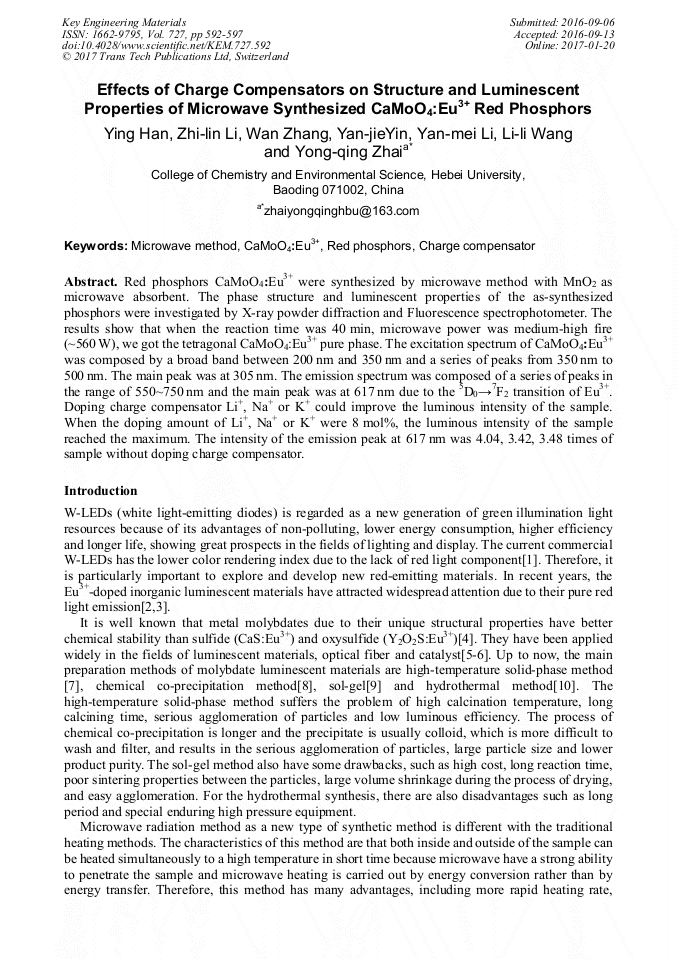
Red phosphors CaMoO4:Eu3+ were synthesized by microwave method with MnO2 as microwave absorbent. The phase structure and luminescent properties of the as-synthesized phosphors were investigated by X-ray powder diffraction and Fluorescence spectrophotometer. The results show that when the reaction time was 40 min, microwave power was medium-high fire (~560 W), we got the tetragonal CaMoO4:Eu3+ pure phase. The excitation spectrum of CaMoO4:Eu3+ was composed by a broad band between 200 nm and 350 nm and a series of peaks from 350 nm to 500 nm. The main peak was at 305 nm. The emission spectrum was composed of a series of peaks in the range of 550~750 nm and the main peak was at 617 nm due to the 5D07F2 transition of Eu3+. Doping charge compensator Li+, Na+ or K+ could improve the luminous intensity of the sample. When the doping amount of Li+, Na+ or K+ were 8 mol%, the luminous intensity of the sample reached the maximum. The intensity of the emission peak at 617 nm was 4.04, 3.42, 3.48 times of sample without doping charge compensator.

You might also be interested in these eBooks

Info:

Periodical:

Pages:

592-597

Citation:

Online since:

January 2017

Export:

Price:

Permissions CCC:

Permissions PLS:

Сopyright:

© 2017 Trans Tech Publications Ltd. All Rights Reserved

Share:

Citation:

* - Corresponding Author

[1] C. Yang, G.R. Gu, X.J. Zhao, X.J. Liang and W.D. Xiang: Materials Letters, Vol. 170 (2016) p.58.

Google Scholar

[2] A. Khanna and P.S. Dutta: Journal of Solid State Chemistry, Vol. 198 (2013) p.93.

Google Scholar

[3] Y.G. Su, L.P. Li and G.S. Li: Chemistry of Materials, Vol. 20 (2008) No. 19, p.6060.

Google Scholar

[4] S.X. Yan, J.H. Zhang, X. Zhang, S.Z. Lu, X.G. Ren, Z.G. Nie, and X.J. Wang: Journal of Physic Chemistry C, Vol. 111 (2007) No. 35, p.13256.

Google Scholar

[5] B.P. Singh, A.K. Parchur, R.S. Ningthoujam, A.A. Ansari, P. Singh and S.B. Rai: Dalton transactions, Vol. 43 (2014) No. 12, p.4779.

DOI: 10.1039/c3dt53408a

Google Scholar

[6] D.J. Gao, Y. Li, X. Lai, Y.Y. Wei, J. Bi, Y. Li and M.J. Liu: Materials Chemistry and Physics, Vol. 126 (2011) No. 1-2, p.391.

Google Scholar

[7] F. Zhu, Z.S. Xiao, L. Yan, F. Zhang and A. Huang: Applied Physics A, Vol. 101 (2010) No. 4, p.689.

Google Scholar

[8] C.L. Zhao, Y. S Hu, , W.D. Zhuang, X.W. Huang and T. He: Journal of Rare Earths, Vol. 27 (2009) No. 5, p.758.

Google Scholar

[9] Y.Q. Zhai, J.H. Li, X. Li, Y. Dong, Y.H. Wang and S.S. Song: Journal of Sol-Gel Science and Technology, Vol. 74 (2015) No. 2, p.544.

Google Scholar

[10] Y. Jin, J.H. Zhang, S.Z. Lü, H.F. Zhao, X. Zhang and X.J. Wang: The Journal of Physical Chemistry C, Vol. 112 (2008) No. 15, p.5860.

Google Scholar

[11] Y.Q. Zhai and Y.H. Liu: Journal of Synthetic Crystals, Vol. 35(2006) No. 4, p.871. (In Chinese).

Google Scholar

[12] Y.Q. Zhai, Y.H. Liu, Y. Meng and S.Y. Zhang: Spectroscopy and Spectral Analysis, Vol. 27(2007) No. 4, pp.634-638. (In Chinese).

Google Scholar

[13] Y.Q. Zhai, J. Qiao, G.Y. Huo and S.Q. Han: Journal of Magnetism and Magnetic Materials, Vol. 324 (2012) No. 13, p. (2006).

Google Scholar

[14] S. Saha, S. Das, U.K. Ghorai, N. Mazumder, B.K. Gupta and K.K. Chattopadhyay: Dalton transactions, Vol. 42 (2013) No. 36, p.12965.

DOI: 10.1039/c3dt51411k

Google Scholar

[15] L.K. Bharat, Y.I. Jeon and J.S. Yu: Ceramics International, Vol. 42 (2016) No. 5, p.5677.

Google Scholar

[16] R.D. Shannon: Acta Crystallographica Section A: Crystal Physics, Diffraction, Theoretical and General Crystallography, Vol. 32 (1976) No. 5, p.751.

Google Scholar

[17] Y.B. Wu, Z. Sun, K.B. Ruan, Y. Xu and H. Zhang: Journal of Luminescence, Vol. 155 (2014) p.269.

Google Scholar