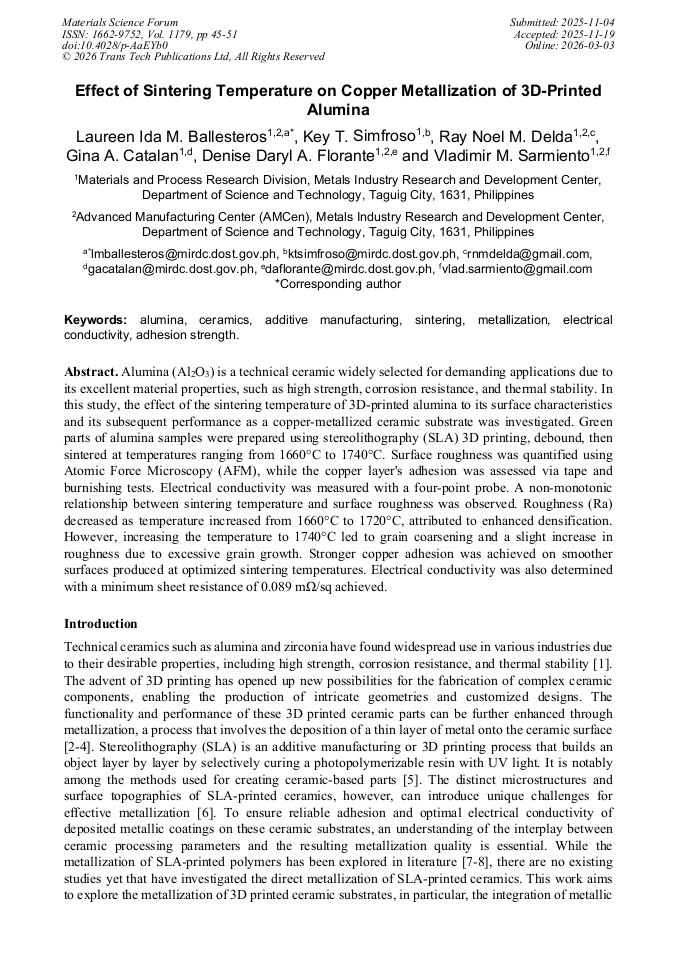
Effect of Sintering Temperature on Copper Metallization of 3D-Printed Alumina

Article Preview

Abstract:

Alumina (Al2O3) is a technical ceramic widely selected for demanding applications due to its excellent material properties, such as high strength, corrosion resistance, and thermal stability. In this study, the effect of the sintering temperature of 3D-printed alumina to its surface characteristics and its subsequent performance as a copper-metallized ceramic substrate was investigated. Green parts of alumina samples were prepared using stereolithography (SLA) 3D printing, debound, then sintered at temperatures ranging from 1660°C to 1740°C. Surface roughness was quantified using Atomic Force Microscopy (AFM), while the copper layer's adhesion was assessed via tape and burnishing tests. Electrical conductivity was measured with a four-point probe. A non-monotonic relationship between sintering temperature and surface roughness was observed. Roughness (Ra​) decreased as temperature increased from 1660°C to 1720°C, attributed to enhanced densification. However, increasing the temperature to 1740°C led to grain coarsening and a slight increase in roughness due to excessive grain growth. Stronger copper adhesion was achieved on smoother surfaces produced at optimized sintering temperatures. Electrical conductivity was also determined with a minimum sheet resistance of 0.089 mΩ/sq achieved.
You might also be interested in these eBooks

Info:

Periodical:

Materials Science Forum (Volume 1179)

Pages:

45-51

Citation:

Online since:

March 2026

Export:

Price:

Permissions CCC:

Permissions PLS:

Сopyright:

© 2026 Trans Tech Publications Ltd. All Rights Reserved

Share:

Citation:

* - Corresponding Author

[1] Otitoju TA, Okoye PU, Chen G, Li Y, Okoye MO, Li S. Journal of industrial and engineering chemistry 85 (2020): 34-65.

DOI: 10.1016/j.jiec.2020.02.002

Google Scholar

[2] Gomez A, Yelamanchi B, Maurel A, Martinez AC, Feldhausen T, Shivakumar J, Rojas E, Lin Y, Cortes P, MacDonald E, Roberson DA IEEE Access 12 (2024): 92295-92305.

DOI: 10.1109/access.2024.3421288

Google Scholar

[3] Miek D, Höft M, Lorente JA, Berger A, Brouczek D, Schwentenwein M, Brandao A, Martín-Iglesias P, di Crestvolant VT. IEEE Journal of Microwaves 2.3 (2022): 496-506.

DOI: 10.1109/jmw.2022.3167250

Google Scholar

[4] Obeidat AS, Richmond D, Howard-Jennings J, Umar A, Al-Haidari R, Alhendi M, Garakani B, Smilgies DM, Poliks MD. IEEE 74th Electronic Components and Technology Conference (ECTC). IEEE, 2024.

DOI: 10.1109/ectc51529.2024.00114

Google Scholar

[5] Halloran, JW. Annual Review of Materials Research 46.1 (2016): 19-40.

Google Scholar

[6] Quan H, Zhang T, Xu H, Luo S, Nie J, Zhu X. Bioactive materials 5.1 (2020): 110-115.

Google Scholar

[7] Kołczyk K, Zborowski W, Kutyła D, Kwiecińska A, Kowalik R, Żabiński P. Archives of Metallurgy and Materials 63 (2018).

DOI: 10.24425/122438

Google Scholar

[8] Miller Z, Fernandes P, Hunter B, Maldonado C, Patterson B, Skoug R. IEEE Aerospace Conference. IEEE, 2024.

Google Scholar

[9] Liu W, Shen Y, Li D, Ouyang X, Liu Q, Wang S. Ceramics International 51.4 (2025): 5000-5010.

Google Scholar

[10] Moradkhani A, Baharvandi H, Naserifar A.Journal of the Korean Ceramic Society 56.3 (2019): 256-268.

Google Scholar

[11] ASTM B571-23 Standard Practice for Qualitative Adhesion Testing of Metallic Coatings.

Google Scholar