Effect of Zn Addition on the Physical and Mechanical Properties of Sn 0.7Cu1.5Ag Lead-Free Solder Alloy

Article Preview

Abstract:

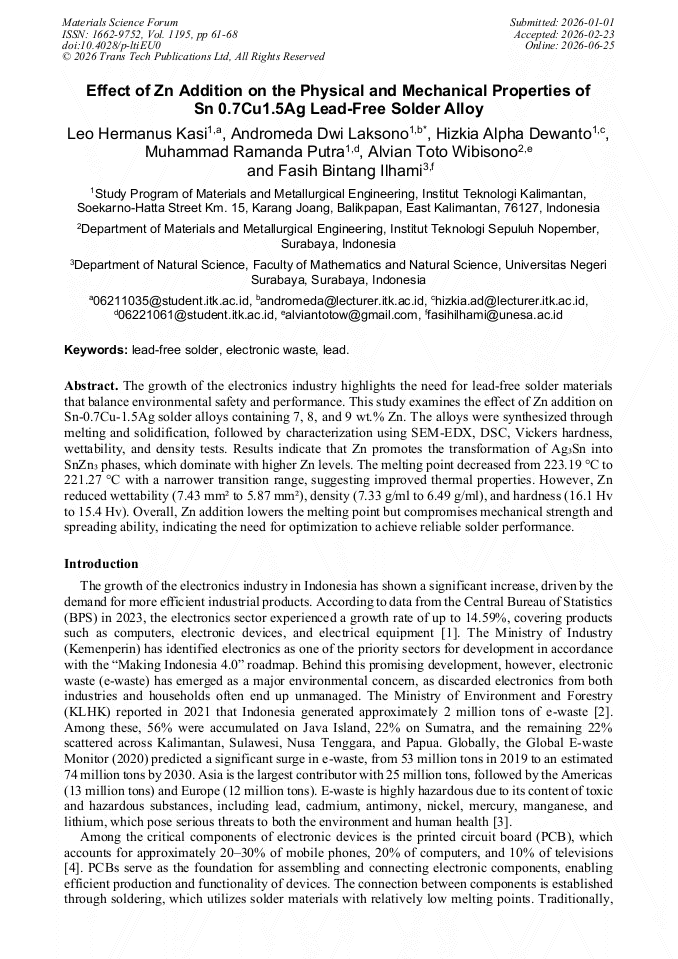
The growth of the electronics industry highlights the need for lead-free solder materials that balance environmental safety and performance. This study examines the effect of Zn addition on Sn-0.7Cu-1.5Ag solder alloys containing 7, 8, and 9 wt.% Zn. The alloys were synthesized through melting and solidification, followed by characterization using SEM-EDX, DSC, Vickers hardness, wettability, and density tests. Results indicate that Zn promotes the transformation of Ag3Sn into SnZn3 phases, which dominate with higher Zn levels. The melting point decreased from 223.19 °C to 221.27 °C with a narrower transition range, suggesting improved thermal properties. However, Zn reduced wettability (7.43 mm2 to 5.87 mm2), density (7.33 g/ml to 6.49 g/ml), and hardness (16.1 Hv to 15.4 Hv). Overall, Zn addition lowers the melting point but compromises mechanical strength and spreading ability, indicating the need for optimization to achieve reliable solder performance.
You might also be interested in these eBooks

Info:

Periodical:

Materials Science Forum (Volume 1195)

Pages:

61-68

Citation:

Online since:

June 2026

Export:

Price:

Permissions CCC:

Permissions PLS:

Сopyright:

© 2026 Trans Tech Publications Ltd. All Rights Reserved

Share:

Citation:

* - Corresponding Author

[1] B. P. Statistik and K. B. BARAT, "Tahun 2023," Produksi Cabai Rawit Di Kabupaten Ngada.

Google Scholar

[2] B. B. K. S. D. ALAM, "Kementerian Lingkungan Hidup dan Kehutanan," 2021.

Google Scholar

[3] R. N. Dwiyanti, "Identifikasi Awal Pengelolaan Limbah Elektronik (E-Waste) Dari Masyarakat Di Kota Surabaya," Upn" Veteran'jawa Timur, 2022.

Google Scholar

[4] H. Wang, S. Zhang, B. Li, D. a. Pan, Y. Wu, and T. Zuo, "Recovery of waste printed circuit boards through pyrometallurgical processing: A review," Resources, Conservation and Recycling, vol. 126, pp.209-218, 2017.

DOI: 10.1016/j.resconrec.2017.08.001

Google Scholar

[5] A. Abubakar et al., "Pollution of heavy metal threat posed by e-waste burning and its assessment of human health risk," Environmental Science and Pollution Research, vol. 29, no. 40, pp.61065-61079, 2022.

DOI: 10.1007/s11356-022-19974-6

Google Scholar

[6] W. I. Wijayati and I. Purwanti, "Kajian remediasi tanah terkontaminasi logam berat timbal di Desa Pesarean, Kabupaten Tegal dengan stabilisasi/solidifikasi," Jurnal Teknik ITS, vol. 11, no. 2, pp. D28-D33, 2022.

DOI: 10.12962/j23373539.v11i2.83122

Google Scholar

[7] Y. Cui, J. Xian, A. Zois, K. Marquardt, H. Yasuda, and C. Gourlay, "Nucleation and growth of Ag3Sn in Sn-Ag and Sn-Ag-Cu solder alloys," Acta Materialia, vol. 249, p.118831, 2023.

DOI: 10.1016/j.actamat.2023.118831

Google Scholar

[8] Y. Chen, Z.-C. Meng, L.-Y. Gao, and Z.-Q. Liu, "Effect of Bi addition on the shear strength and failure mechanism of low-Ag lead-free solder joints," Journal of Materials Science: Materials in Electronics, vol. 32, pp.2172-2186, 2021.

DOI: 10.1007/s10854-020-04982-4

Google Scholar

[9] W. D. Callister Jr and D. G. Rethwisch, Callister's materials science and engineering. John Wiley & Sons, 2020.

Google Scholar

[10] T. Laurila, V. Vuorinen, and J. K. Kivilahti, "Interfacial reactions between lead-free solders and common base materials," (in English), Mat Sci Eng R, vol. 49, no. 1-2, pp.1-60, Mar 24 2005.

DOI: 10.1016/j.mser.2005.03.001

Google Scholar